Why Documentation is Critical for Business Growth and Franchising (2026)
Introduction
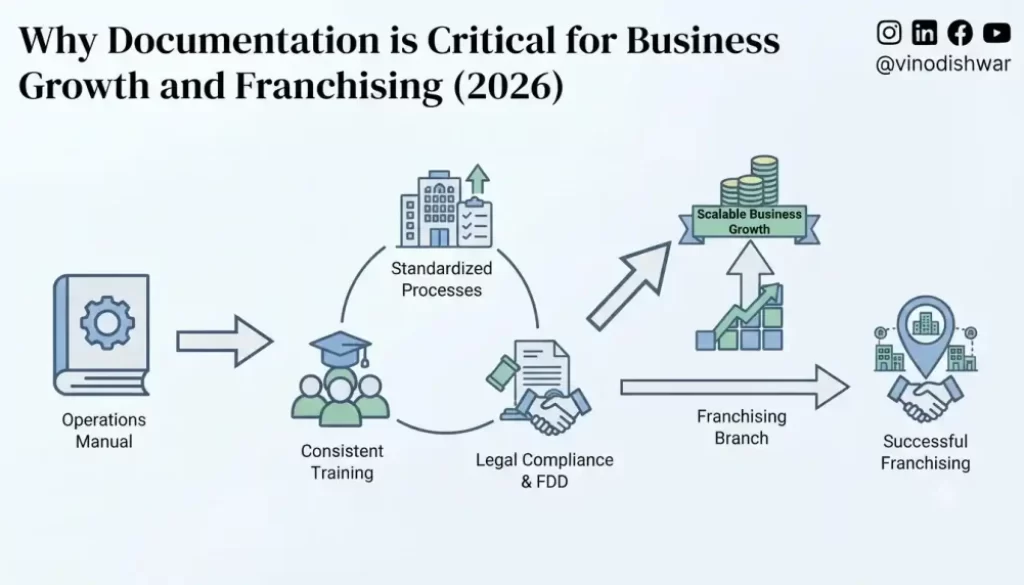
Why Documentation is Critical for every growing business becomes clear as soon as expansion, delegation, or franchising begins. Every successful business eventually reaches a point where growth depends less on hard work and more on systems.
Every successful business eventually reaches a point where growth depends less on hard work and more on systems.
Many entrepreneurs build profitable businesses using their experience, instincts, and daily involvement. However, when the time comes to expand, open multiple locations, attract investors, or franchise the business, they often discover that one essential element is missing—documentation.
Without documented processes, knowledge remains locked inside the founder’s mind or scattered among employees. This creates inconsistency, slows decision-making, increases operational risk, and makes scaling difficult.
Business documentation transforms individual knowledge into organizational knowledge. It creates a repeatable operating system that allows teams, managers, and franchisees to deliver consistent results without depending on a single person.
In this guide, you’ll learn why documentation is one of the most valuable assets a growing business can build, what should be documented, and how it prepares your organization for sustainable growth and franchising. A professional Franchise Readiness Assessment helps identify documentation gaps before expansion.
https://franchisealpha.com/franchise-readiness-assessment/
What Is Business Documentation?
Business documentation is the structured process of recording how a business operates.
It includes written guidelines, policies, procedures, workflows, manuals, templates, checklists, and standards that explain how work should be completed.
Examples include:
- Standard Operating Procedures (SOPs)
- Operations Manuals
- Employee Handbooks
- Training Manuals
- HR Policies
- Sales Processes
- Quality Standards
- Customer Service Guidelines
- Vendor Procedures
- Compliance Documentation
Good documentation ensures that every employee follows the same proven methods.
Why Documentation is Critical for Business Growth
Documentation is the foundation of operational consistency.
It helps businesses:
- Preserve institutional knowledge
- Improve operational efficiency
- Reduce dependency on individuals
- Simplify employee training
- Improve quality control
- Strengthen compliance
- Support business continuity
- Prepare for expansion
- Increase business valuation
- Enable franchising
Businesses that document their systems grow faster because they spend less time reinventing processes.
Why Documentation is Critical: 15 Key Benefits
1. Reduces Founder Dependency
When knowledge exists only in the founder’s mind, the business becomes difficult to scale.
Documentation allows operations to continue smoothly without constant founder involvement.
2. Creates Operational Consistency
Documented procedures ensure every employee performs tasks the same way, regardless of location or experience.
Consistency improves customer satisfaction and operational quality.
3. Simplifies Employee Training
New employees learn faster when structured manuals and SOPs are available.
Training becomes more efficient and less dependent on senior staff.
4. Protects Business Knowledge
Employee turnover is inevitable.
Documentation prevents valuable operational knowledge from leaving with employees.
5. Improves Customer Experience
Consistent processes create predictable customer experiences across all locations.
Customers receive the same level of service every time.
6. Supports Better Decision-Making
Clearly documented workflows reduce confusion and help managers make faster, more informed decisions.
7. Improves Productivity
Employees spend less time asking questions and more time executing standardized processes.
8. Strengthens Quality Control
Documentation establishes measurable standards for products, services, and operations.
Regular audits become easier and more objective.
9. Reduces Operational Errors
Step-by-step instructions minimize mistakes and improve accuracy across departments.
10. Improves Compliance
Documented policies help businesses comply with legal, safety, industry, and regulatory requirements.
11. Makes Expansion Easier
Opening additional locations becomes significantly easier when systems are already documented.
Managers can replicate proven processes rather than creating new ones.
12. Enables Franchising
A franchise cannot succeed without documented systems.
SOPs, Operations Manuals, and training guides enable franchisees to replicate the business consistently.
13. Increases Business Valuation
Businesses with documented systems are generally viewed as lower-risk investments because they are easier to manage and scale.
14. Supports Business Continuity
Unexpected situations such as leadership changes, emergencies, or employee turnover have less impact when processes are documented.
15. Creates a Scalable Organization
Documentation transforms a founder-led business into a systems-driven organization capable of sustainable growth.
What Should Every Business Document?
Professional business documentation typically includes:
Operational Documentation
- Standard Operating Procedures
- Workflow Diagrams
- Daily Checklists
- Operations Manual
Human Resources
- Recruitment Process
- Employee Handbook
- Training Materials
- Performance Review Process
Customer Experience
- Sales Scripts
- Customer Service Standards
- Complaint Resolution Process
- Follow-up Procedures
Finance
- Billing Procedures
- Cash Handling
- Expense Approval
- Financial Reporting
Marketing
- Brand Guidelines
- Social Media Standards
- Campaign Approval Process
Compliance
- Safety Procedures
- Legal Policies
- Risk Management
- Audit Checklists
Documentation vs Knowledge
Many businesses confuse experience with documentation.
Knowledge exists in people’s minds.
Documentation converts that knowledge into repeatable systems that anyone can follow.
This transformation is essential for scalability.
Common Documentation Mistakes
Many businesses create documentation that is:
- Too generic
- Outdated
- Difficult to understand
- Never reviewed
- Not followed by employees
- Missing practical examples
Effective documentation should be clear, visual, practical, and updated regularly.
Why Documentation is Critical Before Franchising
Documentation is one of the first areas evaluated during a Franchise Readiness Assessment.
Essential franchise documents include:
- SOPs
- Franchise Operations Manual
- Training Programs
- Brand Guidelines
- Operational Checklists
- Quality Standards
These documents allow franchisees to replicate the business while protecting the brand.
How Franchise Consultants Help
Professional franchise consultants help businesses:
- Map business processes
- Develop SOPs
- Create Operations Manuals
- Build training systems
- Standardize documentation
- Prepare franchise documentation
- Implement business systems
This ensures documentation supports long-term business growth. Learn how Franchise Consulting Services help businesses create scalable systems and documentation:
https://franchisealpha.com/franchise-consulting/ You may also like Top Benefits of Franchise Consulting:
https://vinodishwar.com/top-benefits-of-franchise-consulting/
The SOLEMN® Framework
At Franchise Alpha, business documentation is developed using the proprietary SOLEMN® Framework.
Strategy
Identify the knowledge and systems that drive business success.
Operations
Document workflows, SOPs, manuals, and operational standards.
Legal
Ensure documentation supports compliance and franchise governance.
Entrust
Develop structured training materials and leadership systems.
Marketing
Document customer experience standards and brand guidelines.
Nitty-Gritty
Continuously review and improve documentation through operational audits.
This methodology transforms businesses into scalable, systems-driven organizations.
Frequently Asked Questions
Why is documentation important in business?
Documentation creates consistency, preserves business knowledge, simplifies training, reduces errors, and prepares businesses for growth and franchising.
What business documents should every company have?
Every business should maintain SOPs, Operations Manuals, Employee Handbooks, HR policies, quality standards, customer service guidelines, compliance documentation, and training manuals.
How does documentation support franchising?
Documentation allows franchisees to replicate business operations consistently by providing standardized procedures, training materials, and operational guidelines. Learn more about the complete Franchise Consulting Process:
Prepare franchise document If you’re new to franchising, start with What is Franchise Consulting?
https://vinodishwar.com/what-is-franchise-consulting/
How often should business documentation be updated?
Documentation should be reviewed annually or whenever significant operational, legal, or technological changes occur.
Conclusion
Why Documentation is Critical goes far beyond paperwork—it is the foundation of a scalable, systems-driven business that can grow consistently and successfully. Explore additional franchise growth resources at:
Documentation is far more than paperwork—it is the foundation of a scalable business.
By capturing your processes, standards, and knowledge in structured documentation, you reduce operational risk, improve consistency, empower employees, and prepare your business for expansion.
Whether your goal is to improve efficiency, open multiple locations, attract investors, or build a franchise network, documentation provides the framework that makes sustainable growth possible.
The strongest businesses are not those with the smartest founders—they are those with the clearest systems.
Call to Action
Turn Your Business Knowledge Into Scalable Systems
Book a Business Documentation & Franchise Readiness Assessment with Vinod Ishwar to identify documentation gaps, develop professional SOPs, create comprehensive Operations Manuals, and build systems that support long-term business growth and successful franchise expansion.