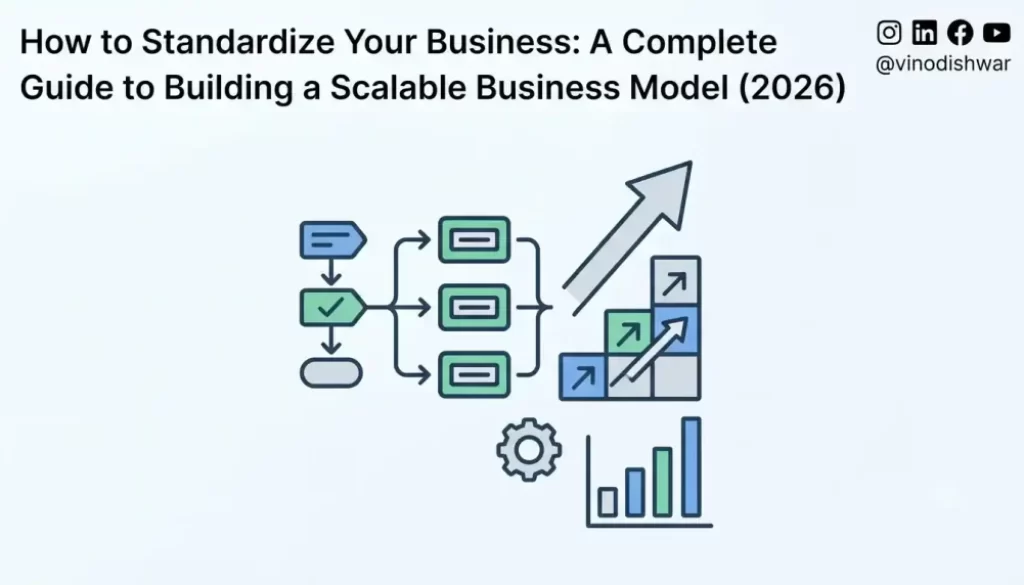
How to Standardize Your Business: A Complete Guide to Building a Scalable Business Model (2026)
Introduction
How to Standardize Your Business is one of the most important questions every growing entrepreneur should answer before expanding into multiple locations or franchising. One of the biggest reasons businesses struggle to scale is inconsistency.
One of the biggest reasons businesses struggle to scale is inconsistency.
Customers receive different experiences, employees perform tasks differently, managers create their own methods, and operational quality varies from one location to another. While this may seem manageable with one outlet, these inconsistencies become major obstacles when opening multiple locations or preparing to franchise.
The solution is business standardization.
Standardizing your business means documenting and implementing repeatable systems that ensure every employee, department, and location operates using the same proven processes.
Whether you’re running a restaurant, retail store, healthcare clinic, salon, education institute, manufacturing unit, or service business, standardization creates the foundation for sustainable growth. If you’re planning to expand through franchising, working with experienced professionals can help you standardize your operations and prepare for scalable growth. Learn more about Franchise Alpha’s Franchise Consulting Services here:
https://franchisealpha.com/franchise-consulting/
In this guide, you’ll learn what business standardization is, why it matters, and the step-by-step process to build a scalable business that is ready for expansion.
What Does It Mean to Standardize Your Business?
Business standardization is the process of creating consistent systems, procedures, and operational guidelines that define how work should be performed across the organization.
Instead of depending on individual employees or founders, standardized businesses rely on documented processes that produce consistent results.
Standardization includes:
- Standard Operating Procedures (SOPs)
- Quality standards
- Employee training
- Customer service guidelines
- Technology systems
- Performance measurement
- Operational documentation
The objective is simple: deliver the same high-quality experience every time.
Why How to Standardize Your Business Matters
Businesses that standardize operations benefit from:
- Consistent customer experiences
- Faster employee onboarding
- Reduced operational errors
- Better quality control
- Improved productivity
- Easier delegation
- Reduced founder dependency
- Simplified expansion
- Higher business valuation
- Franchise readiness
Without standardization, growth often leads to confusion instead of efficiency.
How to Standardize Your Business: 15 Essential Steps
1. Document Your Core Processes
Start by identifying every recurring business activity.
Examples include:
- Sales
- Customer service
- Inventory management
- Billing
- Product preparation
- Marketing
- Recruitment
- Complaint resolution
Document each process in detail.
2. Create Standard Operating Procedures (SOPs)
Convert every important process into clear step-by-step instructions.
Well-written SOPs reduce variation and improve operational consistency.
3. Define Quality Standards
Every task should have measurable expectations.
Examples include:
- Service response time
- Product specifications
- Customer satisfaction targets
- Cleanliness standards
- Delivery timelines
Quality standards create accountability.
4. Build an Operations Manual
Combine SOPs, policies, checklists, and guidelines into one comprehensive business operations manual.
This becomes the reference guide for employees and future franchisees.
5. Standardize Customer Experience
Every customer should receive the same experience regardless of:
- Employee
- Store
- City
- Time of visit
Develop customer journey standards covering greetings, service, complaint handling, and follow-up.
6. Standardize Employee Training
Create structured onboarding programs including:
- Training manuals
- Videos
- Assessments
- Practical demonstrations
- Refresher sessions
Training ensures consistent execution.
7. Define Roles and Responsibilities
Clearly document:
- Job descriptions
- Reporting structures
- Decision-making authority
- Performance expectations
Role clarity improves efficiency.
8. Implement Technology
Technology helps automate and standardize operations.
Examples include:
- POS systems
- CRM software
- Inventory management
- HR platforms
- Business dashboards
Automation reduces human error.
9. Develop Performance Metrics
Track business performance using KPIs such as:
- Revenue
- Customer satisfaction
- Staff productivity
- Inventory accuracy
- Profit margins
- Service quality
Data supports continuous improvement.
10. Standardize Vendor Management
Document supplier selection, purchasing procedures, delivery standards, and payment processes.
Reliable vendor systems improve operational stability.
11. Create Compliance Checklists
Ensure consistency through:
- Safety audits
- Hygiene standards
- Legal compliance
- Brand guidelines
- Operational inspections
Regular checklists reduce operational risk.
12. Improve Internal Communication
Develop communication systems including:
- Weekly meetings
- Reporting templates
- Internal newsletters
- Digital collaboration tools
Strong communication keeps teams aligned.
13. Conduct Operational Audits
Regular audits help identify:
- Process deviations
- Training gaps
- Quality issues
- Compliance concerns
Continuous monitoring strengthens consistency.
14. Encourage Continuous Improvement
Standardization should evolve.
Collect feedback from:
- Employees
- Customers
- Managers
- Franchisees
Update systems regularly.
15. Prepare for Scalability
Once your systems operate consistently at one location, they become the blueprint for opening additional branches or developing a franchise network.
Scalability begins with standardization.
Common Mistakes Businesses Make
Many businesses attempt to grow before creating systems.
Common mistakes include:
- No documented SOPs
- Founder dependency
- Inconsistent customer service
- Poor employee training
- Lack of operational audits
- Undefined quality standards
- Manual processes without technology
These issues become increasingly expensive as the business grows.
How Standardization Supports Franchising
A franchise can only succeed if every location delivers the same customer experience. Before implementing these systems, it’s useful to understand the complete Franchise Consulting Process:
https://vinodishwar.com/franchise-consulting-process/
Business standardization enables:
- Faster franchise onboarding
- Easier employee training
- Consistent operations
- Better quality control
- Stronger brand reputation
- Reduced operational risks
Standardization transforms a successful business into a scalable franchise model. Before expanding, many businesses complete a professional Franchise Readiness Assessment to identify operational gaps and improve scalability.
https://franchisealpha.com/franchise-readiness-assessment/
The Role of Franchise Consultants
Franchise consultants help businesses standardize operations by:
- Mapping business processes
- Developing SOPs
- Creating operations manuals
- Designing training systems
- Implementing performance frameworks
- Preparing franchise documentation
This structured approach reduces risk and accelerates growth. If you’re unsure whether professional guidance is right for you, read What is Franchise Consulting?
https://vinodishwar.com/what-is-franchise-consulting/
The SOLEMN® Framework
At Franchise Alpha, business standardization is guided by the proprietary SOLEMN® Framework.
Strategy
Identify scalable business processes and operational goals.
Operations
Develop SOPs, workflows, manuals, and standardized systems.
Legal
Ensure documentation supports compliance and franchise agreements.
Entrust
Build leadership capability and structured training programs.
Marketing
Standardize customer experience and brand communication.
Nitty-Gritty
Continuously improve systems through audits, KPIs, and operational reviews.
This methodology helps businesses build repeatable systems that support long-term growth.
Frequently Asked Questions
What does it mean to standardize a business?
Business standardization means creating documented systems, procedures, and quality standards that ensure consistent operations across employees, departments, and locations.
Why should businesses standardize operations?
Standardization improves consistency, reduces errors, simplifies training, increases efficiency, and prepares businesses for expansion or franchising.
How do SOPs help standardize a business?
SOPs document step-by-step processes so employees perform tasks consistently, reducing operational variation and improving quality.
Is standardization necessary before franchising?
Yes. Standardized systems form the operational foundation of a successful franchise and help franchisees replicate the business consistently.
Conclusion
Business growth should never depend on luck or individual performance—it should depend on well-designed systems. How to Standardize Your Business is not just about creating processes—it’s about building a company that can grow consistently, efficiently, and profitably.
Standardizing your business creates operational consistency, improves customer experience, empowers employees, reduces founder dependency, and prepares your organization for sustainable growth.
Whether your goal is to open new locations, attract investors, or build a franchise network, standardization is the first step toward creating a business that can scale with confidence.
The businesses that achieve long-term success are not simply well-managed—they are well-systemized. You can also explore more franchise growth resources at:
Call to Action
Ready to Standardize Your Business?
Book a Business Standardization & Franchise Readiness Assessment with Vinod Ishwar to evaluate your current operations, identify system gaps, and develop SOPs, operations manuals, and scalable business processes that support long-term growth and franchise expansion.