Founder Dependency: The Biggest Franchise Killer (And How to Fix It)
Introduction
Founder Dependency is one of the biggest reasons businesses struggle to scale through franchising. Many businesses generate healthy profits, have loyal customers, and enjoy strong local recognition, yet expansion becomes difficult because the business relies too heavily on the founder.
Many businesses generate healthy profits, have loyal customers, and enjoy strong local recognition. Yet when the owner decides to franchise, expansion becomes difficult—or even impossible.
The reason is often not the business model, the market, or the competition.
It is founder dependency.
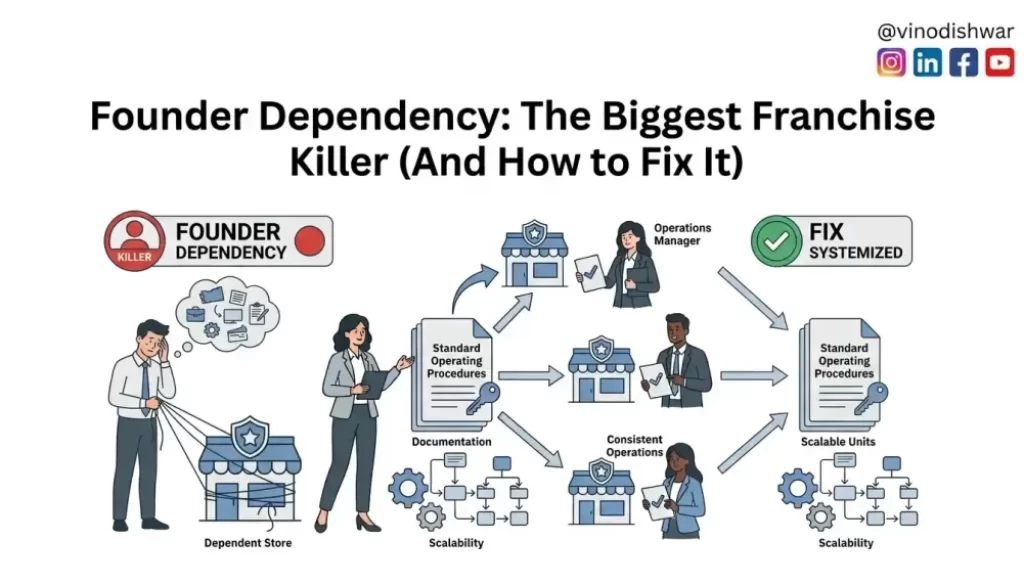
Founder dependency occurs when a business relies heavily on the founder for daily decisions, customer relationships, operations, problem-solving, or growth. While this approach may work for a single location, it becomes one of the biggest barriers to scaling through franchising.
A successful franchise is built on systems, not personalities. Franchisees invest in a business model that can be replicated—not in the founder’s individual expertise.
In this guide, you’ll learn what founder dependency is, why it prevents franchise success, how to identify it, and the practical steps to build a business that can grow beyond its founder.
What Is Founder Dependency?
Founder dependency exists when the business cannot operate effectively without the active involvement of its founder.
Examples include:
- The founder approves every major decision.
- Customers insist on speaking only with the founder.
- Staff rely on the founder for problem-solving.
- Sales decline when the founder is absent.
- Processes exist only in the founder’s memory.
This creates operational bottlenecks and limits scalability. Learn whether your company is ready to expand in our guide Is Your Business Ready for Franchising?
https://vinodishwar.com/is-your-business-ready-for-franchising/
Why Founder Dependency Prevents Franchise Growth
Franchising requires consistency across multiple locations managed by independent business owners.
If success depends on one person’s knowledge, experience, or relationships, franchisees cannot replicate the same outcomes.
Founder dependency often results in:
- Slow decision-making
- Inconsistent operations
- Limited scalability
- Difficult franchisee training
- Higher operational risk
- Reduced business valuation
The goal of franchise development is to transform founder knowledge into documented business systems.
15 Signs of Founder Dependency in Your Business
1. Every Important Decision Requires Your Approval
If your team waits for you to approve routine decisions, the business is overly centralized.
2. Customers Ask Only for You
A strong business should deliver consistent service regardless of which team member interacts with the customer.
3. Employees Constantly Seek Your Guidance
Frequent interruptions for routine questions often indicate that systems and procedures are missing.
4. Your Business Slows Down When You’re Away
If sales, service quality, or productivity decline during your absence, operational dependency exists.
5. You Handle Most Customer Complaints Personally
Well-trained managers should resolve the majority of operational issues without founder involvement.
6. Critical Processes Are Not Documented
Knowledge stored only in the founder’s mind cannot be replicated across franchise locations.
7. You Train Every Employee Yourself
A scalable business relies on structured training programs rather than one-on-one founder instruction.
8. There Are No Standard Operating Procedures
Without SOPs, employees develop inconsistent working methods.
9. Managers Lack Decision-Making Authority
Empowered managers improve responsiveness and reduce founder workload.
10. Vendor Relationships Depend on You
Supplier management should be system-driven rather than relationship-dependent.
11. You Are the Primary Salesperson
Businesses that rely entirely on founder-led sales often struggle to expand.
12. You Solve Every Operational Problem
A mature organization develops leaders who can solve challenges independently.
13. Business Performance Depends on Your Presence
Performance should remain consistent regardless of whether the founder is in the office.
14. Expansion Feels Impossible Without You
If opening a second location seems overwhelming because everything depends on you, founder dependency is limiting growth.
15. You Cannot Take an Extended Vacation
Perhaps the simplest test:
Can your business operate successfully for four weeks without your direct involvement?
If not, systems require improvement.
Why Founder Dependency Prevents Franchise Growth
Franchisees invest in repeatable systems—not personal talent.
Without documented processes and standardized operations:
- Training becomes inconsistent.
- Customer experiences vary.
- Quality declines.
- Brand standards become difficult to maintain.
- Franchisee confidence decreases.
Reducing founder dependency is one of the most important steps before franchise development. Read our detailed guide on Franchise Operations Manual Explained.
https://vinodishwar.com/franchise-operations-manual-explained/
How to Reduce Founder Dependency Before Franchising
Document Standard Operating Procedures
Convert founder knowledge into written SOPs covering every critical business process.
Build a Franchise Operations Manual
Combine SOPs, policies, workflows, and quality standards into a structured operating guide.
Delegate Decision-Making
Clearly define responsibilities and empower managers to make operational decisions within established guidelines.
Create Structured Training Programs
Develop repeatable onboarding and training systems instead of relying solely on founder-led coaching.
Implement Technology
Use POS systems, CRM software, dashboards, and reporting tools to standardize operations and improve visibility.
Develop Leadership
Invest in training managers to lead teams, solve problems, and maintain operational standards independently.
Review Performance Using KPIs
Measure results through data rather than personal supervision.
Examples include:
- Customer satisfaction
- Sales
- Productivity
- Staff retention
- Inventory accuracy
How SOPs Reduce Founder Dependency
Standard Operating Procedures help transfer knowledge from individuals to the organization.
They define:
- Daily operations
- Customer service
- Sales processes
- Inventory management
- Staff responsibilities
- Quality standards
This allows the business to operate consistently regardless of who is managing the location. Discover why documentation matters in Why SOPs Matter Before Franchising.
https://vinodishwar.com/why-sops-matter-before-franchising/
How Franchise Consultants Help
A franchise consultant evaluates founder dependency through a Franchise Readiness Assessment and helps businesses build scalable systems.
Typical consulting activities include:
- Process mapping
- SOP development
- Operations manual creation
- Organizational restructuring
- Leadership development
- Training program design
- Business systems implementation
The objective is to build a business that can succeed without constant founder involvement. Learn more about professional Franchise Consulting Services offered by Franchise Alpha.
https://franchisealpha.com/franchise-consulting/
The SOLEMN® Framework
At Franchise Alpha, reducing founder dependency is an important part of the proprietary SOLEMN® Framework.
Strategy
Assess business scalability and identify operational bottlenecks.
Operations
Develop SOPs, workflows, manuals, and standardized systems.
Legal
Ensure documentation aligns with franchise governance.
Entrust
Build leadership capability, delegation structures, and franchisee support systems.
Marketing
Create consistent customer experiences that are independent of the founder.
Nitty-Gritty
Continuously refine systems through audits and operational improvements.
This framework helps businesses transition from founder-led organizations to scalable franchise-ready enterprises.
Frequently Asked Questions
What is founder dependency?
Founder dependency occurs when a business relies heavily on its founder for operations, decision-making, customer relationships, or problem-solving, making it difficult to scale.
Why is founder dependency bad for franchising?
Franchisees invest in systems, not individuals. Businesses that depend on the founder struggle to deliver consistent operations across multiple locations.
How do I know if my business is founder dependent?
Common signs include founder-led decision-making, undocumented processes, lack of delegation, inconsistent performance during the founder’s absence, and limited management autonomy.
How can I reduce founder dependency?
Develop SOPs, create an operations manual, delegate authority, implement technology, train managers, and build standardized systems that allow the business to operate independently.
Conclusion
Founder dependency is one of the most common—and most overlooked—obstacles to successful franchising.
The businesses that scale successfully are not necessarily those with the most talented founders, but those with the strongest systems. By documenting processes, empowering teams, implementing SOPs, and building repeatable operating frameworks, you transform your business into an asset that can grow beyond your personal involvement. Visit Franchise Alpha for more insights on franchise systems and business expansion.
https://franchisealpha.com/
Reducing founder dependency is not about becoming less important—it is about creating a business that continues to succeed because of the systems you have built.
That transformation is the foundation of every successful franchise. Learn more about the Franchise Consulting Process before expanding your business.
https://vinodishwar.com/franchise-consulting-process/
Call to Action
Build a Business That Can Grow Without You
Book a Franchise Readiness Assessment with Vinod Ishwar to evaluate founder dependency, strengthen your business systems, develop professional SOPs, and prepare your business for scalable franchise expansion.
Receive a practical roadmap for transforming your business from founder-led to systems-driven.