How to Build Standard Operating Procedures (SOPs): A Step-by-Step Guide for Growing Businesses (2026)
Introduction
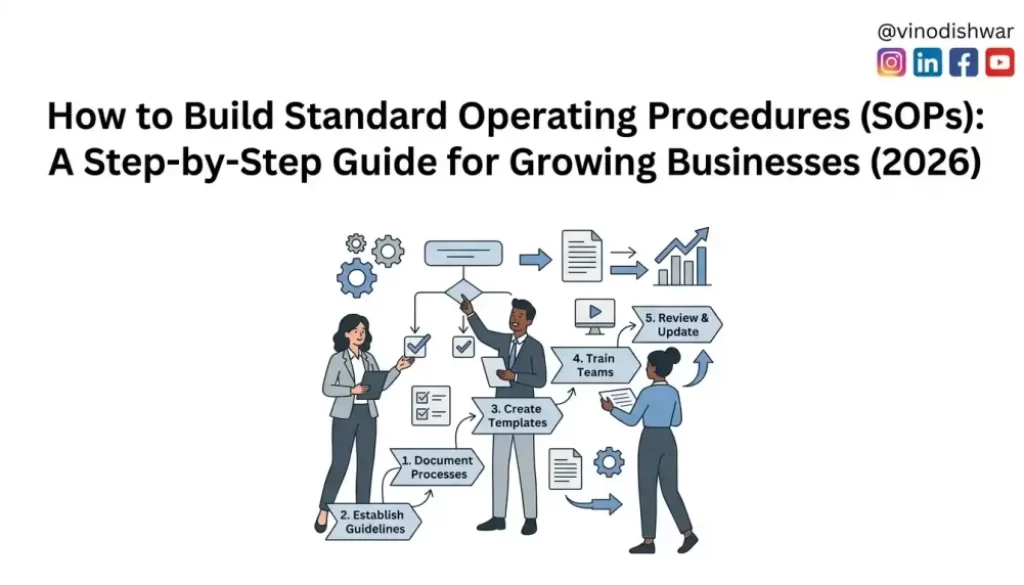
How to Build Standard Operating Procedures is one of the most important skills for growing businesses. Every successful business reaches a stage where growth becomes difficult without systems. As teams expand, locations increase, and customer expectations rise, relying on verbal instructions or individual experience is no longer enough. Learning how to build Standard Operating Procedures ensures every employee follows consistent processes, making your business more efficient and easier to scale.
Every successful business reaches a stage where growth becomes difficult without systems. As teams expand, locations increase, and customer expectations rise, relying on verbal instructions or individual experience is no longer enough.
This is where Standard Operating Procedures (SOPs) become essential.
SOPs document how routine tasks should be performed, ensuring consistency, quality, and efficiency across the organization. Whether you operate a restaurant, retail store, healthcare clinic, manufacturing unit, educational institute, or service business, well-written SOPs help reduce errors, simplify training, improve customer experience, and prepare your business for expansion.
For businesses planning to franchise, SOPs are even more critical. They form the foundation of the Franchise Operations Manual and enable franchisees to replicate your business model successfully.
This guide explains how to build effective Standard Operating Procedures from scratch, with practical examples, templates, and best practices.
What Are Standard Operating Procedures?
Standard Operating Procedures (SOPs) are written documents that describe the exact steps required to perform recurring business activities.
They create a consistent way of working by documenting:
- Tasks
- Responsibilities
- Workflows
- Quality standards
- Safety requirements
- Reporting processes
Rather than relying on memory or individual expertise, SOPs ensure that every employee follows the same process.
Why Every Business Needs Standard Operating Procedures
Businesses with documented procedures benefit from:
- Consistent customer experience
- Faster employee onboarding
- Reduced operational errors
- Improved productivity
- Better quality control
- Easier compliance
- Higher accountability
- Stronger business continuity
- Greater scalability
As businesses grow, SOPs become the operating system that keeps every location and every team aligned. If you’re preparing your company for expansion, read our guide on Is Your Business Ready for Franchising?
https://vinodishwar.com/is-your-business-ready-for-franchising/
When to Build Standard Operating Procedures
Many businesses wait until they are preparing to franchise or expand.
A better approach is to begin documenting processes as soon as operations become repeatable.
Common milestones include:
- Hiring your first employees
- Opening a second location
- Introducing new products or services
- Experiencing inconsistent service quality
- Preparing for franchising
- Seeking operational efficiency
Starting early makes future growth much easier.
How to Build Standard Operating Procedures Step by Step
Step 1: Identify Core Business Processes
Begin by listing all recurring activities in your business.
Examples include:
- Customer enquiries
- Sales
- Product preparation
- Service delivery
- Billing
- Inventory management
- Staff recruitment
- Vendor management
- Marketing
- Customer support
Focus first on high-impact processes.
Step 2: Prioritize Critical Operations
Not every process needs immediate documentation.
Prioritize activities that:
- Affect customers directly
- Involve multiple employees
- Impact quality
- Require compliance
- Are repeated frequently
These procedures deliver the greatest operational benefits.
Step 3: Observe Current Workflows
Before documenting a process, watch how experienced employees complete the task.
Ask questions such as:
- What is the first step?
- What decisions are made?
- What tools are used?
- What problems occur frequently?
- How is quality verified?
Capture the actual process rather than the ideal version.
Step 4: Break the Process into Clear Steps
Write instructions in a logical sequence.
Each step should be:
- Simple
- Action-oriented
- Easy to follow
- Specific
Avoid vague language such as “handle appropriately.” Instead, explain exactly what should be done.
Step 5: Assign Responsibilities
Clearly define who performs each task.
Examples include:
- Store Manager
- Sales Executive
- Cashier
- Kitchen Staff
- Customer Support Executive
Role clarity improves accountability. Understanding how to build Standard Operating Procedures also improves accountability because every role has clearly documented responsibilities.
Step 6: Add Quality Standards
Every SOP should define what successful execution looks like.
Include measurable standards such as:
- Response times
- Accuracy requirements
- Hygiene standards
- Customer satisfaction targets
- Product quality checks
These benchmarks help maintain consistency.
Step 7: Include Required Resources
Document everything needed to complete the process.
Examples:
- Software
- Equipment
- Forms
- Checklists
- Templates
- Safety gear
Providing resource information reduces confusion.
Step 8: Review with Your Team
Before finalizing an SOP, test it with the employees who perform the task daily.
Their feedback helps identify missing steps and practical improvements.
Step 9: Train Employees
Documentation alone is not enough.
Conduct structured training sessions to explain:
- Why the SOP exists
- How to follow it
- Common mistakes
- Expected outcomes
Training improves adoption.
Step 10: Review and Update Regularly
Businesses evolve.
Review SOPs periodically to reflect:
- New technology
- Operational improvements
- Customer feedback
- Regulatory changes
- Business expansion
Keeping SOPs current ensures long-term effectiveness.
Essential Sections of Every SOP
A professional SOP should include:
SOP Title
Clearly identify the process.
Objective
Explain the purpose of the procedure.
Scope
Specify where the SOP applies.
Roles and Responsibilities
Identify who performs each task.
Step-by-Step Procedure
Provide detailed instructions.
Quality Standards
Define expected outcomes.
Safety or Compliance Requirements
Include any mandatory guidelines.
Forms and Templates
Reference supporting documents.
Review Date
Schedule periodic updates.
SOP Example
SOP: Customer Complaint Resolution
Objective: Resolve customer complaints consistently within 24 hours.
Responsible: Customer Service Executive
Steps:
- Listen without interruption.
- Record complaint details.
- Verify purchase information.
- Offer appropriate resolution.
- Escalate unresolved cases.
- Follow up with the customer.
- Close the complaint in the CRM.
Quality Standard: 95% customer satisfaction score.
Common Mistakes When Building SOPs
Avoid these common errors:
- Writing overly complicated procedures
- Using technical jargon unnecessarily
- Failing to involve employees
- Ignoring updates
- Creating SOPs that are too generic
- Not testing procedures
- Skipping employee training
Effective SOPs should be practical, clear, and regularly reviewed.
SOPs and Franchise Development
For businesses planning to franchise, SOPs are one of the most valuable assets.
They become the foundation of the Franchise Operations Manual, enabling franchisees to:
- Deliver consistent customer experiences
- Maintain quality standards
- Train new employees
- Follow standardized workflows
- Protect brand reputation
Without SOPs, franchise expansion becomes difficult to manage effectively. Learn why documentation matters in our article Why SOPs Matter Before Franchising.
https://vinodishwar.com/why-sops-matter-before-franchising/
How Franchise Consultants Help Develop SOPs
Professional franchise consultants bring structure and objectivity to SOP development.
They help businesses:
- Map business processes
- Eliminate inefficiencies
- Standardize workflows
- Create process documentation
- Develop training manuals
- Build franchise operations manuals
- Prepare for scalable expansion
This ensures SOPs are not only documented but also aligned with long-term growth goals. Businesses can also explore professional SOP Development and Franchise Consulting Services offered by Franchise Alpha.
https://franchisealpha.com/franchise-consulting/
The SOLEMN® Framework
At Franchise Alpha, SOP development forms a key part of the proprietary SOLEMN® Framework.
Strategy
Identify business processes that drive scalable growth.
Operations
Document workflows, SOPs, manuals, and operational standards.
Legal
Ensure operational documentation supports franchise compliance.
Entrust
Develop structured training systems for managers and franchisees.
Marketing
Standardize customer experience and brand delivery.
Nitty-Gritty
Continuously improve processes through operational audits and performance reviews.
This framework helps businesses build systems that support sustainable expansion.
Frequently Asked Questions
What is a Standard Operating Procedure (SOP)?
A Standard Operating Procedure is a written document that explains how a specific business task should be performed to ensure consistency, quality, and efficiency.
Why should businesses create SOPs?
SOPs improve operational consistency, reduce errors, simplify training, increase productivity, and support business growth.
How often should SOPs be updated?
Most businesses should review SOPs annually or whenever significant operational changes occur.
Can SOPs help prepare a business for franchising?
Yes. SOPs form the foundation of a Franchise Operations Manual and enable franchisees to replicate the business consistently across multiple locations.
Conclusion
Building Standard Operating Procedures is one of the most valuable investments a growing business can make. Businesses that know how to build Standard Operating Procedures are better prepared for expansion, franchising, and long-term operational excellence.
SOPs create consistency, improve efficiency, simplify training, reduce operational risks, and prepare businesses for sustainable expansion. They transform knowledge into repeatable systems, allowing organizations to grow without relying on individual employees or founders.
Whether your goal is operational excellence, opening multiple locations, or developing a franchise network, strong SOPs provide the foundation needed for long-term success.
Start documenting your processes today, review them regularly, and treat your SOPs as living documents that evolve alongside your business. You may also find our guide on Franchise Consulting Process helpful before documenting your systems.
https://vinodishwar.com/franchise-consulting-process/
Call to Action
Need Help Building SOPs for Your Business?
Book a Business Process & Franchise Readiness Assessment with Vinod Ishwar to identify your critical processes, develop professional Standard Operating Procedures, and create systems that support sustainable business growth and franchise expansion.