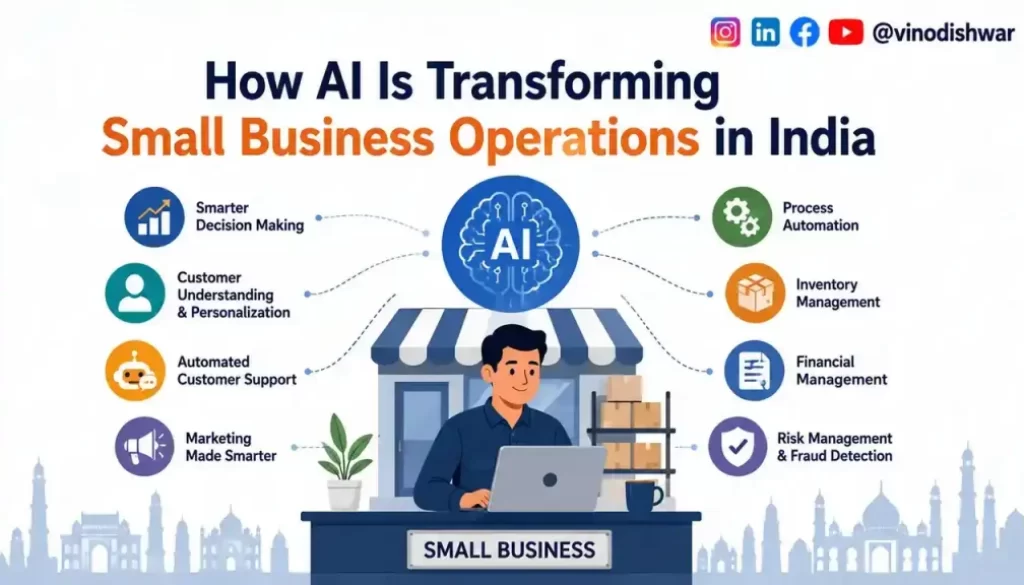
How AI Is Transforming Small Business Operations in India
Artificial intelligence conversations often center around large enterprises deploying sophisticated, expensive systems — but a quieter, equally significant shift is happening among small and medium businesses across India, who are increasingly adopting accessible, affordable AI tools to improve efficiency, customer experience, and decision-making, without requiring large technical teams or budgets. A well-optimized business website helps AI-powered tools deliver a smoother customer experience and improve online conversions.
Why AI Adoption Matters for Small Businesses Now
Many AI tools that were prohibitively expensive or technically complex just a few years ago are now available through simple, subscription-based platforms requiring minimal technical expertise to implement. This democratization means small businesses can access capabilities that were previously the exclusive domain of larger, better-resourced competitors.
Practical Ways Small Businesses Are Using AI
1. Customer Service Chatbots
AI-powered chatbots can handle common customer queries, order status questions, and basic support requests around the clock, freeing up staff time for more complex customer interactions while improving response speed for routine questions. Businesses can build AI-powered chatbots and virtual assistants using ChatGPT to improve customer support and response times.
2. Content Creation and Marketing
AI writing tools help small businesses generate marketing copy, social media content, and product descriptions more efficiently, though genuine brand voice and strategic oversight remain essential to avoid generic, undifferentiated output. AI-generated content becomes even more effective when supported by a strong content marketing strategy focused on building trust and authority.
3. Inventory and Demand Forecasting
AI-powered forecasting tools analyze historical sales data to predict future demand more accurately, helping small retailers and product businesses reduce both stockouts and excess inventory.
4. Personalized Customer Recommendations
E-commerce businesses increasingly use AI to power personalized product recommendations based on customer browsing and purchase behavior, improving conversion rates without requiring a large dedicated data science team.
5. Automated Bookkeeping and Financial Insights
AI-enhanced accounting tools can automatically categorize expenses, flag anomalies, and generate financial insights, reducing the manual bookkeeping burden many small business owners currently handle themselves.
6. Social Media Management and Scheduling
AI tools assist with content scheduling, optimal posting time recommendations, and even initial content generation, helping small businesses maintain consistent social media presence without a dedicated marketing team. AI tools can also improve your social media marketing by helping businesses schedule posts, analyze engagement, and maintain consistency.
7. Recruitment and Hiring Support
AI-powered tools can help screen resumes and identify strong candidate matches more efficiently, particularly valuable for small businesses without dedicated HR resources.
8. Voice and Image Recognition Applications
Depending on the industry, AI-powered voice assistants or image recognition tools can streamline specific operational tasks — from voice-based order taking to automated quality inspection in manufacturing or retail settings.
Getting Started With AI as a Small Business
1. Identify Specific, High-Friction Problems First
Rather than adopting AI tools broadly and speculatively, identify the specific operational bottlenecks or repetitive tasks causing the most friction, and evaluate AI solutions specifically targeted at those problems.
2. Start With Accessible, Low-Commitment Tools
Many AI tools offer free trials or low-cost entry tiers, allowing small businesses to test genuine value before committing to significant investment or organizational change.
3. Maintain Human Oversight, Especially Early On
AI tools work best as an enhancement to human judgment and oversight, particularly in customer-facing applications, rather than being deployed as a complete, unsupervised replacement before you fully understand their limitations and failure modes.
4. Train Your Team on New Tools
Adoption success depends heavily on team members understanding how to use new AI tools effectively, and importantly, when to escalate to human judgment rather than relying entirely on automated output.
Common AI Adoption Mistakes
- Adopting AI tools speculatively, without a clear, specific problem they’re intended to solve.
- Removing human oversight too early, particularly in customer-facing applications where errors damage trust.
- Using AI-generated content without review, risking generic, inaccurate, or off-brand output reaching customers.
- Underestimating the learning curve for staff to effectively integrate new AI tools into daily workflows.
- Ignoring data privacy and security considerations when adopting AI tools that handle customer information.
Key Takeaways
- AI tools have become increasingly accessible and affordable for small and medium businesses, not just large enterprises.
- Customer service, content creation, forecasting, and bookkeeping are common practical starting points for AI adoption.
- Maintaining human oversight remains essential, particularly for customer-facing AI applications.
- Starting with a specific, well-defined problem improves the likelihood of successful AI adoption.
- Team training and gradual, focused implementation improve outcomes compared to broad, speculative AI adoption.
Conclusion
AI is no longer a capability exclusive to large, well-resourced businesses. Indian small and medium businesses that thoughtfully adopt accessible AI tools — targeted at specific, genuine operational needs — can meaningfully improve efficiency and customer experience without requiring significant technical investment. Business owners who embrace AI can also strengthen their personal brand by showcasing innovation, leadership, and forward-thinking business practices.
-Vinod Ishwar
FAQs
1. How can AI help small businesses in India?
AI helps small businesses automate repetitive tasks, improve customer service, create marketing content, analyze business data, and increase overall productivity while reducing operational costs.
2. Is AI affordable for small businesses?
Yes. Many AI tools offer free plans or affordable monthly subscriptions, making them accessible even for startups and small businesses with limited budgets.
3. What are the best AI tools for small businesses?
Popular AI tools include ChatGPT for content creation, Google AI for productivity, Zoho Books for accounting, Canva AI for design, and Zapier for workflow automation.
4. Can AI replace employees in small businesses?
AI is designed to support employees by automating repetitive tasks, not replace human expertise. Human oversight remains essential for decision-making, creativity, and customer relationships.
5. Which business processes can be automated using AI?
AI can automate customer support, email marketing, social media scheduling, bookkeeping, inventory management, appointment scheduling, reporting, and lead qualification.
6. How do I start using AI in my business?
Start by identifying repetitive tasks, choose one affordable AI tool, train your team, monitor the results, and gradually expand AI adoption based on business needs.
7. Is AI safe for handling customer data?
AI can be safe when businesses use trusted platforms with strong security measures and follow data privacy regulations. Sensitive customer information should always be handled responsibly.