Sustainable Growth: Why Growing Too Fast Can Break Your Business
Sustainable business growth is the key to building a profitable company that lasts. While rapid expansion may seem attractive, growing too quickly without strong systems, healthy cash flow, and operational readiness can create serious challenges. Understanding how to scale sustainably helps businesses protect quality, profitability, and long-term success.
Rapid growth gets celebrated — in headlines, in investor pitches, in founder success stories. What gets far less attention is how many fast-growing businesses quietly collapse under the weight of their own expansion, undone not by lack of demand but by growing faster than their systems, cash flow, and teams could actually support. Sustainable growth, while less dramatic, consistently outperforms aggressive, unsupported expansion over the long run. A strong business website supports sustainable growth by improving customer experience and increasing conversions.
Why Fast Growth Can Be Dangerous
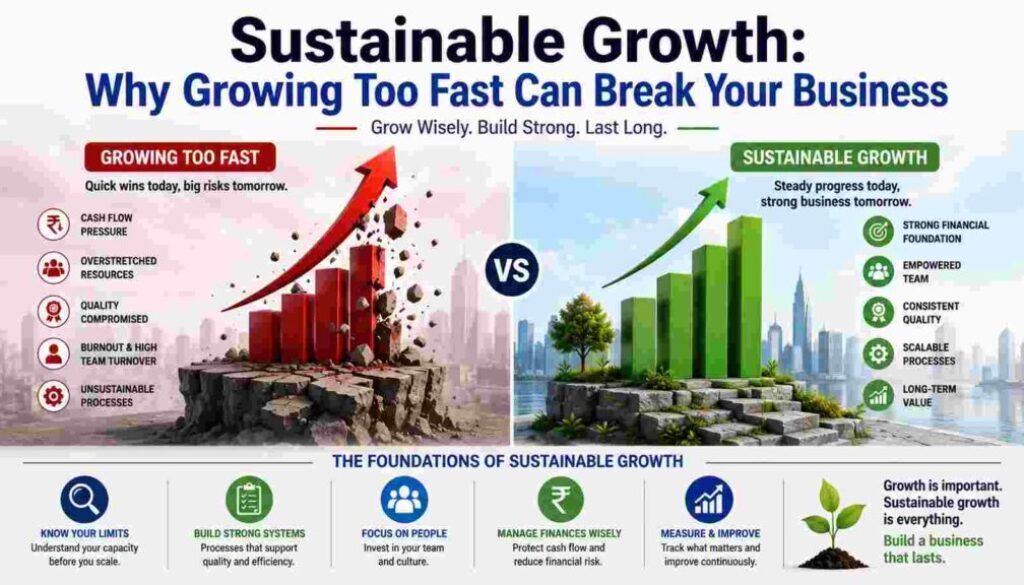
Growth consumes cash, strains operational systems, and demands more from teams — often faster than a business can build the infrastructure to support it. A business growing 200% in a year with systems designed for steady 20% growth is operating under enormous, often invisible strain, until something breaks: a cash flow crisis, a quality collapse, key employee burnout, or a customer experience failure at scale.
The Hidden Costs of Overly Aggressive Growth
1. Cash Flow Strain
Growth often requires spending money — on inventory, hiring, marketing, new locations — well before the corresponding revenue materializes. Businesses that scale faster than their cash reserves and financing can support frequently find themselves unable to meet basic obligations, even while technically growing. Effective lead generation helps businesses maintain consistent revenue while supporting sustainable expansion.
2. Operational System Breakdown
Systems that work smoothly at one scale — manual inventory tracking, informal communication, founder-led decision-making — often break down entirely at a larger scale, leading to errors, delays, and inconsistent customer experience. Business automation can reduce operational bottlenecks and improve efficiency as your company grows.
3. Team Burnout and Turnover
Rapid growth frequently means existing employees absorb dramatically increased workload before new hires are trained and productive, leading to burnout, mistakes, and turnover — which, ironically, further strains the very growth the business is trying to sustain.
4. Quality and Brand Damage
As covered in scaling discussions elsewhere, rapid, unsupported growth is one of the most common causes of quality decline, which can damage brand reputation far more durably than the growth itself was worth.
5. Loss of Strategic Control
Businesses growing reactively — saying yes to every opportunity, expanding wherever demand appears — often lose the strategic focus that made them successful in the first place, spreading resources thin across too many directions simultaneously.
Principles of Sustainable Growth
1. Grow at the Pace Your Systems Can Support
Before pursuing aggressive growth, honestly assess whether your operational systems, cash reserves, and team capacity can genuinely support the scale you’re targeting — not just the revenue potential.
2. Prioritize Profitable Growth Over Growth for Its Own Sake
Revenue growth that comes at the cost of unsustainable margins, excessive discounting, or unprofitable customer segments isn’t genuinely healthy growth, regardless of how impressive the top-line numbers look.
3. Build Financial Buffers Before Scaling
Maintaining adequate cash reserves — beyond the immediate capital required for expansion — provides critical breathing room to navigate the inevitable surprises that accompany growth.
4. Invest in Systems and Team Development Ahead of Growth
Rather than reactively building infrastructure after growth has already outpaced it, invest in systems, training, and management capacity slightly ahead of immediate need, creating capacity for growth rather than constantly playing catch-up. Consistent content marketing helps businesses build authority and attract customers without relying only on rapid expansion.
5. Say No to Growth Opportunities That Don’t Fit
Not every available growth opportunity — a new market, a new product line, an aggressive expansion offer — genuinely fits your business’s strengths, capacity, or strategic direction. Sustainable growth requires the discipline to decline opportunities that would strain the business beyond what it can healthily support.
6. Monitor Leading Indicators, Not Just Revenue
Track metrics beyond top-line revenue — cash flow trends, employee turnover, customer satisfaction scores, quality audit results — as early warning signals that growth may be outpacing the business’s capacity to support it. Businesses can monitor important financial metrics and cash flow using QuickBooks.
A Balanced Perspective
Sustainable growth doesn’t mean slow or unambitious growth. Many businesses achieve substantial, even rapid, growth sustainably — by ensuring systems, cash flow, and team capacity are deliberately built to support each stage of expansion before pushing to the next. The distinction isn’t speed alone; it’s whether growth is genuinely supported by the underlying business infrastructure.
Common Mistakes That Undermine Sustainable Growth
- Chasing growth targets set by external pressure (investors, competitive comparison) rather than genuine business readiness.
- Ignoring cash flow projections in favor of revenue growth projections alone.
- Expanding into new markets or products without validating demand and operational fit first.
- Underinvesting in team development and systems relative to the pace of growth.
- Treating every growth opportunity as one that must be pursued immediately.
Key Takeaways
- Fast growth without supporting infrastructure often causes cash flow, quality, and team strain that can undermine the business.
- Profitable, well-supported growth is more valuable than rapid but unsustainable revenue increases.
- Financial buffers and ahead-of-need system investment create genuine capacity for healthy growth.
- Leading indicators beyond revenue provide early warning of growth outpacing business capacity.
- Sustainable growth requires the discipline to decline opportunities that don’t genuinely fit the business.
Conclusion
The most enduring businesses aren’t necessarily the ones that grew fastest — they’re the ones that grew in step with their own capacity to support that growth. Prioritizing sustainable, well-paced expansion over impressive but fragile growth numbers builds a business capable of thriving for the long term. A strong personal brand also builds long-term trust, making sustainable business growth easier to achieve.
-vinod Ishwar
Frequently Asked Questions (FAQs)
1. What is sustainable business growth?
Sustainable business growth is expanding a business at a pace that supports long-term profitability, operational efficiency, and customer satisfaction.
2. Why can growing too fast hurt a business?
Rapid growth can create cash flow problems, operational inefficiencies, employee burnout, and declining product or service quality.
3. How can businesses achieve sustainable growth?
Businesses should improve systems, monitor cash flow, invest in their teams, automate repetitive tasks, and expand only when they have the capacity.
4. Why is cash flow important during business expansion?
Healthy cash flow ensures a business can pay expenses, invest in growth opportunities, and handle unexpected challenges without financial stress.
5. What role does automation play in sustainable growth?
Business automation improves efficiency, reduces manual work, minimizes errors, and helps companies scale without significantly increasing operating costs.
6. How do strong systems support business growth?
Reliable systems improve productivity, maintain quality, support customer satisfaction, and make business expansion more manageable.