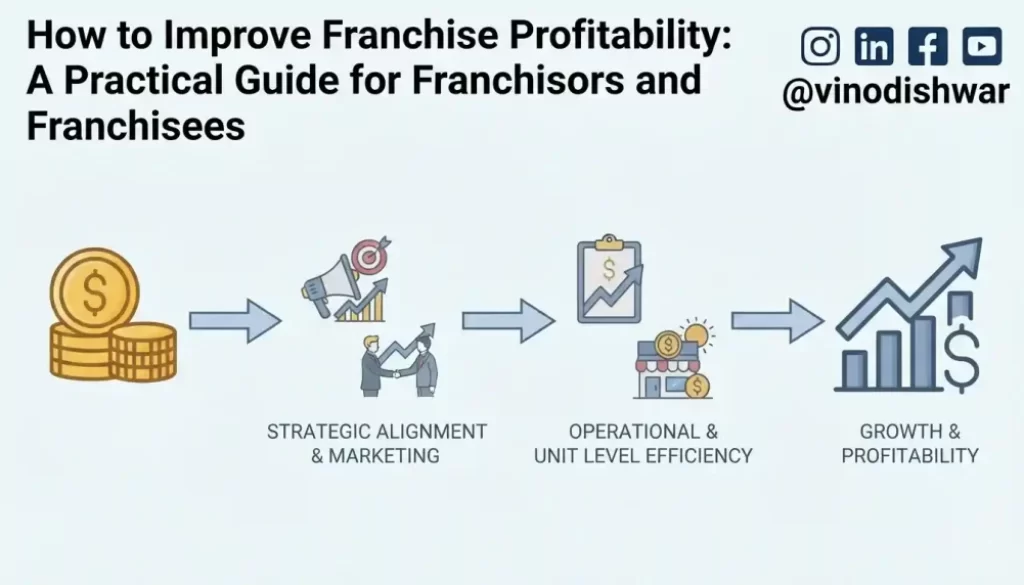
How to Improve Franchise Profitability: A Practical Guide for Franchisors and Franchisees
Franchise profitability is the true measure of long-term business success. Revenue gets the headlines, but profitability determines survival. It’s entirely possible for a franchise outlet to generate impressive sales while barely making a profit. Both franchisors and franchisees should focus on improving franchise profitability rather than chasing revenue alone.
Why Franchise Profitability Often Underperforms Expectations
Many franchise businesses are sold on the strength of their revenue potential, with less attention paid to the cost structure required to achieve it. Franchisees, especially first-timers, often focus on hitting sales targets without closely tracking whether those sales are translating into sustainable margins after rent, royalties, staffing, and operational costs.
Before expansion, evaluate whether your business is franchise-ready.
How to Improve Franchise Profitability
1. Get Serious About Cost Structure, Not Just Revenue Targets
Break down every cost category — rent, staff, raw materials, utilities, marketing — as a percentage of revenue, and compare these against category benchmarks. A outlet with strong sales but disproportionately high staffing costs, for example, may need to restructure shift patterns or staff allocation rather than simply “sell more.”
2. Optimize Inventory and Reduce Wastage
In food, retail, and FMCG-driven franchise categories, inventory mismanagement is one of the biggest silent profit drains. Implementing proper stock rotation, demand forecasting based on historical sales patterns, and portion control (in food businesses) can meaningfully improve margins without changing pricing or volume at all.
3. Improve Staff Productivity and Scheduling
Labor is typically one of the largest controllable costs in a franchise outlet. Aligning staffing levels with actual footfall patterns — rather than uniform shift schedules regardless of demand — often reveals significant opportunities to reduce labor costs without affecting customer experience.
4. Increase Average Transaction Value
Rather than solely chasing more customers, focus on increasing what each customer spends — through upselling, cross-selling, bundled offers, and loyalty programs. A modest increase in average transaction value often has a larger profitability impact than an equivalent increase in footfall.
5. Negotiate Better Supplier and Procurement Terms
Franchisors can significantly boost network-wide profitability by negotiating centralized procurement deals across all franchisees, passing on volume-based discounts that individual franchisees could never secure independently.
6. Review Royalty and Fee Structures Periodically
Franchisors should periodically assess whether royalty structures remain fair and sustainable as the network matures. Overly aggressive royalty percentages can quietly erode franchisee profitability to the point of disengagement or exit — ultimately hurting the franchisor’s long-term brand strength.
Sustainable profitability also depends on selecting the right franchise partners.
7. Invest in Local Marketing That Actually Converts
Generic, brand-wide marketing campaigns don’t always translate into local footfall. Franchisees benefit from location-specific marketing support — local SEO, geo-targeted digital ads, and community engagement — that drives measurable, trackable customer acquisition.
8. Track Profitability Metrics, Not Just Sales Metrics
Franchisors should equip franchisees with simple, standardized profitability dashboards — tracking gross margin, net margin, and cost-to-revenue ratios — rather than leaving each franchisee to interpret raw sales numbers independently.
Common Profitability Mistakes to Avoid
- Discounting aggressively to drive volume, without calculating the actual margin impact.
- Overstaffing during low-footfall periods out of habit rather than data-driven scheduling.
- Ignoring wastage and shrinkage until it becomes a significant, hard-to-reverse problem.
- Underinvesting in staff training, leading to inefficiency, errors, and customer dissatisfaction that indirectly affects revenue.
- Franchisors setting royalty structures without modeling franchisee-level profitability impact.
- Many businesses also make broader franchise mistakes that reduce long-term performance.
A Real-World Perspective
Two outlets of the same franchise brand, in similar-sized cities, can post nearly identical revenue figures while one operates at a healthy 15% net margin and the other barely breaks even. The difference is almost never the brand or the location — it’s disciplined cost management, inventory control, and staffing efficiency applied consistently, month after month.
Businesses can also explore official guidance on entrepreneurship and business development through the Startup India initiative.
Franchise Profitability: Key Takeaways
- Revenue growth does not automatically translate into profitability.
- Inventory control and staff scheduling are often the highest-impact, lowest-effort improvement areas.
- Increasing average transaction value is frequently more effective than chasing more footfall.
- Franchisors should periodically review royalty structures against franchisee-level profitability.
- Standardized profitability dashboards help franchisees make informed, data-driven decisions.
- Improving franchise profitability requires continuous monitoring of costs, operational efficiency, and customer value across every franchise outlet.
- Businesses with multiple outlets should also understand multi-unit franchising.
Conclusion
A profitable franchise network isn’t built through impressive sales figures alone — it’s built through disciplined cost management, smart operational choices, and a franchisor genuinely invested in franchisee financial health. Prioritizing profitability at every level strengthens the entire network’s long-term sustainability.
Businesses that consistently focus on franchise profitability build stronger, more sustainable franchise networks over time.
Businesses planning expansion should first learn how to expand a franchise network across India.