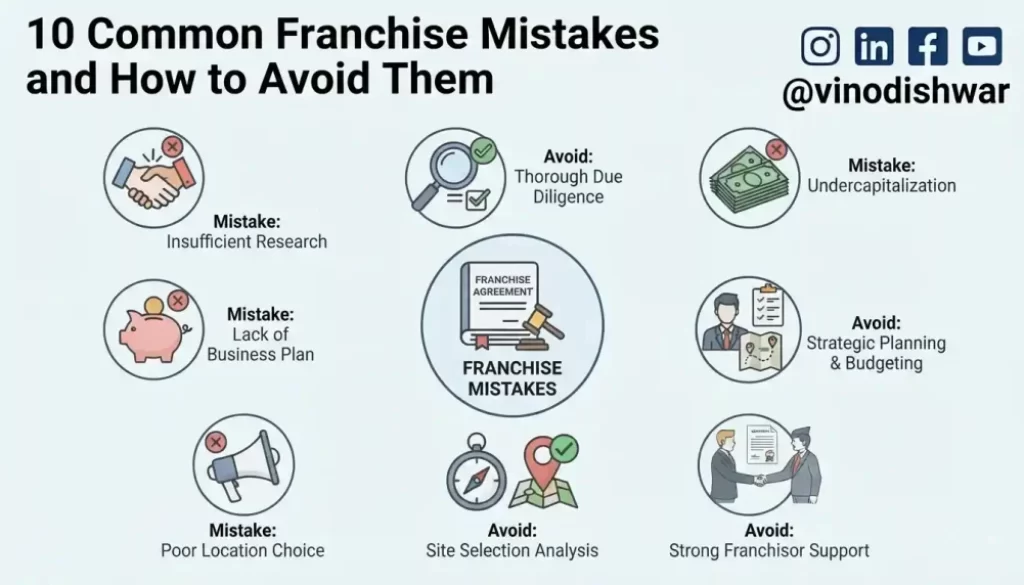
10 Common Franchise Mistakes and How to Avoid Them
Common franchise mistakes can prevent even the most promising businesses from achieving long-term success. Franchising has helped thousands of Indian entrepreneurs build successful businesses without starting from scratch. However, many franchisors and franchisees make avoidable mistakes that quietly derail growth. Most of these mistakes are not caused by bad luck but by decisions that could have been made differently with the right guidance.
1. Franchising Before the Business Is Ready
Many businesses franchise the moment they see early success, without first documenting systems, testing profitability over time, or protecting their brand legally. The result is often franchisees struggling to replicate results that were never actually systemized in the first place.
Before offering franchise opportunities, businesses should first determine whether they are truly franchise-ready by evaluating their systems, profitability, and operational processes.
How to avoid it: Complete a genuine readiness assessment — proven profitability, documented SOPs, and legal protection — before offering franchises.
2. Weak or Generic Franchise Agreements
Using a generic legal template, or one borrowed from an unrelated industry, leaves both franchisors and franchisees exposed when disputes arise over territory, fees, or termination.
How to avoid it: Work with legal and consulting experts experienced specifically in franchise agreements, not general commercial contracts.
A professionally drafted franchise agreement helps protect both franchisors and franchisees while reducing future legal disputes.
3. Recruiting Franchisees Based on Capital Alone
Approving any candidate who can pay the franchise fee, regardless of fit, experience, or values alignment, frequently leads to inconsistent brand experience and operational friction down the line.
How to avoid it: Build a structured, multi-stage recruitment process that evaluates capability and alignment, not just financial capacity.
A structured recruitment process helps identify franchise partners who align with the brand’s vision and long-term objectives.
4. Overpromising Returns During Sales Conversations
It’s tempting to present best-case revenue projections to close a franchise deal faster — but when reality falls short, franchisee trust and satisfaction collapse quickly.
How to avoid it: Share honest, comparable outlet performance data, and let franchisees make informed decisions based on realistic expectations.
5. Poor Territory Planning
Approving franchisees opportunistically, without a structured territory strategy, often leads to market cannibalization, uneven brand presence, and disputes between neighboring franchisees.
How to avoid it: Develop a clear territory map based on market research before recruitment begins, and enforce exclusivity boundaries consistently.
6. Underinvesting in Franchisee Training and Support
Handing over an operations manual and calling it “training” leaves franchisees unprepared for real-world operational challenges.
A detailed franchise operations manual ensures every franchisee follows the same operational standards and best practices.
How to avoid it: Build structured, hands-on training programs, including on-site support during the critical early weeks of operation.
7. Inconsistent Brand Standards Across Outlets
When quality, service, and presentation vary noticeably between outlets, customer trust in the overall brand erodes — even at outlets that are individually performing well.
How to avoid it: Implement regular quality audits, mystery shopper programs, and clear consequences for non-compliance with brand standards.
Maintaining consistent quality standards directly contributes to stronger franchise profitability and long-term customer trust.
8. Neglecting the Franchisee Relationship After Onboarding
Some franchisors focus heavily on recruitment but under-invest in ongoing franchisee support, communication, and relationship management once outlets are operational.
How to avoid it: Establish regular check-ins, feedback channels, and a genuine support system that treats franchisees as long-term partners.
9. Ignoring Working Capital Requirements
Franchisees who invest their entire budget into the franchise fee and setup costs, without reserving working capital, frequently face cash flow crises within the first few months.
How to avoid it: Build a realistic financial model that includes at least 6 months of operating expenses as a separate reserve, beyond setup costs.
10. Failing to Adapt the Model to Local Market Realities
A franchise system that works perfectly in one city doesn’t always translate directly to another without adjustments for local demographics, price sensitivity, and cultural preferences.
How to avoid it: Build flexibility into the franchise model for reasonable local adaptation, while maintaining core brand standards, and gather local market insights before entering new territories.
Why Common Franchise Mistakes Keep Happening
Most of these mistakes share a common root: rushing. Franchisors rush to expand before systems are ready. Franchisees rush to invest before doing proper due diligence. Both sides, in the excitement of a growing opportunity, skip the unglamorous groundwork — legal structuring, financial modeling, training systems — that actually determines long-term success.
Businesses can also explore official resources on entrepreneurship, startups, and business growth through the Startup India initiative.
Common Franchise Mistakes: Key Takeaways
- Most franchise failures stem from predictable, avoidable mistakes, not bad luck.
- Rushing — in readiness, recruitment, or investment decisions — is the common root cause.
- Structured processes for legal, financial, and operational preparation prevent the majority of these pitfalls.
- Ongoing franchisee support matters as much as initial recruitment and onboarding.
- Local market adaptation, within brand standards, improves franchise success rates significantly.
- Avoiding common franchise mistakes requires proper planning, strong operational systems, and continuous support for franchisees throughout their business journey.
Conclusion: Avoiding Common Franchise Mistakes
Franchising remains one of the most reliable paths to business growth and entrepreneurship in India — but only when approached with discipline, realistic expectations, and proper professional guidance.
Businesses planning future growth should also understand how to expand their franchise network strategically while avoiding common operational mistakes. Avoiding these ten common mistakes puts both franchisors and franchisees on a far stronger path to long-term success.
Understanding and avoiding common franchise mistakes helps franchisors and franchisees build sustainable businesses with fewer operational risks.
-Vinod Ishwar
Frequently Asked Questions (FAQs)
What are the most common franchise mistakes businesses make?
Some of the most common franchise mistakes include expanding before the business is franchise-ready, using weak franchise agreements, recruiting franchisees based only on financial capability, providing inadequate training, and failing to maintain consistent brand standards. These mistakes can significantly impact long-term franchise success.
How can franchisors avoid common franchise mistakes?
Franchisors can reduce risks by developing documented operating systems, preparing legally sound franchise agreements, selecting the right franchise partners, providing ongoing training, and continuously supporting franchisees after launch.
Why is franchisee selection important?
Choosing the right franchise partners is essential because they represent your brand in different markets. Selecting candidates based on business skills, commitment, financial capability, and cultural fit helps maintain brand consistency and long-term growth.
What role does franchise training play in business success?
Comprehensive franchise training equips franchisees with the knowledge, systems, and operational standards required to run the business successfully. Continuous support also improves consistency and customer satisfaction across all franchise locations.
How important is a franchise agreement?
A franchise agreement defines the legal rights and responsibilities of both the franchisor and franchisee. A professionally drafted agreement helps prevent disputes and protects the interests of both parties throughout the franchise relationship.
Can franchise mistakes be prevented?
Yes. Most franchise mistakes are avoidable through careful planning, market research, proper legal documentation, structured recruitment, ongoing operational support, and continuous quality monitoring.
How can a franchise consultant help avoid costly mistakes?
A franchise consultant helps businesses evaluate franchise readiness, develop scalable systems, prepare legal documentation, recruit suitable franchise partners, and implement strategies that reduce operational and financial risks during expansion.