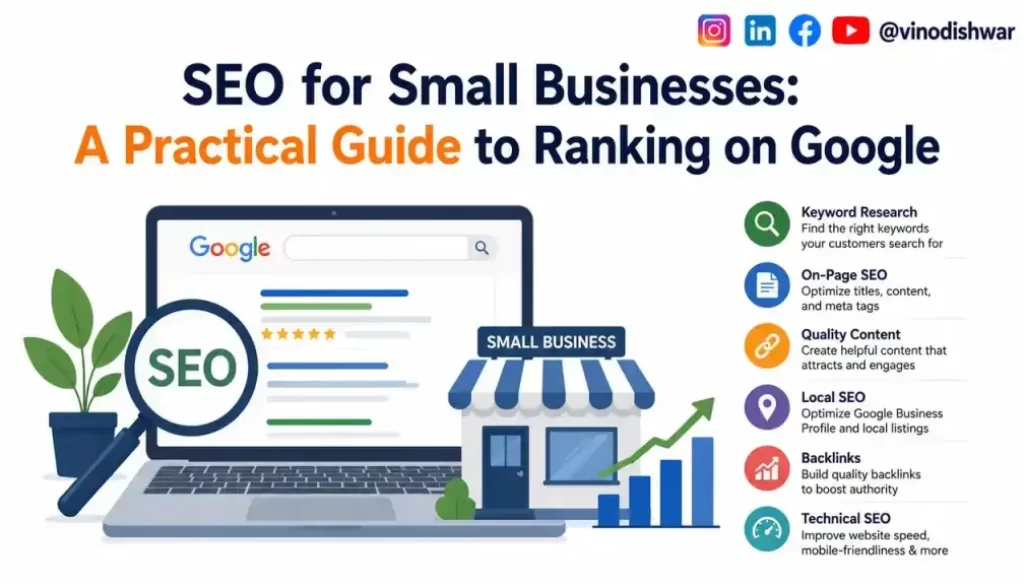
SEO for Small Businesses: A Practical Guide to Ranking on Google
SEO for small businesses is one of the most cost-effective ways to increase online visibility, attract qualified customers, and grow consistently through Google search. By focusing on practical SEO strategies, businesses can improve rankings without spending heavily on advertising. A well-optimized website also converts more visitors into paying customers. A fast, user-friendly business website provides the foundation for successful SEO and higher search rankings.
Search Engine Optimization often gets treated as a specialized, technical discipline reserved for large companies with dedicated marketing teams. In reality, many of the highest-impact SEO practices are entirely accessible to small businesses willing to invest consistent, focused effort — no large budget required, just a clear understanding of what actually moves the needle.
Why SEO for Small Businesses Matters
Unlike paid advertising, which stops generating traffic the moment you stop paying, organic search visibility compounds over time, continuing to drive traffic long after the initial content investment. For small businesses with limited marketing budgets, this makes SEO one of the most cost-effective long-term growth channels available.
Best SEO Strategies for Small Businesses
1. Claim and Optimize Your Google Business Profile
For businesses with a physical location or local service area, a fully optimized Google Business Profile — accurate categories, complete business information, regular photo updates, and active review management — is often the single highest-impact SEO action available. Google Business Profile is one of the most important tools for improving local SEO visibility.
2. Target Specific, Realistic Keywords
Rather than competing for broad, highly competitive keywords, focus on specific, longer-tail keywords that match genuine customer search intent and carry realistic ranking potential for a smaller business — for example, “best affordable tailoring services in Andheri” rather than simply “tailoring.” Keyword research becomes even more valuable when combined with an effective social media marketing strategy that drives additional traffic.
3. Create Genuinely Useful Content
Publish content that directly answers questions your customers actually search for — how-to guides, comparisons, FAQs — rather than generic promotional content. This builds both search visibility and genuine customer trust. A strong content marketing strategy helps businesses publish valuable content consistently while building authority online.
4. Optimize On-Page Elements
Ensure page titles, meta descriptions, headers, and image alt text accurately reflect your content and naturally incorporate relevant keywords, without keyword stuffing that degrades readability and can trigger search engine penalties.
5. Build Genuine Backlinks
Earn links from other credible websites — local business directories, industry publications, partner businesses — through genuine relationships and valuable content, rather than purchasing low-quality, spammy backlinks that can harm your search standing.
6. Ensure Mobile-Friendly, Fast-Loading Pages
Given the dominance of mobile search in India, a website that loads slowly or displays poorly on mobile devices will underperform in search rankings and lose potential customers, regardless of content quality. Business automation tools can also improve website performance by simplifying updates and reducing repetitive tasks.
7. Maintain Consistent NAP (Name, Address, Phone) Information
Ensure your business name, address, and phone number are consistent across your website, Google Business Profile, and all online directories, since inconsistency undermines both customer trust and search engine credibility signals.
8. Encourage and Respond to Customer Reviews
Genuine customer reviews, particularly on Google, influence both local search rankings and customer purchase decisions. Actively encouraging satisfied customers to leave reviews, and responding professionally to all reviews, strengthens this signal over time.
SEO for Small Businesses: Timeline and Expectations
SEO is a long-term strategy, not an immediate fix. Meaningful ranking improvements for competitive keywords typically take several months of consistent effort, though local search improvements (particularly via Google Business Profile optimization) can show results more quickly. Setting realistic expectations prevents premature abandonment of genuinely effective, but slower-building, SEO efforts.
Common Small Business SEO Mistakes
- Focusing only on the website, neglecting Google Business Profile and local search signals.
- Keyword stuffing content unnaturally, which harms both readability and search rankings.
- Publishing content inconsistently, losing the compounding benefit of regular, sustained content creation.
- Ignoring mobile optimization, despite mobile traffic dominance in most search categories.
- Expecting immediate results, leading to premature abandonment of effective long-term strategies.
Key Takeaways
- Organic SEO offers compounding, cost-effective visibility compared to ongoing paid advertising spend.
- Google Business Profile optimization is often the highest-impact SEO action for local businesses.
- Specific, longer-tail keywords offer more realistic ranking potential for smaller businesses than broad, competitive terms.
- Genuine, useful content consistently published builds both search visibility and customer trust over time.
- SEO requires realistic timeline expectations, with meaningful results typically building over several months.
Conclusion
Effective SEO is genuinely accessible to small businesses willing to invest consistent, focused effort into the fundamentals — without requiring large budgets or specialized technical expertise. Building this organic visibility deliberately creates a durable, cost-effective growth channel over time.
-Vinod Ishwar
FAQs
1. What is SEO for small businesses?
SEO for small businesses is the process of optimizing a website to improve its visibility on Google, helping attract more organic traffic and potential customers.
2. How long does SEO take to show results?
Most businesses begin seeing noticeable improvements within three to six months, depending on competition, website quality, and consistency.
3. Why is Google Business Profile important for local SEO?
A Google Business Profile helps businesses appear in local search results and Google Maps, increasing visibility and attracting nearby customers.
4. Do small businesses need SEO if they already use social media?
Yes. SEO and social media work together. SEO brings long-term organic traffic, while social media helps increase brand awareness and engagement.
5. What are the best SEO strategies for small businesses?
The most effective strategies include keyword research, creating helpful content, optimizing website pages, improving page speed, earning quality backlinks, and maintaining a Google Business Profile.