Copyright vs Trademark in Franchise Businesses
Copyright vs trademark is an important distinction for franchise businesses protecting their intellectual property. A franchise brand name, logo, website content, advertising creatives, training manuals and promotional videos may involve different forms of IP protection.
Two of the most important are copyright and trademarks.
Although they are often discussed together, they protect different things.
Understanding copyright vs trademark in franchise businesses can help franchisors identify their IP assets, establish ownership and give franchisees clear rules for using them.
For franchisees, understanding the distinction is equally important because receiving permission to operate under a brand does not automatically mean owning the brand’s intellectual property.
What Is a Trademark?
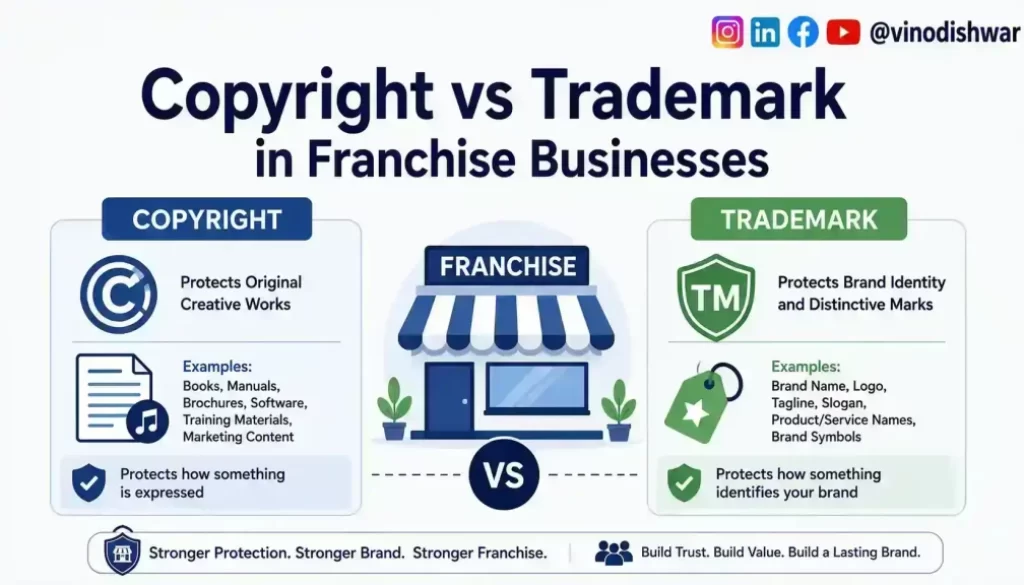
A trademark generally identifies and distinguishes the source of goods or services.
In franchising, trademarks can include:
- Brand names
- Logos
- Taglines
- Product names
- Service names
- Symbols
- Other distinctive brand identifiers
For example, the name displayed above a franchise outlet can be a key trademark asset.
Trademark protection is particularly important because franchisees may use the same brand across multiple locations.
In India, trademarks are primarily governed by the Trade Marks Act, 1999.
What Is Copyright?
Copyright generally protects original creative works.
In a franchise business, examples may include:
- Website content
- Photographs
- Videos
- Advertisements
- Brochures
- Training materials
- Franchise manuals
- Graphics
- Original written content
- Software code
Copyright therefore often protects the creative expression used to operate and market the franchise.
The underlying idea or business concept is not automatically protected merely because it has been written down; the scope of copyright protection depends on the nature of the work and applicable law.
Copyright vs Trademark: Key Difference
The simplest distinction is:
Trademark = brand identity
Copyright = original creative expression
A franchise may need both.
For example, consider a restaurant franchise.
Its brand name and logo may be protected through trademark rights.
Its menu photographs, website copy, promotional videos and training materials may be protected by copyright.
Together, these rights can help protect different parts of the franchise’s intellectual property portfolio.
Copyright vs Trademark Comparison
| Feature | Trademark | Copyright |
|---|---|---|
| Primary purpose | Protect brand identifiers | Protect original creative works |
| Franchise examples | Brand name, logo, tagline | Website content, manuals, videos |
| Main value | Brand recognition | Creative and informational assets |
| Registration | Available and strategically important | Rights may arise automatically for qualifying works, with registration/recording options depending on jurisdiction |
| Franchise use | Brand licensing | Permission to reproduce/use creative materials |
| Main concern | Unauthorized brand use | Unauthorized copying or reproduction |
The exact scope and enforcement of each right depends on the applicable law and individual circumstances.
Why Franchisors Need Both
A franchise business can have hundreds or thousands of intellectual property assets.
Consider a fitness franchise.
Its trademark portfolio may protect:
- Brand name
- Logo
- Program names
- Tagline
Its copyright-protected materials may include:
- Workout videos
- Website content
- Training manuals
- Marketing graphics
- Educational content
Protecting only one category can leave important assets exposed.
A comprehensive franchise IP strategy should therefore identify both trademark and copyright assets.
Trademark Protection in Franchise Agreements
The franchise agreement should establish how franchisees can use the franchisor’s trademarks.
Relevant provisions may cover:
- Approved trademarks
- Permitted locations
- Authorized business activities
- Brand standards
- Advertising
- Digital usage
- Modification restrictions
- Quality control
- Post-termination obligations
The franchisee should understand that trademark use is generally granted under defined contractual conditions.
It does not automatically transfer ownership.
Copyright Protection for Franchise Materials
Franchisors should also determine who owns copyright in materials used throughout the franchise system.
This is particularly important when content is created by:
- Employees
- Freelancers
- Advertising agencies
- Website developers
- Graphic designers
- Photographers
- Video production companies
Contracts should clearly address ownership and permitted use where appropriate.
Otherwise, a franchisor may discover that it does not have the rights it assumed it had over an important creative asset.
Franchisee Rights and Restrictions
Franchisees need access to copyrighted and trademarked materials to operate the business.
However, their rights should generally be clearly defined.
For example, a franchisee may be permitted to:
- Display the approved logo
- Use approved advertising
- Access the franchise manual
- Publish approved content
- Use authorized promotional materials
But may be restricted from:
- Altering the logo
- Copying manuals for unauthorized distribution
- Selling proprietary materials
- Sharing confidential content
- Using the brand after termination
Clear rules reduce confusion and potential disputes.
Common IP Mistakes in Franchising
Businesses often make mistakes such as:
- Treating trademarks and copyright as the same
- Failing to identify IP ownership
- Not protecting important trademarks
- Assuming all commissioned content belongs automatically to the franchisor
- Allowing franchisees unrestricted use of creative assets
- Failing to control logo modifications
- Not addressing digital content rights
- Ignoring third-party content licences
- Failing to define post-termination obligations
A proper IP audit can help identify these gaps before franchise expansion.
How to Protect Both
A practical franchise IP strategy can include:
1. Identify your IP
Create an inventory of trademarks, copyright works, trade secrets, technology and other relevant assets.
2. Establish ownership
Determine who legally owns each important asset.
3. Protect key trademarks
Conduct appropriate searches and pursue suitable trademark protection.
4. Document copyright ownership
Use appropriate agreements with employees and external creators.
5. Create usage guidelines
Explain exactly how franchisees can use brand and creative assets.
6. Include IP provisions
Address licensing, restrictions, confidentiality, infringement and termination in franchise documentation.
7. Monitor usage
Regularly check physical and digital brand implementation.
Franchise IP Protection Checklist
Before expanding your franchise, review:
- Brand names
- Logos
- Taglines
- Product names
- Website content
- Photography
- Videos
- Advertising materials
- Franchise manuals
- Training materials
- Software
- Third-party content
- IP ownership
- Trademark protection
- Copyright ownership
- Franchisee usage rights
- Post-termination restrictions
How Franchise Alpha Can Help
Strong intellectual property management should be part of the overall franchise development strategy.
Franchise Alpha helps businesses develop structured franchise systems covering:
- Franchise strategy
- Franchise model development
- Franchise documentation
- Brand development
- Franchise marketing
- Lead generation
- Franchise sales
- Operations manuals
- Franchisee training
- Ongoing franchise support
Trademark registration, copyright ownership and IP licensing matters should be handled or reviewed by qualified intellectual property professionals.
Frequently Asked Questions
What is the difference between copyright and trademark?
A trademark generally protects brand identifiers such as names and logos, while copyright generally protects original creative works such as written content, photographs, videos and manuals.
Does a franchise need both copyright and trademark protection?
Many franchises have assets that benefit from both forms of protection. The appropriate strategy depends on the business and its intellectual property portfolio.
Is a franchise logo protected by copyright or trademark?
A logo may potentially have both trademark and copyright protection, depending on the circumstances and applicable law.
Who owns the copyright in franchise marketing materials?
Ownership depends on how and by whom the material was created and what contractual arrangements apply. Franchisors should establish ownership clearly through appropriate agreements.
Can franchisees use copyrighted materials after termination?
Generally, post-termination use depends on the applicable rights and contractual terms. Franchise agreements should clearly address what happens to intellectual property after termination.
Conclusion
Copyright and trademarks protect different but complementary aspects of a franchise business.
Trademarks help protect the identity customers associate with the brand, while copyright can protect the original creative materials used to market, train and operate the franchise. Visit Franchise Alpha and Webs alpha
For franchisors, the goal should be to understand the entire IP portfolio—not simply the logo.
By identifying ownership, protecting valuable assets, establishing clear franchisee licences and controlling how IP is used, businesses can create a stronger foundation for franchise expansion.
Protect Every Valuable Part of Your Franchise Brand
Franchise Alpha helps businesses build structured franchise models, documentation, marketing, operations and growth systems designed for sustainable expansion.
Protect your brand. Protect your content. Build a franchise system that scales.