Intellectual Property Rights in Franchising
Intellectual Property Rights in Franchising are essential for protecting the brands, systems, technology and proprietary assets that make a franchise business valuable. A franchise is built on more than a business model. Its value often comes from the intellectual property that makes the business recognizable, repeatable and different from competitors.
The brand name, logo, operating manuals, recipes, technology, marketing materials, proprietary processes and confidential information can all represent valuable intellectual property. Understanding how these rights are owned, licensed and protected is therefore important for both franchisors and franchisees.
A franchise is built on more than a business model. Its value often comes from the intellectual property that makes the business recognizable, repeatable and different from competitors.
The brand name, logo, operating manuals, recipes, technology, marketing materials, proprietary processes and confidential information can all represent valuable intellectual property.
Understanding intellectual property rights in franchising is therefore essential for both franchisors and franchisees.
For franchisors, the priority is protecting valuable IP while giving franchisees sufficient rights to operate the business. For franchisees, the priority is understanding exactly what they are permitted to use, what restrictions apply and what happens to those rights when the franchise relationship ends.
What Are Intellectual Property Rights in Franchising?
Intellectual property rights give owners certain legal rights over qualifying creations, brands and proprietary information.
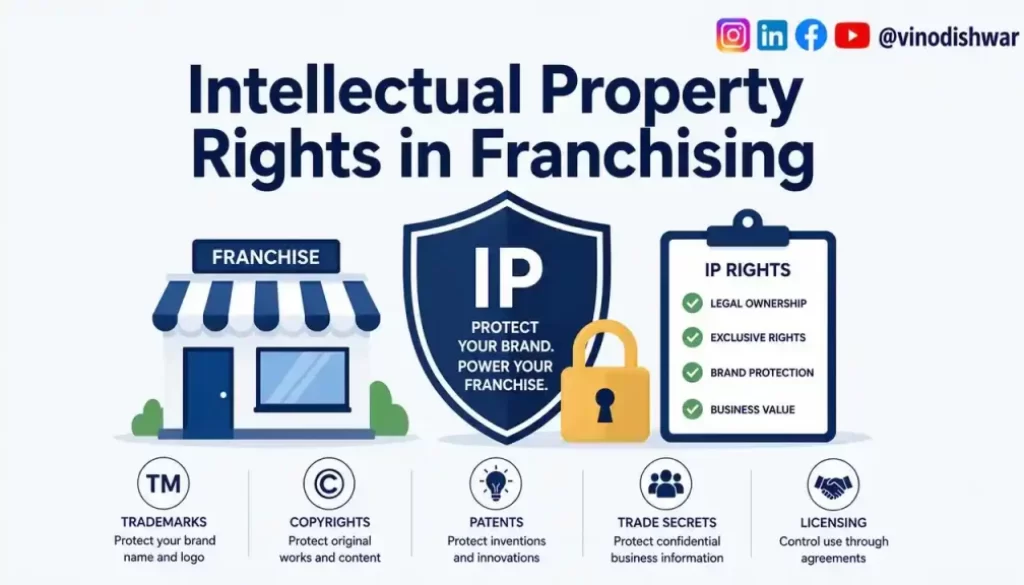
In franchising, relevant IP may include:
- Trademarks
- Copyright
- Trade secrets
- Patents
- Designs
- Domain names
- Software
- Brand guidelines
- Operations manuals
- Recipes and formulas
- Marketing materials
- Proprietary business systems
The exact protection available depends on the nature of the asset and applicable law.
A franchise relationship often involves licensing or permitting the franchisee to use the franchisor’s IP for a defined business purpose.
Why IP Rights Matter to Franchise Businesses
A franchisee is often paying for the ability to operate under an established brand and business system.
Without strong IP management, a franchisor could face:
- Unauthorized brand use
- Copying of proprietary systems
- Brand dilution
- Loss of confidential information
- Customer confusion
- Franchise disputes
- Competitive imitation
Effective IP management helps preserve the value of the franchise network.
1. Trademark Rights
Trademarks are often the most visible form of franchise intellectual property.
They may include:
- Brand names
- Logos
- Taglines
- Product names
- Service marks
- Distinctive symbols
Trademark rights help identify the source of goods or services and protect brand identity.
In India, trademarks are primarily governed by the Trade Marks Act, 1999.
Before franchising, businesses should consider appropriate searches, ownership, registration and licensing arrangements.
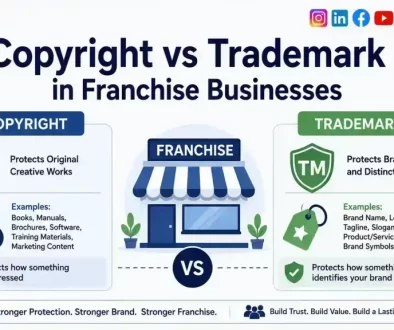
2. Copyright Rights
Copyright may protect original creative works used in the franchise.
Examples include:
- Website content
- Photography
- Videos
- Advertising material
- Training content
- Franchise manuals
- Graphics
- Software
- Written materials
Franchisors should establish who owns commissioned content and how franchisees are permitted to use it.
This is particularly important when third-party agencies create websites, advertisements or marketing assets.
3. Trade Secrets and Confidential Information
Some of the most valuable franchise IP may not be registered.
Examples include:
- Recipes
- Formulas
- Supplier information
- Customer databases
- Pricing methods
- Marketing strategies
- Operating techniques
- Business processes
Confidentiality agreements and franchise contract provisions can help protect this information.
Franchisees should also be trained to understand what information is confidential and how it must be handled.
4. Patents and Designs
Certain franchise businesses may have patentable inventions or protectable designs.
These may be particularly relevant to businesses involving:
- Manufacturing
- Food technology
- Equipment
- Proprietary products
- Technical processes
- Innovative devices
Not every franchise needs patent protection, but emerging brands should identify whether their business contains valuable technical innovations.
5. Software and Technology
Technology is increasingly important in franchise operations.
IP may exist in:
- POS systems
- Mobile applications
- Websites
- CRM platforms
- Franchise management software
- Proprietary algorithms
- Databases
- Digital tools
The franchise agreement should clarify whether the franchisee receives:
- A licence
- Subscription access
- Limited-use rights
- Access to third-party software
It should also address what happens to access when the franchise relationship ends.
6. Franchise Manuals and Operating Systems
A franchise manual can contain years of accumulated business knowledge.
It may cover:
- Store operations
- Customer service
- Quality standards
- Staff training
- Inventory
- Procurement
- Technology
- Marketing
- Safety
The franchisor should maintain control over these materials and define the franchisee’s permitted access and use.
Unauthorized copying or distribution can undermine the value of the franchise system.
7. Franchisee Rights to Use Intellectual Property
Franchisees need IP rights to operate the business.
However, those rights are usually limited by the franchise agreement.
The agreement should define:
- What IP may be used
- Where it may be used
- How it may be used
- Duration of use
- Approved products or services
- Brand standards
- Modification restrictions
- Approval requirements
This creates a balance between franchisee operational rights and franchisor IP ownership.
8. Franchisor Rights and Responsibilities
The franchisor should maintain appropriate control over its intellectual property.
Responsibilities may include:
- Protecting important trademarks
- Maintaining brand standards
- Monitoring unauthorized use
- Updating brand guidelines
- Controlling proprietary information
- Taking appropriate action against infringement
The franchisor should also ensure that it actually has the rights it claims to license.
9. IP Clauses in a Franchise Agreement
A strong franchise agreement should address intellectual property comprehensively.
Relevant provisions may cover:
Ownership
Who owns each IP asset?
Licence
What rights does the franchisee receive?
Restrictions
What uses are prohibited?
Quality Control
What standards must the franchisee follow?
Confidentiality
What information must remain confidential?
Infringement
What should happen if unauthorized use is discovered?
Termination
What happens to IP rights after the franchise ends?
Clear clauses can reduce uncertainty and potential disputes.
10. Protecting IP Across the Franchise Network
As a franchise network grows, IP monitoring becomes increasingly important.
Franchisors can conduct periodic reviews of:
- Store signage
- Packaging
- Websites
- Social media
- Advertising
- Promotional materials
- Digital listings
A centralized approval process can help prevent unauthorized modifications.
This is especially important for multi-location franchise brands where inconsistent branding can quickly become visible to customers.
11. Intellectual Property After Franchise Termination
The franchisee’s right to use the franchisor’s IP generally needs to end or change according to the franchise agreement.
Post-termination requirements may include:
- Removing trademarks
- Removing signage
- Stopping use of branded materials
- Returning manuals
- Deleting confidential information
- Ending software access
- Removing digital branding
- Stopping representation as an authorized franchisee
A detailed exit process can help protect the brand after the relationship ends.
Common IP Mistakes in Franchising
Franchisors should avoid:
- Failing to establish IP ownership
- Not protecting important trademarks
- Using unclear licence provisions
- Sharing confidential information without safeguards
- Allowing unauthorized brand modifications
- Ignoring software ownership
- Failing to monitor franchisee usage
- Overlooking third-party IP rights
- Not addressing post-termination obligations
Franchise IP Rights Checklist
Before franchising, review:
- Trademark ownership
- Trademark registration strategy
- Copyright ownership
- Confidential information
- Trade secrets
- Patents and designs where relevant
- Software and technology rights
- Franchise manual ownership
- IP licensing provisions
- Brand guidelines
- Franchisee restrictions
- IP monitoring
- Infringement process
- Post-termination requirements
How Franchise Alpha Can Help
Intellectual property should be integrated into the overall franchise development strategy.
Franchise Alpha helps businesses build structured franchise systems covering:
- Franchise strategy
- Franchise model development
- Franchise documentation
- Brand development
- Franchise marketing
- Lead generation
- Franchise sales
- Operations manuals
- Franchisee training
- Ongoing support
Trademark registration, copyright matters, IP licensing and legal enforcement should be handled or reviewed by qualified intellectual property professionals.
Frequently Asked Questions
What are intellectual property rights in franchising?
They are the legal rights associated with trademarks, copyrights, trade secrets, patents, designs, software and other qualifying intellectual property used within a franchise system.
Does a franchisee own the franchisor’s intellectual property?
Generally, no. The franchisee usually receives defined rights or a licence to use specified IP while operating the franchise.
Why are trademarks important in franchising?
Trademarks help protect the brand identity customers associate with the franchise and allow the franchisor to control authorized brand usage.
Can franchise manuals be considered intellectual property?
Original franchise manuals may contain copyright-protected content and confidential business information. The exact protection depends on the material and applicable law.
What happens to IP rights after franchise termination?
The franchisee will generally have to stop using the franchisor’s IP and comply with the post-termination requirements established in the franchise agreement.
Conclusion
Intellectual property rights are fundamental to the value and scalability of a franchise business.
Franchisors need to identify their IP, establish ownership, protect valuable assets and provide franchisees with clearly defined rights to use them.
At the same time, franchisees need to understand that access to a brand, operating system or proprietary technology does not necessarily mean ownership.
The strongest franchise systems create a clear balance between IP protection, franchisee access, brand consistency and contractual control.
When these rights are properly structured from the beginning, franchisors can protect their brand while giving franchisees the tools they need to operate successfully. Visit Franchise Alpha and Webs Alpha
Protect the IP Behind Your Franchise
Franchise Alpha helps businesses develop franchise models, documentation, marketing, operations and scalable growth systems.
Protect your intellectual property. Strengthen your franchise system. Build a brand that can scale.