How to Register a Trademark Before Franchising
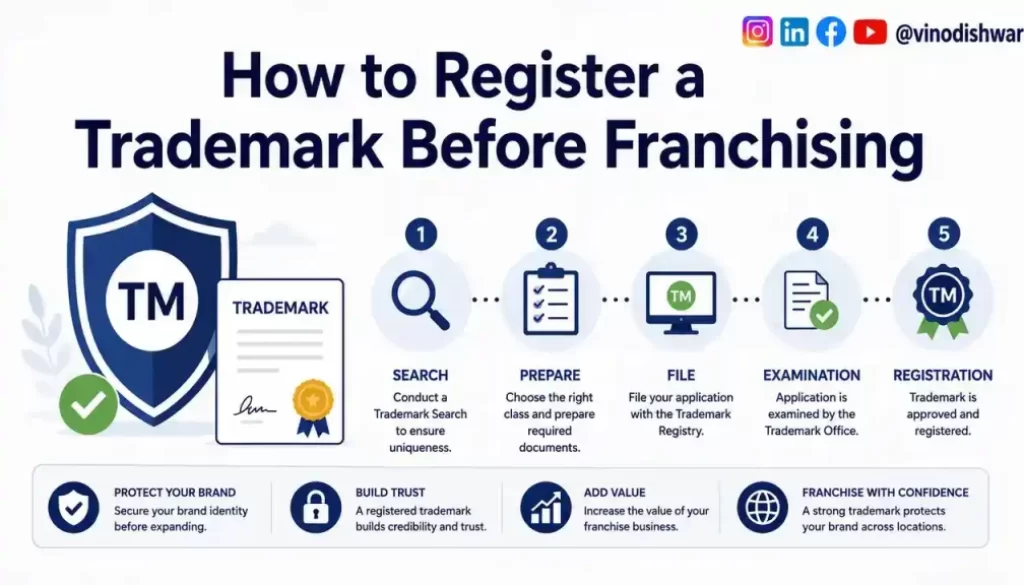
Register a Trademark Before Franchising is an important step for businesses preparing to build a franchise network. A strong brand is one of the most valuable assets in a franchise business because franchisees invest not only in a business model but also in the right to operate under a recognized brand name and use its associated intellectual property. Taking the right trademark steps early can help protect the brand, reduce ownership risks and create a stronger foundation for franchise expansion.
A strong brand is one of the most valuable assets in a franchise business. Franchisees invest not only in a business model but also in the right to operate under a recognized brand name and use its associated intellectual property.
That is why registering a trademark before franchising should be an important part of franchise preparation.
A franchisor that has not properly protected its brand may face ownership disputes, infringement claims, rebranding costs, or difficulties licensing the brand to franchisees.
For businesses planning to franchise in India, the process should ideally begin well before franchise recruitment.
Why Register a Trademark Before Franchising?
Franchising involves allowing independent businesses to operate using your brand.
Before granting those rights, the franchisor should have clarity over its own intellectual property.
Trademark registration can help a business:
- Establish legal rights in the registered mark
- Strengthen brand protection
- Support licensing arrangements
- Deter unauthorized use
- Increase brand value
- Reduce rebranding risks
- Provide greater confidence to franchise investors
Consider a business that recruits 30 franchisees before discovering a serious conflict with its brand name.
Changing the name at that stage could affect:
- Store signage
- Packaging
- Websites
- Advertising
- Franchise agreements
- Customer recognition
- Franchisee investments
Early trademark planning can help reduce this risk.
Step 1: Identify What Needs Trademark Protection
Start by identifying the brand assets that are commercially important.
These may include:
- Main brand name
- Logo
- Tagline
- Product names
- Service names
- Sub-brands
- Distinctive symbols
Do not assume that registering a logo automatically provides the same protection as registering the underlying word mark.
A trademark professional can help determine which marks should be protected based on the business strategy.
Step 2: Conduct a Trademark Search
Before filing an application, conduct an appropriate trademark search.
The purpose is to identify existing marks that may be similar or potentially conflicting.
Consider similarities in:
- Spelling
- Pronunciation
- Meaning
- Appearance
- Goods or services
- Overall commercial impression
A professional search should go beyond simply checking whether the exact brand name appears in a database.
This stage can help identify potential problems before significant money is invested in franchise branding.
Step 3: Select the Appropriate Trademark Classes
Trademark protection is linked to specific goods and services.
India follows the Nice Classification system, which categorizes goods and services into 45 classes.
For example, depending on the business, relevant areas may include:
- Food and beverage services
- Retail services
- Education
- Hospitality
- Healthcare
- Clothing
- Technology services
Choosing classes requires careful consideration of the current business as well as planned expansion.
For a franchising business, it can be particularly important to consider whether the proposed protection adequately covers the brand’s actual and intended commercial activities.
Step 4: Confirm Trademark Ownership
Before filing, establish who should own the trademark.
The owner could be:
- An individual founder
- A partnership
- A private limited company
- An LLP
- Another appropriate legal entity
This decision matters because the entity granting trademark rights to franchisees should have a clear legal basis for doing so.
If the operating company and trademark owner are different entities, appropriate licensing or assignment arrangements may be necessary.
Professional legal advice is recommended when determining ownership structure.
Step 5: Prepare the Trademark Application
The application generally includes information such as:
- Applicant details
- Trademark representation
- Goods or services
- Relevant class
- Supporting information where applicable
Depending on the mark, the application may relate to a word mark, device/logo mark, or another appropriate category.
Accuracy at the filing stage can help avoid unnecessary complications later.
Step 6: File the Application
Trademark applications in India are filed with the Indian Trade Marks Registry under the applicable trademark framework.
Once properly filed, the application enters the examination process.
Businesses should retain their application details and monitor the status throughout the process.
Importantly, filing an application and receiving a registration are not the same thing.
The trademark should not be treated as fully registered merely because an application has been submitted.
Step 7: Understand Trademark Examination
After filing, the application may be examined by the Trade Marks Registry.
An examination report may raise objections based on applicable grounds.
The applicant may need to:
- Review the objection
- Prepare a response
- Provide supporting evidence
- Attend a hearing where required
The appropriate response depends on the specific objection.
A trademark professional can help determine the best strategy.
Step 8: Handle Opposition Proceedings
After the application is published in the appropriate trademark journal, third parties may have an opportunity to oppose it within the applicable statutory period.
If an opposition is filed, the applicant may need to respond through the prescribed legal process.
This is one reason why conducting a strong trademark search before filing is valuable.
Step 9: Obtain Registration
If the application successfully completes the applicable process without unresolved opposition or objection, the trademark may be registered.
The registration provides important legal protection within the scope of the registered mark and applicable goods or services.
Once registered, maintain records of:
- Registration number
- Classes
- Owner
- Renewal date
- Related marks
- Licensing arrangements
Step 10: Build Trademark Protection Into the Franchise Agreement
Trademark registration is only one part of franchise brand protection.
The franchise agreement should clearly address the franchisee’s right to use the trademark.
It should cover:
- Approved trademark use
- Territory
- Business purpose
- Brand standards
- Advertising
- Digital usage
- Restrictions
- Approval procedures
- Infringement reporting
- Post-termination obligations
The franchisee should understand that they are receiving permission to use the brand, not ownership of the franchisor’s trademark.
Step 11: Protect the Trademark Across Digital Channels
Modern franchise brands also need to consider digital identity.
Secure and monitor:
- Domain names
- Social media handles
- Websites
- Mobile applications
- Online marketplaces
- Digital advertising accounts
A consistent digital identity can help reinforce the brand and reduce customer confusion.
Common Trademark Mistakes Before Franchising
Avoid these mistakes:
- Choosing a brand without conducting a proper search
- Filing only the logo when the name also requires protection
- Selecting inappropriate classes
- Failing to establish ownership clearly
- Franchising before addressing trademark risks
- Assuming filing equals registration
- Ignoring objections or oppositions
- Allowing inconsistent trademark usage
- Failing to include IP provisions in franchise agreements
Trademark Registration Checklist
Before launching franchise recruitment:
- Identify important brand assets
- Conduct a trademark search
- Evaluate potential conflicts
- Select appropriate classes
- Confirm trademark ownership
- Prepare the application
- File with the Trade Marks Registry
- Monitor examination
- Respond to objections if required
- Monitor opposition proceedings
- Obtain registration where successful
- Include trademark licensing provisions in the franchise agreement
- Create brand usage guidelines
- Monitor unauthorized use
How Franchise Alpha Can Help
Trademark registration should be integrated into the wider franchise development process.
Franchise Alpha helps businesses develop franchise systems covering:
- Franchise strategy
- Franchise model development
- Franchise documentation
- Brand development
- Franchise marketing
- Franchise lead generation
- Investor qualification
- Franchise sales
- Operations manuals
- Franchisee training
- Ongoing support
Trademark searches, applications, legal opinions and trademark disputes should be handled or reviewed by qualified trademark and intellectual property professionals.
Frequently Asked Questions
Should I register my trademark before franchising?
Ideally, important brand assets should be evaluated and appropriate trademark protection pursued before significant franchise expansion.
Can I franchise while my trademark application is pending?
A business may be able to operate and structure a franchise while an application is pending, but the legal position and risks depend on the circumstances. Professional legal advice is recommended before granting trademark rights to franchisees.
How long does trademark registration take in India?
The timeline can vary considerably depending on examination, objections, opposition and other procedural factors. There is no single guaranteed registration timeline.
Should I trademark my brand name and logo separately?
Depending on the business strategy, both the word mark and logo/device mark may warrant separate protection. A trademark professional can advise on the appropriate filing strategy.
What happens if another business already has a similar trademark?
The appropriate response depends on the similarity, classes, dates, use, geographic considerations and other legal factors. A professional trademark assessment should be obtained before proceeding.
Conclusion
Registering a trademark before franchising is an important step in protecting the foundation of a franchise brand.
Before recruiting franchisees, businesses should identify their important intellectual property, conduct appropriate searches, select relevant classes, establish ownership and pursue suitable trademark protection.
But registration alone is not enough. Visit Franchise Alpha and Webs Alpha
A strong franchise IP strategy also requires clear licensing provisions, brand guidelines, monitoring, enforcement procedures and post-termination controls.
Protecting the brand before scaling can help franchisors build investor confidence while reducing the risk of expensive brand disputes later.
Prepare Your Brand for Franchise Expansion
Franchise Alpha helps businesses build structured franchise models, documentation, marketing, operations and growth systems for sustainable expansion.
Protect your trademark. Strengthen your franchise. Scale your brand with confidence.