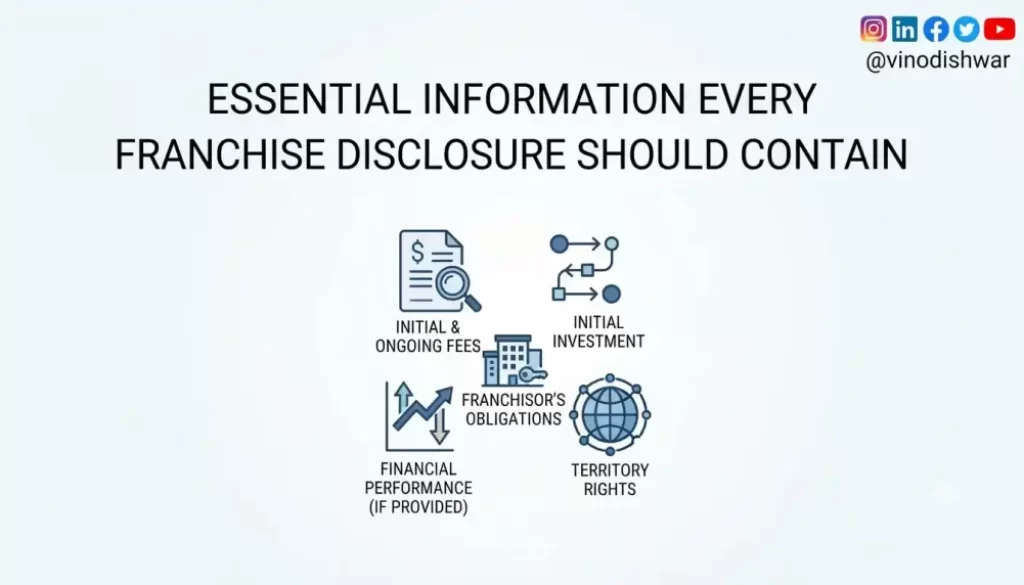
Essential Information Every Franchise Disclosure Should Contain
Franchise disclosure information gives prospective franchisees the details they need to evaluate a franchise opportunity before investing. A franchisee is not simply buying a brand name; they are entering a structured business relationship involving investment, intellectual property, operational standards, contractual obligations, fees, territory, support and ongoing compliance.
They are entering into a structured business relationship involving investment, intellectual property, operational standards, contractual obligations, fees, territory, support and ongoing compliance.
That is why franchise disclosure is such an important part of the franchise sales process.
A well-prepared disclosure should give a prospective franchisee enough relevant information to understand the opportunity and conduct meaningful due diligence before making an investment decision.
For Indian franchisors, there is an important distinction: India does not currently have a single comprehensive central franchise law requiring every franchisor to issue a standardized Franchise Disclosure Document (FDD) equivalent to the U.S. model. However, a structured disclosure framework can still be an important best practice for transparency, consistency and risk management.
The information below provides a practical framework for what a comprehensive franchise disclosure should contain.
Legal disclaimer: This article is for educational purposes only and does not constitute legal, financial, tax or investment advice. Disclosure requirements vary according to jurisdiction, business structure, industry and transaction. Franchise documents should be reviewed by appropriately qualified professionals.
Why Is Franchise Disclosure Important?
Franchise disclosure helps close the information gap between the franchisor and prospective franchisee.
Before investing, a franchisee should understand:
- Who owns the franchise
- How the business operates
- How much it costs
- What fees apply
- What support is provided
- What the franchisee must do
- What risks exist
- How the territory works
- How renewal works
- How termination works
- How the franchise can be transferred
- What financial information is available
A good disclosure process is therefore not simply about protecting the franchisor or franchisee.
It is about creating clear expectations before the relationship begins.
1. Franchisor Information
Every franchise disclosure should clearly identify the entity offering the franchise.
This can include:
- Legal company name
- Registered office
- Ownership structure
- Parent companies
- Affiliates
- Brand history
- Business history
- Management team
- Relevant industry experience
- Corporate structure
A prospective franchisee should know exactly who they are contracting with.
Questions to answer:
- Who owns the brand?
- How long has the business operated?
- Who manages the franchise network?
- Which legal entity signs the franchise agreement?
2. Franchise Brand Information
The disclosure should explain the brand itself.
Include:
- Brand name
- Products or services
- Target market
- Brand positioning
- Customer profile
- Competitive advantage
- Business format
- Franchise history
This gives the franchisee context for evaluating the opportunity.
A franchisee should understand not only what the brand sells, but also why customers choose it.
3. Franchise Business Model
The disclosure should explain how the franchise actually makes money.
Include:
- Revenue sources
- Products/services
- Pricing model
- Sales channels
- Customer acquisition model
- Store/service format
- Operating hours
- Staffing model
- Technology
- Procurement
- Marketing
For example, a restaurant franchise may generate revenue through dine-in, takeaway, delivery and catering.
A service franchise may generate revenue through subscriptions, appointments or project-based services.
Understanding the revenue model is essential before evaluating financial projections.
4. Initial Investment
One of the most important sections should be the total estimated investment.
It may include:
| Investment Component | Estimated Amount |
|---|---|
| Franchise Fee | ₹X |
| Property Deposit | ₹X |
| Interiors | ₹X |
| Equipment | ₹X |
| Technology | ₹X |
| Initial Inventory | ₹X |
| Licences & Professional Fees | ₹X |
| Pre-Opening Marketing | ₹X |
| Training | ₹X |
| Working Capital | ₹X |
| Estimated Total | ₹X |
The disclosure should distinguish between:
Mandatory costs
and
Estimated or optional costs.
This prevents a prospective franchisee from evaluating the opportunity using an unrealistically low headline investment.
5. Franchise Fee
The disclosure should clearly explain the initial franchise fee.
Include:
- Amount
- Payment timing
- Taxes
- Refundability
- What the fee covers
- Whether the fee varies by format or territory
For example, a franchise fee may provide access to:
- Brand IP
- Training
- SOPs
- Initial support
- Franchise development assistance
The franchisee should know exactly what they receive in return.
6. Recurring Fees
The initial franchise fee is only one part of franchise economics.
Disclosure should cover recurring costs such as:
- Royalty
- Marketing contribution
- Technology fee
- Software fee
- Renewal fee
- Audit fee
- Training fee
- Transfer fee
- Procurement-related charges
- Other mandatory charges
The franchisee should calculate the total ongoing cost of operating the franchise.
7. Royalty Structure
Royalty calculations should be clearly explained.
Possible structures include:
- Percentage of gross sales
- Fixed monthly fee
- Minimum monthly royalty
- Hybrid fee structure
The disclosure should explain:
- Calculation basis
- Payment frequency
- Reporting requirements
- Taxes
- Minimum fees
- Late-payment consequences
Unclear royalty structures can create significant disputes later.
8. Territory and Exclusivity
Territory is one of the most commercially important elements of a franchise.
The disclosure should explain:
- Geographic territory
- Protected territory
- Exclusive territory
- Non-exclusive territory
- Radius restrictions
- Online sales
- Delivery areas
- Corporate sales
- Future franchise locations
Avoid vague statements such as:
“You will receive an exclusive area.”
Instead, explain exactly what exclusivity means.
9. Location Requirements
For location-dependent franchises, disclosure should explain:
- Minimum area
- Preferred location
- Footfall requirements
- Parking requirements
- Visibility
- Demographics
- Catchment area
- Rental considerations
- Site approval process
It should also explain whether the franchisor has the final authority to approve the site.
10. Training
Franchisees need to know what training they will receive.
Disclosure can specify:
Initial Training
- Duration
- Location
- Participants
- Curriculum
- Assessment
Pre-Opening Training
- Staff training
- Operations
- Technology
- Customer service
Ongoing Training
- Refresher programs
- New product training
- Technology updates
- Compliance training
The more specific the training description, the clearer the franchisee’s expectations.
11. Ongoing Support
“Complete support” is too vague.
A disclosure should explain actual support, such as:
- Operations support
- Marketing
- Site support
- Technology
- Procurement
- Recruitment
- Training
- Quality audits
- New product development
- Business reviews
The disclosure should distinguish between:
Support the franchisor commits to provide
and
Support that may be available at additional cost.
12. Franchisee Obligations
The franchisee should understand their responsibilities.
These can include:
- Maintaining operating standards
- Hiring staff
- Completing training
- Purchasing approved products
- Following SOPs
- Maintaining records
- Paying fees
- Participating in marketing
- Using approved technology
- Maintaining insurance
- Complying with applicable laws
This section should align with the actual franchise agreement.
13. Products and Services
The disclosure should explain exactly what the franchisee is permitted to sell.
Include:
- Approved products
- Approved services
- Product categories
- Pricing controls
- Product changes
- Seasonal offerings
- New products
- Restrictions
Franchisors may restrict products to maintain quality and brand consistency.
14. Supplier and Procurement Requirements
Some franchises require franchisees to purchase from approved suppliers.
Disclosure should explain:
- Approved suppliers
- Mandatory suppliers
- Procurement process
- Quality standards
- Minimum orders
- Pricing arrangements
- Logistics
- Alternative suppliers
This is important because procurement requirements can materially affect operating margins.
15. Technology Requirements
Modern franchises often rely heavily on technology.
Disclosure can identify required systems such as:
- POS
- CRM
- ERP
- Accounting software
- Booking systems
- Mobile applications
- Franchise management software
- Reporting dashboards
Also clarify:
- Setup cost
- Subscription cost
- Hardware requirements
- Maintenance
- Data ownership
- Upgrade requirements
16. Marketing Obligations
The franchisee should understand how brand marketing works.
Disclosure should cover:
- National marketing
- Local marketing
- Marketing fund
- Digital marketing
- Social media
- Advertising approvals
- Brand assets
- Local campaigns
If franchisees must contribute to a marketing fund, explain:
- Contribution amount
- Payment frequency
- Permitted use
- Administration
- Reporting, where applicable
17. Intellectual Property
Franchising depends heavily on intellectual property.
Disclosure should identify relevant:
- Trademarks
- Logos
- Copyrights
- Trade secrets
- Proprietary processes
- Manuals
- Software
- Brand assets
The franchisee should understand that receiving permission to use a trademark does not generally mean acquiring ownership of that trademark.
In India, trademark protection is principally governed by the Trade Marks Act, 1999.
18. Franchise Term
The disclosure should clearly state:
- Initial franchise term
- Start date
- Expiry
- Renewal process
- Conditions for renewal
The franchisee should understand the expected duration of the business relationship.
19. Renewal Conditions
Renewal should never be assumed to be automatic.
Disclosure should explain:
- Whether renewal is available
- Renewal fee
- Performance conditions
- Updated agreement requirements
- Refurbishment requirements
- Notice period
- Compliance requirements
The actual franchise agreement should contain the binding terms.
20. Termination
The disclosure should explain circumstances that could lead to termination.
Potential reasons include:
- Non-payment
- Material breach
- Fraud
- Brand misuse
- Regulatory violations
- Unauthorized transfer
- Repeated operational failures
Also explain:
- Notice requirements
- Cure periods
- Immediate termination situations
- Post-termination obligations
21. Transfer and Exit Rights
A franchisee may eventually want to sell the business.
Disclosure should explain:
- Whether transfer is allowed
- Approval requirements
- Transfer fee
- Buyer qualification
- Training requirements
- Right of first refusal, where applicable
- Post-transfer obligations
Exit planning should be considered before investing, not after problems arise.
22. Financial Performance Information
Financial information can be one of the most important—and most sensitive—parts of disclosure.
Where financial performance information is provided, clearly distinguish:
Historical Data
Actual results from existing locations.
Illustrative Model
A model based on stated assumptions.
Projection
An estimate of possible future performance.
Never blur these categories.
A statement such as:
“Illustrative revenue model based on stated assumptions”
is very different from:
“Every franchise will generate ₹10 lakh per month.”
Financial claims should be supportable and professionally reviewed where appropriate.
23. Break-Even and Payback Assumptions
If a franchisor provides break-even or payback estimates, the disclosure should explain the assumptions.
For example:
Break-even = Fixed Costs ÷ Contribution Margin
The model may depend on:
- Revenue
- Rent
- Staff
- Utilities
- Marketing
- Royalty
- Gross margin
- Working capital
A franchisee should understand that estimated payback periods are not guarantees.
24. Risks and Challenges
A credible disclosure should discuss material risks.
These may include:
- Market competition
- Location risk
- High rent
- Labour costs
- Supply chain disruption
- Seasonality
- Regulatory changes
- Customer demand
- Technology dependence
- Economic conditions
A franchise opportunity should not be presented as risk-free.
25. Litigation and Legal Matters
Where relevant, disclosure should address material legal matters involving the franchisor.
Potential areas include:
- Significant litigation
- Regulatory disputes
- Intellectual property disputes
- Contractual disputes
The exact disclosure requirements depend on the applicable legal framework.
26. Existing Franchise Network
Prospective franchisees should understand the size and development of the franchise network.
Information may include:
- Total locations
- Company-owned locations
- Franchise-owned locations
- New locations
- Closed locations
- Locations under development
Network data can provide useful context when evaluating the maturity of the franchise system.
27. Existing and Former Franchisees
Providing appropriate franchisee references can support due diligence.
Prospective franchisees may ask:
- How accurate was the investment estimate?
- How useful was the training?
- Was support adequate?
- Were there unexpected expenses?
- How long did the outlet take to stabilize?
- Would the franchisee invest again?
Franchisee feedback should complement—not replace—independent due diligence.
28. Insurance Requirements
The disclosure should identify required insurance where applicable.
Examples may include:
- Property insurance
- Public liability insurance
- Employee-related coverage
- Business interruption insurance
- Product liability insurance
The franchisee should understand who is responsible for obtaining and paying for the required coverage.
29. Regulatory and Compliance Requirements
Depending on the industry, a franchise may require:
- Business licences
- Food licences
- Trade licences
- Fire approvals
- Labour registrations
- Professional licences
- Sector-specific permits
- Tax registrations
The disclosure should clearly identify which compliance responsibilities belong to the franchisor and which belong to the franchisee.
30. Dispute Resolution
The disclosure should direct the prospective franchisee to the applicable contractual provisions regarding:
- Governing law
- Jurisdiction
- Arbitration
- Mediation
- Courts
- Notice procedures
These provisions should be consistent with the actual franchise agreement.
31. Post-Termination Obligations
A franchise relationship does not necessarily end when the agreement terminates.
The franchisee may have obligations involving:
- Removing branding
- Returning manuals
- Returning equipment
- Discontinuing trademark use
- De-branding premises
- Confidentiality
- Outstanding payments
- Customer information
- Non-solicitation or other contractual restrictions, where legally applicable
These obligations should be clearly understood before signing.
32. Franchise Agreement and Other Contracts
The disclosure should identify the key documents that the franchisee may need to sign.
These may include:
- Franchise agreement
- Development agreement
- Trademark licence
- Lease agreement
- Supplier agreement
- Technology agreement
- Personal guarantee
- Marketing agreement
The franchisee should review the actual contracts rather than relying solely on summaries.
Franchise Disclosure for Indian Franchisors
Because India does not currently have a universal statutory FDD requirement, Indian franchisors should focus on building a legally appropriate disclosure framework rather than simply copying a foreign FDD.
A practical Indian disclosure pack can include:
- Franchisor information
- Business model
- Investment
- Fees
- Territory
- Training
- Support
- Operations
- Financial assumptions
- Risks
- Intellectual property
- Franchise agreement summary
- Renewal
- Termination
- Transfer
- Compliance
The exact contents should be tailored to the franchise model and reviewed by qualified legal counsel.
Common Franchise Disclosure Mistakes
1. Giving Only the Franchise Fee
A ₹10 lakh franchise fee does not necessarily mean a ₹10 lakh investment.
2. Hiding Working Capital
Working capital can be essential to surviving the initial operating period.
3. Using Guaranteed Income Claims
Projected revenue is not guaranteed income.
4. Vague Territory
“Exclusive territory” should have a clear contractual meaning.
5. Promising Unlimited Support
Support should be defined.
6. Ignoring Exit Conditions
Franchisees should understand transfer and termination before investing.
7. Contradictory Marketing
The website, brochure and sales team should not provide conflicting information.
8. Using Outdated Financial Data
Old performance data can produce unrealistic expectations.
9. Copying a Foreign FDD
A U.S.-style FDD should not automatically be treated as an Indian legal document.
10. Failing to Train Sales Teams
Even an excellent disclosure document can be undermined by inaccurate verbal representations.
Franchise Disclosure Checklist for Franchisors
Before presenting a franchise opportunity:
Company
- Corporate information updated
- Brand ownership verified
- Management information updated
Investment
- Franchise fee confirmed
- Total setup cost calculated
- Working capital included
- Recurring costs identified
Operations
- Training defined
- Support defined
- Procurement explained
- Technology requirements documented
Territory
- Territory defined
- Exclusivity explained
- Online sales addressed
- Expansion policy documented
Financial
- Historical data verified
- Projections labelled
- Assumptions documented
- Risks explained
Legal
- Franchise agreement reviewed
- IP ownership checked
- Renewal explained
- Termination explained
- Transfer explained
Marketing
- Website claims reviewed
- Advertising claims reviewed
- Sales scripts aligned
- Investor presentations aligned
Franchise Disclosure Checklist for Franchisees
Before investing:
- Read the complete disclosure
- Read the franchise agreement
- Verify total investment
- Calculate working capital
- Understand all recurring fees
- Review territory
- Review support
- Review supplier requirements
- Review renewal
- Review termination
- Review transfer rights
- Examine financial assumptions
- Speak with existing franchisees
- Research the local market
- Obtain professional legal advice
How Franchise Alpha Can Help
Building a strong franchise disclosure framework requires alignment across the entire franchise system.
At Franchise Alpha, businesses can develop structured franchise systems covering:
Franchise Strategy
- Franchise feasibility
- Franchise model development
- Unit economics
- Investment structure
Franchise Development
- Franchise package development
- Franchise documentation
- Territory strategy
- Franchisee qualification
Franchise Marketing
- Franchise recruitment
- Investor marketing
- Digital marketing
- Lead generation
Franchise Sales
- Lead qualification
- Discovery process
- Franchise sales funnel
- Investor communication
Franchise Operations
- SOP development
- Operations manuals
- Training
- Franchisee support
Legal documentation and legal opinions should be prepared or reviewed by appropriately qualified legal professionals.
Frequently Asked Questions
What information should a franchise disclosure contain?
A comprehensive franchise disclosure should explain the franchisor, business model, investment, fees, territory, training, support, franchisee obligations, intellectual property, financial information, risks, renewal, termination, transfer and other material contractual and commercial information.
Is there a standard franchise disclosure format in India?
India does not currently have a single comprehensive statutory FDD format applicable to every franchise. Businesses can create structured disclosure frameworks tailored to their franchise model and applicable laws.
Should franchise investment include working capital?
Yes. A realistic investment estimate should identify working capital separately where applicable because it can be a significant part of the capital required to operate the franchise during its early stages.
Should franchise financial projections be included?
They may be included where appropriate, but financial projections should be clearly identified, supported by reasonable assumptions and not presented as guaranteed results.
Should franchise territory be disclosed?
Yes. Territory, exclusivity and restrictions can materially affect franchise economics and should be clearly explained.
Should existing franchisees be disclosed?
Where appropriate, information about the franchise network and opportunities to contact existing or former franchisees can support meaningful due diligence.
Should franchise risks be disclosed?
A credible franchise disclosure should address material risks that could affect the franchisee’s decision. The purpose is to provide a balanced understanding of the opportunity.
Conclusion
Every franchise disclosure should answer one fundamental question:
“What does a prospective franchisee need to know before deciding whether to invest?”
That means going beyond the franchise fee and brand presentation.
A strong disclosure should provide a clear picture of:
The franchisor → The business model → The investment → The fees → The territory → The support → The obligations → The financial assumptions → The risks → The contract → The exit options.
For Indian franchisors, the absence of a universal statutory FDD requirement does not eliminate the value of transparency.
A structured disclosure framework can help create:
- Better-qualified franchise leads
- More informed franchisees
- Consistent sales communication
- Stronger investor confidence
- Fewer misunderstandings
- Better long-term franchise relationships
The best franchise disclosure does not simply make an opportunity look attractive. It makes the opportunity understandable. Visit Franchise Alpha and Webs Alpha
Call to Action
Building a Franchise Business?
Create a professional franchise system with:
Clear Investment Structure + Transparent Disclosure + Strong Documentation + Qualified Franchisees + Scalable Marketing + Reliable Operations
Franchise Alpha helps businesses develop franchise models, franchise documentation, franchise marketing, lead generation, franchise sales systems and operational frameworks.
Build a Franchise Business Investors Can Understand and Trust.
Book a Franchise Strategy Session.