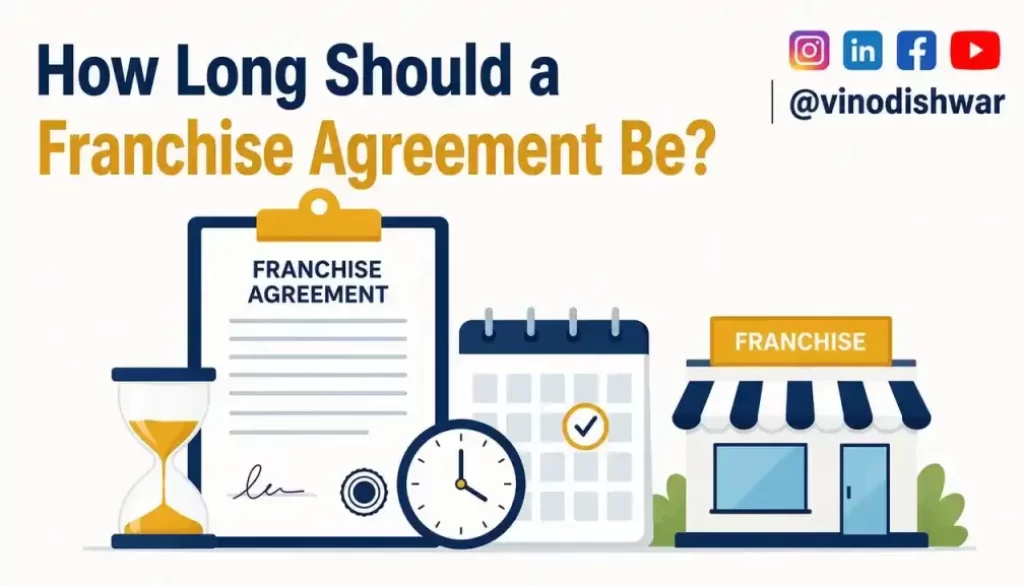
How Long Should a Franchise Agreement Be?
The length of a franchise agreement is one of the most important commercial decisions in franchise structuring.
A franchise agreement that is too short may make it difficult for the franchisee to recover the initial investment and build a profitable business.
A term that is too long may reduce flexibility for the franchisor and make it harder to adapt the franchise system to changing market conditions.
So, how long should a franchise agreement be?
There is no universal answer.
The appropriate term depends on factors such as:
- Initial investment
- Business model
- Expected payback period
- Industry
- Location
- Equipment requirements
- Brand maturity
- Franchisee economics
- Territory
- Renewal structure
- Technology investment
- Property lease
- Training and setup costs
In India, franchise agreements are primarily contractual arrangements, and their terms should be evaluated against the Indian Contract Act, 1872, as well as other laws relevant to the specific business.
What Is the Term of a Franchise Agreement?
The term is the period during which the franchise agreement remains in force.
For example:
Agreement Date: 1 January 2026
Initial Term: 5 years
Expiry: 31 December 2030
The franchisee receives contractual rights to operate under the franchise system during the agreed term, subject to the agreement’s conditions.
The agreement may then:
- Expire
- Renew
- Be extended
- Be terminated early
- Be transferred, if permitted
How Long Do Franchise Agreements Typically Last?
There is no legally mandated universal franchise term in India.
Commercially, franchise agreements often use multi-year initial terms, with renewal opportunities where the franchisee satisfies specified conditions.
A simplified example:
| Franchise Model | Potential Initial Term |
|---|---|
| Low-investment service business | 3–5 years |
| Retail franchise | 5–7 years |
| Restaurant/café | 5–10 years |
| Education centre | 5–10 years |
| Gym/fitness centre | 5–10 years |
| Large-format franchise | 7–10+ years |
These are illustrative commercial ranges, not legal standards. The right duration should be determined from the economics and contractual structure of the individual franchise.
Why Franchise Agreement Length Matters
The franchise term affects both parties.
For the Franchisee
A longer term can provide:
- More time to recover investment
- Greater operational stability
- Longer customer-building period
- More time to generate returns
For the Franchisor
A defined term provides:
- Periodic review opportunities
- Ability to update contractual arrangements
- Control over renewal decisions
- Flexibility to respond to market changes
The objective is to create a term that is commercially fair and economically rational.
The Most Important Factor: Investment Recovery
One of the strongest factors in determining franchise duration is the investment recovery period.
Suppose a franchisee invests:
₹50 lakh
and expects to recover the investment over:
3 years
A 3-year agreement may leave little room for the franchisee to generate meaningful returns after recovering the initial investment.
A longer term may provide greater economic stability.
A simplified model is:
Initial Investment ↓Business Launch ↓Ramp-Up Period ↓Break-Even ↓Investment Recovery ↓Profit Generation ↓Renewal / Exit
The franchise term should provide sufficient time to move through these stages.
Franchise Agreement Term vs Payback Period
These should not be treated as identical.
Suppose:
- Initial investment = ₹40 lakh
- Expected payback = 4 years
- Initial franchise term = 5 years
The franchisee may have only about one year after payback to generate additional returns before renewal becomes relevant.
A more commercially comfortable structure might provide a longer initial term or clear renewal rights.
However, the exact structure depends on the business model.
What Is a Good Franchise Agreement Term?
A useful principle is:
The franchise term should generally provide enough time for a competent franchisee to recover a reasonable portion of the investment and operate the business profitably, while preserving appropriate renewal and system-control rights for the franchisor.
This means the term should be based on unit economics, not simply a standard number.
7 Factors That Should Determine Franchise Agreement Length
1. Initial Investment
The higher the investment, the more important the term becomes.
Low Investment
A service franchise requiring modest setup costs may work with a shorter term.
High Investment
A restaurant, school, clinic or large retail outlet may require a longer period.
2. Expected Payback Period
Calculate:
Initial Investment ÷ Annual Cash Generation
For example:
- Investment: ₹30 lakh
- Expected annual cash generation: ₹10 lakh
Approximate payback:
3 years
The agreement should be structured with this economic reality in mind.
3. Business Ramp-Up Time
A franchise rarely reaches full performance on day one.
The business may require:
- Site development
- Hiring
- Training
- Marketing
- Customer acquisition
- Local awareness
- Operational stabilization
A franchise agreement should account for this ramp-up period.
4. Asset Life
Asset-heavy businesses may require longer contractual periods.
Examples:
- Restaurant equipment
- Gym equipment
- Manufacturing equipment
- Medical equipment
- Furniture
- Technology infrastructure
If equipment has a useful economic life of several years, the franchise term should be considered alongside the investment cycle.
5. Property Lease
The franchise term should ideally be evaluated alongside the premises arrangement.
For example:
Franchise Agreement: 5 years
Lease: 3 years
This creates uncertainty.
What happens when the property lease ends?
The franchisee may not have secure access to the location for the remainder of the franchise term.
6. Industry
Different industries have different economic cycles.
A small service franchise may become operational quickly.
A school, restaurant, healthcare centre or manufacturing franchise may require:
- Larger investment
- More infrastructure
- Longer setup
- Longer customer acquisition
- Longer break-even periods
Therefore, a standard 3-year term may not be appropriate for every model.
7. Brand and Market Strategy
A newer franchisor may want shorter initial terms with renewal mechanisms to maintain flexibility.
An established franchisor with mature systems may choose longer terms to encourage investment and network stability.
The right approach depends on the brand’s strategy.
Initial Term vs Renewal Term
A franchise agreement commonly needs to distinguish between:
Initial Term
The first contractual period.
Renewal Term
An additional period granted after the initial term, subject to contractual conditions.
For example:
Initial Term2026 ───────────── 2031 ↓ Renewal Review ↓ Renewal Conditions ↓2031 ───────────── 2036Renewal Term
Why Renewal Clauses Matter
A 5-year franchise agreement may not really be a “5-year opportunity” if renewal is uncertain.
The franchisee should understand:
- Is renewal automatic?
- Is renewal optional?
- Who decides?
- What conditions must be met?
- Is there a renewal fee?
- Is a new agreement required?
- Can the franchisor change fees?
- Can territory change?
- Is refurbishment required?
These questions should be answered in the agreement.
How Long Should a Franchise Renewal Be?
Renewal terms can vary.
For example:
Initial Term: 5 years
Renewal: 5 years
or:
Initial Term: 7 years
Renewal: 5 years
or:
Initial Term: 10 years
Renewal: 5 years
There is no universal legally prescribed duration.
The renewal period should reflect the franchise model and investment cycle.
Franchise Agreement Length by Investment Type
A practical way to think about duration is:
| Investment Profile | Typical Consideration |
|---|---|
| Low investment | Shorter term may be viable |
| Moderate investment | Medium-term agreement |
| High investment | Longer term often commercially preferable |
| Heavy infrastructure | Longer term may be necessary |
| Property-intensive | Align with lease economics |
| Technology-intensive | Consider upgrade/replacement cycles |
Again, these are planning considerations, not fixed legal rules.
Franchise Agreement and Break-Even Point
A franchisee should estimate:
Initial Investment
₹40 lakh
Monthly Fixed Costs
₹4 lakh
Expected Monthly Contribution
₹1.5 lakh
Estimated Payback
Approximately 27 months under the simplified assumptions.
But the agreement may need to account for:
- Ramp-up
- Unexpected expenses
- Seasonality
- Working capital
- Reinvestment
- Maintenance
- Marketing
Therefore, the franchise term should not be based on a simplistic payback calculation alone.
Should the Franchise Term Match the Lease?
Ideally, the two should be commercially coordinated.
Consider:
Franchise Agreement: 10 years
Property Lease: 5 years
At the end of Year 5, the franchisee may face significant uncertainty.
Better structures may involve:
- Lease term aligned with franchise term
- Extension options
- Renewal rights
- Landlord consent mechanisms
- Relocation provisions
The exact structure depends on the location and contract.
What Happens When a Franchise Agreement Expires?
Expiration does not necessarily mean the franchise automatically continues.
Possible outcomes include:
1. Renewal
The parties enter a new term.
2. New Agreement
The franchisor requires the franchisee to sign an updated agreement.
3. Non-Renewal
The relationship ends at expiry.
4. Negotiated Extension
The parties agree to extend the existing arrangement.
5. Exit
The franchisee de-brands and leaves the system.
The agreement should explain the process.
Expiry vs Termination
These are different.
Expiry
The agreed term ends.
Termination
The agreement ends before the scheduled expiry due to a contractual or legally recognized mechanism.
For example:
Agreement: 2026–2031
If it ends in 2031 because the term concludes:
Expiry
If it ends in 2028 because a contractual termination mechanism is exercised:
Termination
Can a Franchise Agreement Be Longer Than 10 Years?
It can be structured for longer periods depending on the business model and applicable contractual considerations.
Longer terms may make sense for:
- Large investments
- Infrastructure-heavy businesses
- Long-term property arrangements
- Large-format retail
- Manufacturing
- Education infrastructure
But a very long term can also reduce flexibility.
Therefore, longer does not automatically mean better.
Can a Franchise Agreement Be Only 1 Year?
A one-year franchise term is commercially possible in some structures, but it may not make sense for businesses requiring substantial investment.
A short term can create problems such as:
- Insufficient investment recovery
- Higher uncertainty
- Reduced franchisee confidence
- Difficult financing
- Short customer-building window
Short terms may be more appropriate for specific low-investment or pilot arrangements.
Common Franchise Agreement Duration Mistakes
1. Using the Same Term for Every Franchise
Different franchise models have different economics.
2. Ignoring Payback
A 3-year agreement may be unsuitable for a business with a 5-year investment recovery period.
3. Ignoring the Lease
The franchise term and property term may become misaligned.
4. Making Renewal Unclear
A vague renewal clause can create significant uncertainty.
5. Ignoring Refurbishment Costs
A franchisee may face substantial investment before renewal.
6. Not Addressing New Agreements
The franchisor may require an updated agreement at renewal.
7. Forgetting Transfer Rights
A short remaining term can significantly affect franchise resale value.
8. Making the Agreement Too Rigid
Long-term agreements should allow appropriate system evolution.
9. Not Considering Financing
The term can influence the franchisee’s ability to secure financing.
10. Focusing Only on the Franchisee
The franchisor also needs flexibility to protect and evolve the franchise system.
How Franchise Alpha Can Help
Determining the right franchise agreement duration should be part of the broader franchise model design, rather than a standalone legal decision.
At Franchise Alpha, businesses can structure franchise models around:
Franchise Strategy
- Franchise model development
- Investment structure
- Unit economics
- Territory planning
Franchise Operations
- SOP development
- Franchise manuals
- Training systems
- Performance standards
Franchise Development
- Franchise package
- Franchisee qualification
- Expansion strategy
- Franchise network planning
Franchise Marketing
- Franchise recruitment
- Lead generation
- Investor marketing
- Brand positioning
Franchise Resale & Exit
- Transfer framework
- Franchise resale
- Renewal planning
- Exit strategy
Legal drafting and legal opinions should be handled by appropriately qualified legal professionals.
Frequently Asked Questions
How long should a franchise agreement typically be?
There is no universal standard. The appropriate term depends on investment, payback period, business model, assets, lease, industry and renewal structure. Commercial franchise terms often span multiple years.
Is a 5-year franchise agreement enough?
It can be, depending on the franchise economics. If the franchise requires several years to recover its investment, a longer term or well-structured renewal option may be more appropriate.
Can a franchise agreement last 10 years?
Yes, longer contractual terms can be commercially structured where appropriate. The agreement should also provide suitable mechanisms for renewal, performance management and system updates.
What is the difference between initial term and renewal term?
The initial term is the original contractual period. The renewal term is an additional period that may become available when specified renewal conditions are satisfied.
Is franchise renewal automatic?
Not necessarily. Renewal depends on the wording of the franchise agreement. It may be conditional upon compliance, payment, performance, notice and other requirements.
Should the franchise agreement match the property lease?
The franchise term and property arrangement should ideally be commercially coordinated. A mismatch can create location and investment risk.
Can the franchisor refuse renewal?
Depending on the agreement and applicable law, renewal may be subject to specified conditions. The exact rights should be determined from the contract and circumstances.
Does a longer franchise agreement benefit the franchisee?
It can provide greater investment security and more time to generate returns, but the value depends on the contractual terms and renewal, termination and performance provisions.
Does a longer franchise agreement benefit the franchisor?
It can provide network stability and reduce frequent contracting, but it may also reduce flexibility. Strong operating, performance and renewal mechanisms can help manage this.
What happens when a franchise agreement expires?
The parties may renew, enter a new agreement, extend the existing arrangement, or end the franchise relationship. The agreement should specify the relevant process and post-expiry obligations.
Conclusion
So, how long should a franchise agreement be?
The answer should not simply be:
3 years.
or:
5 years.
or:
10 years.
The better question is:
How long does the franchisee reasonably need to recover the investment, build the business and generate returns while giving the franchisor appropriate control and flexibility?
A strong franchise agreement should align:
Investment → Payback → Asset Life → Lease → Initial Term → Renewal → Exit
For many franchise models, a multi-year initial term combined with clearly defined renewal rights can provide a practical balance. Visit Franchise Alpha and Webs Alpha
However, the ideal duration depends on the economics and structure of the individual franchise.
The best franchise term is not the longest term. It is the term that makes the franchise model commercially sustainable for both parties.
Call to Action
Designing a Franchise Model?
Don’t choose your franchise agreement duration arbitrarily.
Evaluate your:
- Initial Investment
- Unit Economics
- Payback Period
- Property Lease
- Asset Life
- Renewal Structure
- Franchisee Returns
- Brand Strategy
- Exit & Transfer Options
Franchise Alpha helps businesses build structured franchise models designed around commercial viability, operational systems, franchisee investment and scalable growth.
Book a Franchise Strategy Session
Build the franchise model first. Then build the right franchise agreement around it.