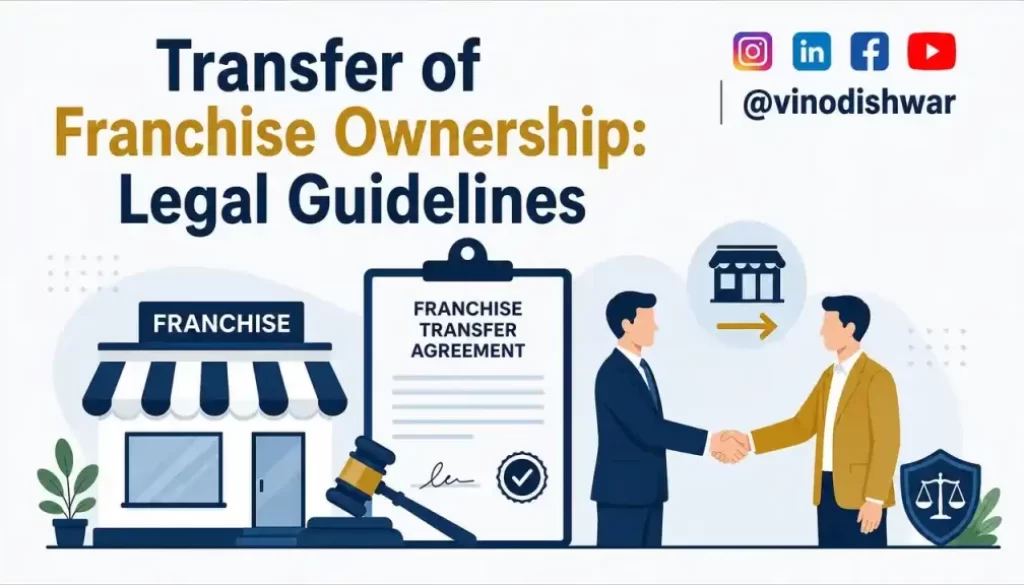
Transfer of Franchise Ownership: Legal Guidelines
Transfer of Franchise Ownership can become necessary when a franchisee wants to sell the franchise, transfer the business to a family member, bring in a new investor, change the ownership structure, or exit the franchise system.
A franchise business is not always operated by the same owner throughout the life of the franchise agreement. However, transferring a franchise is usually more complicated than selling an ordinary business because the franchise relationship involves not only the business and its assets, but also the franchisor’s brand, intellectual property, operating system, territory, technology, customer relationships, and contractual rights.
A franchise business is not always operated by the same owner throughout the life of the franchise agreement.
A franchisee may eventually want to:
- Sell the franchise
- Transfer ownership to a family member
- Bring in a new investor
- Transfer the business to another company
- Change the ownership structure
- Exit the franchise system
- Sell the operating business as part of a franchise resale
However, transferring a franchise is usually more complicated than selling an ordinary business.
The franchise relationship involves not only the business and its assets, but also the franchisor’s brand, intellectual property, operating system, territory, technology, customer relationships, and contractual rights.
This means a franchise ownership transfer needs to be carefully structured.
The first question is:
What exactly is being transferred?
It could be:
- The franchise agreement itself
- The shares of the franchisee company
- The assets of the franchise business
- The operating entity
- The franchise location
- A combination of these
These structures can have very different legal and commercial consequences.
The Indian Contract Act, 1872 provides the general contractual framework in India, while company law, trademark law, taxation, employment, competition, data-protection and other regulations may become relevant depending on the transaction.
What Is a Transfer of Franchise Ownership?
A transfer of franchise ownership occurs when the ownership or control of a franchise business changes from the existing franchisee to another person or entity.
For example:
Existing Franchisee → New Franchisee
The transaction may involve:
- Sale of the business
- Assignment of the franchise agreement
- Transfer of shares
- Transfer of business assets
- Change in control
- Succession
- Family transfer
- Franchise resale
The important point is that ownership of the business and rights under the franchise agreement are not necessarily the same thing.
Franchise Ownership Transfer vs Franchise Agreement Transfer
These concepts are often confused.
Franchise Agreement Transfer
The contractual rights and obligations are transferred from the existing franchisee to another party, subject to the agreement and applicable law.
Ownership Transfer
The ownership or control of the entity operating the franchise changes.
Why Franchise Ownership Transfers Need Special Attention
In a conventional business sale, the buyer and seller may largely control the transaction.
In franchising, there is a third important stakeholder:
The franchisor.
The franchisor may have a legitimate contractual interest in who operates under its brand.
The franchise agreement may therefore require:
- Prior written approval
- Buyer qualification
- Financial evaluation
- Background checks
- Training
- Transfer fees
- Execution of a new agreement
- Compliance with brand standards
Never assume that selling the business automatically transfers the franchise rights.
Does the Franchisee Need Franchisor Approval?
Often, yes—but the answer depends on the franchise agreement.
Many agreements contain provisions dealing with:
- Assignment
- Transfer
- Change of control
- Sale
- Sub-franchising
- Succession
- Share transfers
The agreement should be reviewed before any transaction is announced or completed.
A franchisee should not assume:
“I own the business, so I can sell it to anyone.”
The business may be owned by the franchisee, while the right to operate under the franchisor’s brand is governed separately by contract.
12 Key Legal Considerations When Transferring a Franchise
1. Review the Franchise Agreement
The first step is to identify the agreement’s provisions relating to:
- Transfer
- Assignment
- Change of control
- Sale
- Renewal
- Termination
- Default
- Territory
- IP
- Confidentiality
- Post-termination obligations
Look for language such as:
“The franchisee shall not assign or transfer its rights without the prior written consent of the franchisor.”
The exact wording matters.
2. Determine What Is Actually Being Sold
Before negotiating, define the transaction.
Is the buyer purchasing:
Asset Sale
The buyer acquires selected business assets.
Share Sale
The buyer acquires shares in the company that operates the franchise.
Business Transfer
The operating business is transferred as a going concern.
Franchise Agreement Assignment
The contractual franchise rights are transferred to another party.
These structures can create different legal, tax, contractual and liability consequences.
3. Check for Change-of-Control Provisions
A franchise agreement may treat a change in company ownership as a transfer even if the franchise agreement itself is not formally assigned.
For example:
Company A operates Franchise X.
The shareholders sell a controlling interest in Company A.
The franchise agreement remains in the company’s name.
Does the transaction still require franchisor approval?
Possibly—depending on the agreement.
This is why “change of control” provisions should be reviewed carefully.
4. Obtain Franchisor Approval
Where required, the existing franchisee should formally approach the franchisor.
The franchisor may request information about the proposed buyer, including:
- Identity
- Experience
- Financial capability
- Business background
- Creditworthiness
- Management capability
- Location plans
- Investment capacity
The objective is generally to determine whether the proposed buyer meets the franchise system’s qualification standards.
5. Buyer Due Diligence
The buyer should conduct due diligence before completing the transaction.
Financial
Review:
- Revenue
- Profitability
- Expenses
- Royalties
- Marketing fees
- Outstanding liabilities
- Tax obligations
- Working capital
Legal
Review:
- Franchise agreement
- Lease
- Licences
- Litigation
- Supplier contracts
- Employment arrangements
- IP rights
- Existing defaults
Operational
Review:
- SOP compliance
- Staff
- Equipment
- Inventory
- Customer reviews
- Brand standards
- Technology
Commercial
Review:
- Territory
- Competition
- Customer demand
- Location performance
- Future growth
6. Check Existing Defaults
A buyer should never assume that the franchise business is fully compliant.
Before transfer, identify:
- Unpaid royalties
- Outstanding marketing contributions
- Contractual breaches
- Audit failures
- Regulatory problems
- Supplier disputes
- Customer complaints
- Pending claims
A transfer does not automatically erase historical problems.
The transaction documents should clearly establish who is responsible for pre-transfer liabilities.
7. Transfer Fees
Some franchise agreements permit the franchisor to charge a transfer fee.
The fee may cover:
- Buyer evaluation
- Administrative work
- Training
- Documentation
- System onboarding
The agreement should be checked for:
- Amount
- Calculation method
- Payment timing
- Taxes
- Refundability
Avoid assuming that the buyer or seller is responsible for the fee without checking the contract.
8. New Franchise Agreement
A franchisor may require the incoming franchisee to sign a new franchise agreement rather than simply taking over the existing agreement.
This can be particularly important where:
- The original agreement is old
- Brand standards have changed
- Technology has changed
- Fees have changed
- Compliance requirements have changed
The buyer should carefully compare the old agreement with the proposed new agreement.
A “transfer” can therefore become commercially similar to entering a new franchise relationship.
9. Intellectual Property
The franchise brand usually remains the franchisor’s intellectual property.
The buyer generally does not acquire ownership of the franchisor’s:
- Trademark
- Logo
- Brand identity
- Proprietary systems
- Manuals
- Copyrighted material
- Trade secrets
The buyer receives whatever contractual rights are granted under the franchise arrangement.
If the transaction includes assignment of a trademark or other IP owned by the franchisee, separate IP-transfer requirements may arise.
Under India’s Trade Marks Act, registered trademarks can be assigned subject to statutory restrictions, and the new proprietor should apply to register its title with the Registrar.
10. Company Share Transfer
If the franchise is operated through a company, the transaction may involve transferring shares rather than transferring the operating business itself.
This can create a different legal structure.
Under the Companies Act, 2013, transfer of securities is subject to statutory requirements, and private companies can have restrictions on share transfers under their articles.
Therefore, a franchise transfer involving company shares should be evaluated separately from a straightforward assignment of a franchise agreement.
11. Lease and Property Rights
The franchise location may be one of the most valuable assets.
But the franchisee may not own the property.
The premises may be:
- Leased
- Licensed
- Rented
- Owned by a related entity
The transaction should therefore examine:
- Lease assignment
- Landlord consent
- Change of control
- Security deposit
- Remaining lease term
- Renewal rights
- Rent escalation
A franchise transfer can fail commercially if the buyer acquires the franchise but cannot legally continue operating from the location.
12. Employees
Employees may be critical to the value of the franchise.
The transaction should consider:
- Employment contracts
- Salaries
- Statutory obligations
- Leave
- Benefits
- Pending disputes
- Transfer of employment
- Employee consent where applicable
Employment treatment depends on the transaction structure and applicable law.
Franchise Ownership Transfer: Documents Required
Depending on the transaction, documents may include:
Existing Documents
- Franchise agreement
- Amendments
- Operations manual
- Lease
- Licences
- Supplier agreements
- Employment documents
Transaction Documents
- Business sale agreement
- Share purchase agreement
- Asset purchase agreement
- Assignment agreement
- Transfer agreement
- Franchisor consent
New Franchise Documents
- New franchise agreement
- Personal guarantee, where applicable
- Training acknowledgement
- IP licence or related documentation
- Updated operational documents
The exact document set should be determined by qualified legal professionals.
Franchise Resale vs Franchise Transfer
These terms can overlap but are not always identical.
Franchise Resale
Usually refers to the existing franchisee selling the operating franchise business to a buyer.
Franchise Transfer
Can refer specifically to the transfer of contractual franchise rights or ownership/control.
A resale may therefore require a franchise transfer as part of the overall transaction.
Frequently Asked Questions
Can a franchise business be sold?
Yes, a franchise business may be transferable depending on the franchise agreement, transaction structure, franchisor requirements, and applicable law.
Does the franchisor have to approve a franchise transfer?
If the franchise agreement requires prior approval, the transfer may require the franchisor’s consent. The specific agreement should always be reviewed.
Can I sell my franchise without transferring the franchise agreement?
Possibly, depending on how the transaction is structured. A share sale, asset sale, and contractual assignment can have different consequences.
What is a franchise transfer fee?
A transfer fee is a fee that may be payable under the franchise agreement when a franchise is transferred to a new owner.
Does the buyer receive the same franchise agreement?
Not necessarily. The franchisor may permit an assignment, amend the existing agreement, or require the buyer to sign a new franchise agreement.
Does the franchise territory automatically transfer?
Not necessarily. Territory and exclusivity rights should be specifically reviewed in the transfer documentation.
What happens to franchise renewal rights after a sale?
Renewal rights depend on the existing agreement and the transfer structure. They should be expressly addressed during the transaction.
Conclusion
Transfer of franchise ownership is a significant transaction that requires more than a simple business-sale agreement.
The central issue is that a franchise consists of both:
A Business + A Contractual Right to Operate Under a Brand
The buyer therefore needs to understand not only the value of the business but also the rights and obligations attached to the franchise relationship.
Before transferring a franchise, review:
- Franchise agreement
- Assignment provisions
- Change-of-control clauses
- Franchisor approval requirements
- Transfer fees
- Remaining franchise term
- Renewal rights
- Territory
- IP
- Lease
- Employees
- Financial liabilities
- Customer data
- Digital assets
- Operational compliance
For sellers, proper preparation can make the franchise more transferable and reduce transaction delays.
For buyers, due diligence can reveal obligations and risks that may not be visible from revenue figures alone.
For franchisors, a structured transfer process helps ensure that the incoming franchisee meets the brand’s financial, operational and professional standards. Visit Franchise Alpha and Webs Alpha
The safest approach is simple: review first, obtain the required approvals, complete due diligence, document the transaction properly, and only then complete the transfer.
Call to Action
Planning to Sell or Buy a Franchise?
Before completing a franchise transfer, evaluate the franchise agreement, transfer restrictions, franchisor approval, financial performance, liabilities, territory, renewal rights, lease, IP, operations, and digital assets.
Franchise Alpha helps franchise businesses with franchise development, franchise resale, investor matchmaking, operational systems, marketing and franchise growth, with legal matters coordinated with qualified professionals.
Book a Franchise Transfer Readiness Session
Get clarity on:
- Franchise Resale Strategy
- Buyer Qualification
- Franchise Agreement
- Transfer Requirements
- Franchisor Approval
- Financial Due Diligence
- Territory & Renewal Rights
- Operations
- Brand Compliance
- Buyer Onboarding
Transfer the business. Protect the franchise. Plan the next chapter.