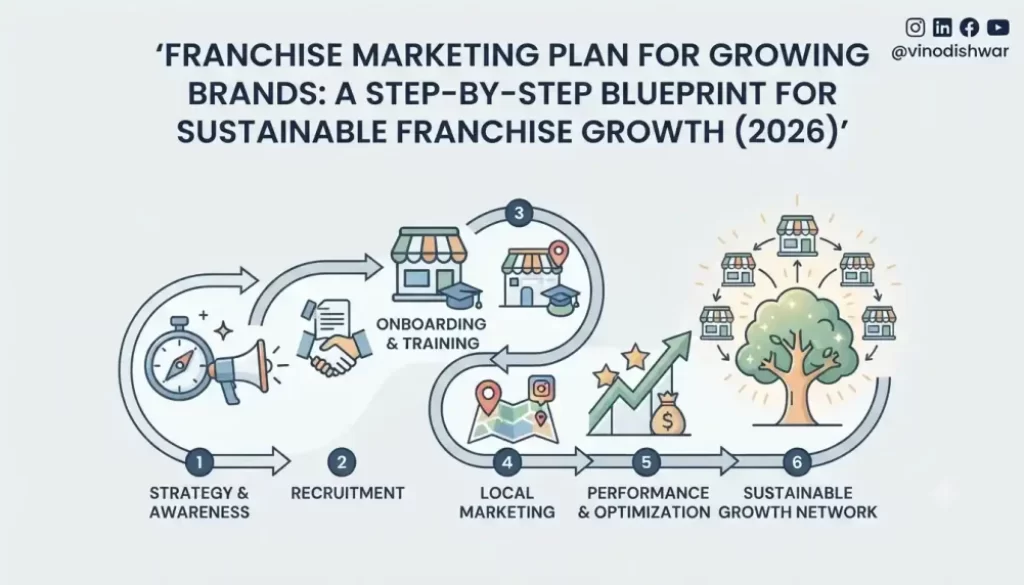
Franchise Marketing Plan for Growing Brands: A Step-by-Step Blueprint for Sustainable Franchise Growth (2026)
A successful franchise doesn’t grow through marketing alone—it grows through a well-structured marketing plan that aligns branding, customer acquisition, franchise recruitment, local marketing, technology, and performance measurement into one scalable system.
As franchise networks expand, marketing becomes increasingly complex. Every new location must maintain consistent brand standards while also attracting customers in its own local market. At the same time, the franchisor must continue generating qualified franchise leads to support expansion.
A Franchise Marketing Plan provides the roadmap for achieving these objectives. It defines marketing goals, identifies target audiences, allocates budgets, establishes marketing channels, creates campaign calendars, and measures results.
Whether you’re launching your first franchise or managing a nationwide franchise network, this guide explains how to develop a franchise marketing plan that supports long-term, sustainable growth.
Important: Marketing activities should comply with applicable advertising, consumer protection, privacy, competition, and intellectual property laws. Businesses should ensure marketing claims are accurate, substantiated, and consistent with brand guidelines.
What Is a Franchise Marketing Plan?
A Franchise Marketing Plan is a documented roadmap that outlines how a franchise business will:
- Build brand awareness
- Attract customers
- Generate franchise enquiries
- Support local franchisees
- Maintain consistent branding
- Allocate marketing budgets
- Measure marketing performance
- Scale into new territories
Unlike a one-time campaign, a marketing plan is an ongoing operational document that guides marketing activities throughout the year.
Why Every Growing Brand Needs a Franchise Marketing Plan
Without a documented marketing plan, franchise businesses often experience:
- Inconsistent branding
- Unclear marketing priorities
- Poor budget allocation
- Weak local marketing
- Low-quality franchise enquiries
- Duplicate marketing efforts
- Limited performance tracking
A structured plan helps every franchise location work toward shared business objectives.
Objectives of a Franchise Marketing Plan
An effective marketing plan should aim to:
- Increase brand awareness
- Generate qualified customer leads
- Attract franchise investors
- Improve local visibility
- Strengthen customer loyalty
- Support franchisee profitability
- Improve marketing ROI
- Enable scalable expansion
These objectives should align with the franchise’s overall growth strategy.
Step 1: Define Your Brand Positioning
Before creating campaigns, establish a clear brand identity.
Include:
- Brand mission
- Vision
- Core values
- Unique selling proposition (USP)
- Brand personality
- Target audience
- Brand messaging
Strong positioning ensures every campaign communicates a consistent message. Before creating your marketing plan, assess whether your business is ready to expand using our Franchise Development Success Framework.
Step 2: Set Marketing Goals
Define measurable goals using SMART principles.
Examples include:
- Increase website traffic by 30%
- Improve organic search rankings
- Generate qualified franchise enquiries
- Increase customer bookings
- Improve Google review ratings
- Expand into new cities
- Increase franchise sales conversions
Goals should be reviewed regularly.
Step 3: Identify Target Audiences
Most franchise brands market to two audiences.
Consumer Audience
Customers looking to purchase products or services.
Consider:
- Demographics
- Buying behavior
- Customer needs
- Geographic location
- Preferred communication channels
Franchise Investor Audience
Entrepreneurs interested in franchise ownership.
Evaluate:
- Investment capacity
- Industry experience
- Business goals
- Preferred locations
- Decision-making process
Each audience requires tailored messaging.
Step 4: Select Marketing Channels
A balanced marketing plan uses multiple channels.
Organic Marketing
- SEO
- Local SEO
- Blogs
- Videos
- Email newsletters
Paid Marketing
- Google Ads
- Meta Ads
- LinkedIn Ads
- YouTube Ads
Local Marketing
- Google Business Profile
- Community events
- Local sponsorships
- Referral programs
- Partnerships
Public Relations
- Press releases
- Industry publications
- Business awards
- Media interviews
An integrated approach delivers stronger results.
Step 5: Create a Content Plan
Content should educate, engage, and convert.
Examples include:
- Blog articles
- Franchise guides
- Success stories
- Customer testimonials
- Videos
- Infographics
- FAQs
- Downloadable resources
Develop a monthly editorial calendar to maintain consistency.
Step 6: Build a Lead Generation System
Lead generation should include:
- Landing pages
- Lead capture forms
- CRM integration
- Email automation
- Discovery calls
- Webinars
- Referral campaigns
Lead quality is more important than lead quantity. A well-defined Franchise Marketing Strategy improves customer acquisition and franchise lead generation.
Step 7: Support Local Franchise Marketing
Provide franchisees with:
- Marketing playbooks
- Brand guidelines
- Social media templates
- Campaign calendars
- Promotional materials
- Local SEO guidance
This helps every location market effectively while protecting the brand.
Step 8: Allocate the Marketing Budget
A franchise marketing budget may include:
- SEO
- Paid advertising
- Content creation
- Website maintenance
- CRM software
- Marketing automation
- Graphic design
- Video production
- Local marketing initiatives
- Analytics tools
Budgets should align with business priorities and expected ROI.
Step 9: Measure Performance
Track KPIs such as:
- Website traffic
- Organic search rankings
- Customer enquiries
- Franchise enquiries
- Lead conversion rate
- Cost per lead
- Customer acquisition cost
- Return on advertising spend (ROAS)
- Customer retention
- Franchise sales
Data-driven decisions improve marketing effectiveness.
Step 10: Optimize Continuously
Marketing plans should evolve based on performance.
Review:
- Campaign results
- Customer feedback
- Search trends
- Franchisee feedback
- Competitor activity
- Emerging technologies
Continuous optimization supports long-term success.
Annual Franchise Marketing Plan Structure
Quarter 1
- Annual strategy
- SEO planning
- Website updates
- Content calendar
- Budget approval
Quarter 2
- Lead generation campaigns
- Local marketing initiatives
- Social media growth
- Paid advertising optimization
Quarter 3
- Brand awareness campaigns
- Customer engagement
- Franchise recruitment drives
- Community partnerships
Quarter 4
- Performance review
- Budget planning
- Strategy refinement
- Next-year marketing roadmap
Franchise Marketing Plan Checklist
Branding
- Brand guidelines documented
- Consistent messaging
- Professional visual identity
Website
- SEO optimized
- Mobile responsive
- Franchise opportunity pages
- Lead capture forms
Content
- Blog strategy
- Video content
- Case studies
- Educational resources
Lead Generation
- CRM integration
- Email automation
- Landing pages
- Qualification process
Local Marketing
- Google Business Profile
- Community outreach
- Referral programs
- Review management
Analytics
- KPI dashboard
- Monthly reporting
- ROI tracking
- Campaign optimization
Practical Example
A growing retail franchise planned expansion into five new cities.
The company developed a comprehensive marketing plan that included:
- Brand positioning refinement
- SEO-focused website improvements
- Franchise opportunity landing pages
- Educational blog content
- Google and Meta advertising
- CRM-based lead nurturing
- Local marketing toolkits
- Monthly KPI reporting
The structured plan improved customer acquisition, generated qualified franchise enquiries, and helped maintain consistent branding across new locations.
Franchise Marketing Plan Framework
Business Goals
        │
        ▼
Brand Positioning
        │
        ▼
Target Audience
        │
        ▼
Marketing Channels
        │
        ▼
Content Strategy
        │
        ▼
Lead Generation
        │
        ▼
Local Marketing
        │
        ▼
Budget Allocation
        │
        ▼
Analytics
        │
        ▼
Continuous Optimization
Common Marketing Planning Mistakes
Avoid these common issues:
- No documented marketing plan
- Undefined target audience
- Inconsistent branding
- Over-reliance on paid advertising
- Weak local marketing support
- Ignoring SEO
- Poor lead follow-up
- No KPI tracking
- Limited franchisee involvement
- Failing to update the marketing plan
Best Practices
- Develop a written annual marketing plan.
- Align marketing goals with franchise expansion objectives.
- Balance national branding with local marketing.
- Invest in SEO and content marketing.
- Equip franchisees with standardized marketing resources.
- Use CRM systems for lead management.
- Review KPIs monthly.
- Continuously optimize campaigns.
- Use AI responsibly to improve efficiency while maintaining human oversight.
How Franchise Marketing Consultants Help
Professional franchise marketing consultants help businesses:
- Create comprehensive marketing plans
- Improve brand positioning
- Build lead generation systems
- Optimize SEO and local SEO
- Manage paid advertising
- Develop content strategies
- Implement CRM and automation
- Improve reporting and analytics
- Train franchisees in local marketing
These services help growing franchise brands market more efficiently and scale more confidently. Businesses looking for end-to-end franchise marketing support can explore Franchise Marketing Services offered by Franchise Alpha.
Why Choose Franchise Alpha?
At Franchise Alpha, we develop customized franchise marketing plans using our proprietary SOLEMN® Framework, integrating strategy, branding, lead generation, technology, governance, and franchise growth expertise.
Strategy
Develop long-term marketing roadmaps aligned with franchise expansion goals.
Operations
Create marketing playbooks, campaign calendars, local marketing systems, and standardized brand assets.
Legal
Coordinate with qualified professionals to help ensure marketing activities align with advertising, intellectual property, and regulatory requirements.
Entrust
Implement governance systems that maintain consistent marketing standards across every franchise location.
Marketing
Deliver SEO, Google Ads, Meta Ads, LinkedIn campaigns, content marketing, CRM automation, email marketing, and franchise lead generation.
Nitty-Gritty
Deploy CRM platforms, AI-assisted marketing workflows, analytics dashboards, marketing automation, conversion tracking, and reporting systems that support scalable growth.
Learn more about Franchise Alpha’s complete Franchise Development Services for businesses planning sustainable expansion.
Frequently Asked Questions
What is a franchise marketing plan?
A franchise marketing plan is a documented roadmap that outlines marketing goals, target audiences, channels, budgets, campaigns, and performance metrics to support customer acquisition and franchise growth.
Why is a franchise marketing plan important?
It provides structure, improves brand consistency, supports franchisees, optimizes marketing budgets, and helps measure the effectiveness of marketing campaigns.
What should be included in a franchise marketing plan?
A comprehensive plan includes brand positioning, marketing goals, target audiences, channel selection, content strategy, lead generation, local marketing, budget allocation, KPIs, and optimization processes.
How often should a franchise marketing plan be updated?
Marketing plans should be reviewed monthly for performance and updated annually or whenever significant business or market changes occur.
Conclusion
A franchise marketing plan is the foundation of sustainable franchise growth. It transforms marketing from a collection of isolated campaigns into a structured, measurable, and scalable business system.
By combining branding, SEO, content marketing, lead generation, local marketing, technology, and analytics, franchise brands can support every location while attracting new customers and qualified franchise partners.
The businesses that plan their marketing strategically are better positioned to grow consistently, strengthen their brand, and achieve long-term franchise success.
Call to Action
Ready to Build Your Franchise Marketing Plan?
Book a Franchise Marketing Strategy Session with Vinod Ishwar and receive a customized marketing plan designed to grow your brand, generate quality franchise leads, and support sustainable expansion.
Your strategy session includes:
- Franchise Marketing Audit
- Brand Positioning Review
- SEO & Digital Presence Assessment
- Lead Generation Strategy Evaluation
- Customized Annual Franchise Marketing Plan
Create a marketing plan that turns your franchise growth goals into measurable results. You may also like our guide on Future of Franchise Development in India.