Franchise Marketing vs Traditional Marketing: Key Differences, Benefits & Growth Strategies (2026)
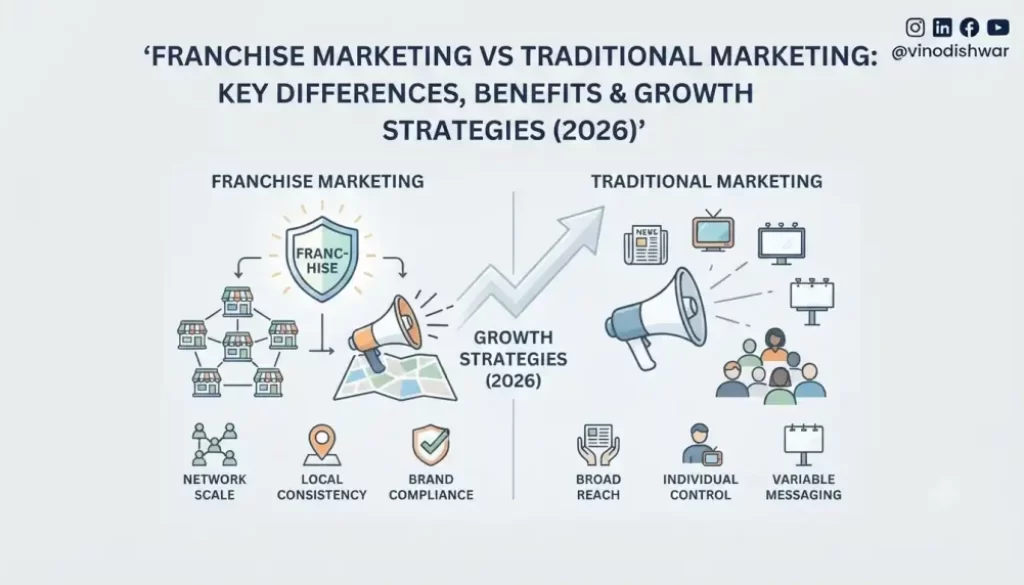
Franchise Marketing vs Traditional Marketing is an important comparison for businesses planning to scale through franchising. While traditional marketing focuses on promoting a single business, franchise marketing supports both customer acquisition and franchise expansion across multiple locations through consistent branding and coordinated marketing strategies.
Marketing is essential for every business, but the approach varies significantly depending on the business model. A single-location business typically focuses on attracting customers to one brand or outlet. In contrast, a franchise business must market both its products or services and the franchise opportunity while maintaining consistency across multiple locations.
This distinction makes franchise marketing fundamentally different from traditional marketing. Franchise marketing requires coordination between the franchisor and franchisees, balancing national brand campaigns with localized marketing efforts. It also involves supporting franchisees with marketing tools, systems, and brand guidelines to ensure a consistent customer experience.
Understanding these differences helps business owners choose the right marketing strategy as they scale from a single business to a franchise network.
Important: Marketing activities should comply with applicable advertising, consumer protection, privacy, competition, and intellectual property laws. Businesses should ensure marketing claims are accurate and consistent with brand standards.
What Is Traditional Marketing?
Traditional marketing refers to strategies used by a single business to promote its products or services directly to customers.
The business owner controls:
- Branding
- Advertising
- Promotions
- Customer communication
- Marketing budget
- Campaign execution
The primary objective is customer acquisition and sales growth.
What Is Franchise Marketing?
Franchise marketing is a coordinated system designed to:
- Promote the franchise brand
- Generate customers for franchise locations
- Recruit qualified franchise investors
- Support local franchise marketing
- Maintain brand consistency across multiple locations
Franchise marketing combines centralized strategy with localized execution. Learn how Franchise Alpha’s Franchise Marketing Services help businesses build stronger brands, attract qualified franchise leads, and scale successfully.
Franchise Marketing vs Traditional Marketing
| Feature | Franchise Marketing | Traditional Marketing |
|---|---|---|
| Primary audience | Customers and franchise investors | Customers only |
| Business model | Multi-location franchise network | Single business or company |
| Brand management | Centralized with local execution | Fully centralized |
| Marketing responsibility | Shared between franchisor and franchisees | Managed by one business |
| Local marketing | Essential for each territory | Optional |
| Brand consistency | Critical across all locations | Easier to maintain |
| Recruitment marketing | Required | Not applicable |
| Marketing systems | Standardized templates and playbooks | Customized for one business |
| Technology | CRM, marketing automation, franchise portals | CRM and standard marketing tools |
| Goal | Grow customers and franchise network | Grow customers and sales |
Why Franchise Marketing Is More Complex
A franchise network introduces additional responsibilities that traditional businesses typically do not face.
These include:
- Coordinating campaigns across multiple locations
- Supporting franchisees with marketing assets
- Maintaining brand consistency
- Managing local SEO for each outlet
- Recruiting franchise investors
- Monitoring marketing performance across the network
A structured system is essential to manage this complexity. Explore our Franchise Development Services to build scalable franchise systems with standardized operations, marketing, and growth strategies.
National Marketing vs Local Marketing
National Marketing
The franchisor typically manages:
- Brand positioning
- Corporate website
- National advertising
- SEO strategy
- Public relations
- Corporate social media
- Franchise recruitment campaigns
National marketing builds awareness and trust for the brand as a whole.
Local Marketing
Franchisees focus on activities within their territories, including:
- Google Business Profile optimization
- Local SEO
- Community sponsorships
- Local partnerships
- Social media engagement
- Promotions and events
- Customer review management
Local marketing converts brand awareness into local sales.
Benefits of Franchise Marketing
A strong franchise marketing strategy helps businesses:
- Build a recognizable brand
- Support every franchise location
- Generate qualified franchise enquiries
- Improve customer acquisition
- Maintain consistent messaging
- Increase franchisee profitability
- Expand into new markets more effectively
- Strengthen long-term brand value
Benefits of Traditional Marketing
Traditional marketing offers:
- Simpler decision-making
- Greater flexibility
- Faster campaign execution
- Direct customer communication
- Complete budget control
- Easier performance tracking
It works well for businesses operating from a single location or under one ownership.
Technology Differences
Franchise Marketing Technology
Growing franchise systems often use:
- CRM platforms
- Franchise portals
- Marketing automation
- Business Intelligence dashboards
- Learning Management Systems (LMS)
- Multi-location SEO tools
- AI-assisted analytics
Technology enables centralized management while supporting local execution.
Traditional Marketing Technology
Single-location businesses commonly rely on:
- Website analytics
- CRM software
- Email marketing platforms
- Social media management tools
- SEO software
- Advertising platforms
These tools focus on customer acquisition rather than franchise management.
Measuring Success
Franchise Marketing KPIs
Monitor:
- Customer enquiries
- Franchise enquiries
- Cost per franchise lead
- Customer acquisition cost
- Franchise sales
- Franchisee profitability
- Brand consistency
- Local search visibility
- Return on ad spend (ROAS)
- Customer lifetime value
Traditional Marketing KPIs
Track:
- Website traffic
- Sales
- Customer leads
- Conversion rate
- Cost per acquisition
- Customer retention
- Marketing ROI
The emphasis is on customer growth rather than network expansion.
When Should a Business Transition?
A business may be ready to shift from traditional marketing to franchise marketing when it has:
- A proven business model
- Standardized operations
- Strong brand recognition
- Repeatable customer experience
- Documented systems
- A strategy for recruiting franchisees
- Plans for multi-location expansion
Transitioning requires both operational readiness and marketing maturity.
Practical Example
A successful café operated from one flagship location using traditional marketing focused on local advertising and social media.
After deciding to franchise, the business introduced:
- Brand guidelines
- Franchise recruitment landing pages
- SEO content targeting franchise investors
- Google Business Profiles for each outlet
- Marketing templates for franchisees
- CRM automation
- National digital advertising
- Local marketing support programs
The shift from traditional marketing to franchise marketing enabled the brand to scale while maintaining a consistent customer experience across multiple locations.
Franchise Marketing Evolution Framework
Single Business
        │
        ▼
Traditional Marketing
        │
        ▼
Business Growth
        │
        ▼
Standardized Systems
        │
        ▼
Franchise Development
        │
        ▼
National Brand Marketing
        │
        ▼
Local Franchise Marketing
        │
        ▼
Customer + Franchise Lead Generation
        │
        ▼
Scalable Franchise Growth
Common Mistakes During the Transition
Businesses often encounter challenges such as:
- Treating every franchise location identically without considering local markets
- Inconsistent branding across franchisees
- Weak local SEO
- Limited franchisee marketing support
- Poor communication between franchisor and franchisees
- Lack of CRM and marketing automation
- Focusing only on customer marketing while neglecting franchise recruitment
Planning for these challenges improves the transition.
Best Practices
- Build comprehensive brand guidelines before expansion.
- Standardize marketing assets and messaging.
- Balance national branding with local flexibility.
- Invest in SEO and local SEO.
- Provide franchisees with training and marketing playbooks.
- Use CRM systems to manage customer and franchise leads.
- Track KPIs across every location.
- Continuously optimize campaigns based on performance data.
- Use AI responsibly to improve efficiency while maintaining human oversight.
How Franchise Marketing Consultants Help
Professional franchise marketing consultants help businesses:
- Transition from traditional marketing to franchise marketing
- Develop scalable marketing strategies
- Create brand guidelines and marketing playbooks
- Improve SEO and local SEO
- Generate qualified franchise leads
- Implement CRM and automation
- Build multi-location marketing systems
- Improve analytics and reporting
- Train franchisees in local marketing
These services help businesses scale their marketing alongside their franchise network. Discover how Franchise Alpha helps businesses with franchise marketing, lead generation, digital transformation, and franchise expansion.
Why Choose Franchise Alpha?
At Franchise Alpha, we help businesses transform from single-location brands into scalable franchise networks using our proprietary SOLEMN® Framework, combining strategy, branding, marketing, technology, and franchise development expertise.
Strategy
Develop customized marketing roadmaps that support franchise expansion.
Operations
Create standardized marketing systems, local marketing toolkits, campaign calendars, and franchise playbooks.
Legal
Coordinate with qualified professionals to help ensure marketing materials align with advertising, intellectual property, and regulatory requirements.
Entrust
Implement governance processes that maintain consistent branding across the franchise network.
Marketing
Deliver SEO, Google Ads, Meta Ads, LinkedIn marketing, content marketing, CRM automation, email marketing, and franchise lead generation.
Nitty-Gritty
Deploy CRM platforms, marketing automation, analytics dashboards, AI-assisted content workflows, conversion tracking, and reporting systems that support scalable franchise growth.
Frequently Asked Questions
What is the difference between franchise marketing and traditional marketing?
Traditional marketing focuses on attracting customers to a single business, while franchise marketing supports both customer acquisition and franchise recruitment across multiple locations with consistent branding.
Why is franchise marketing more complex?
Franchise marketing requires coordination between franchisors and franchisees, standardized brand management, local marketing support, multi-location SEO, and franchise investor marketing.
Can a traditional business use franchise marketing strategies?
Yes. Businesses preparing to franchise often begin implementing standardized branding, content marketing, CRM systems, and scalable digital marketing before launching a franchise program.
Which is better: franchise marketing or traditional marketing?
Neither approach is universally better. Traditional marketing is appropriate for independent businesses, while franchise marketing is designed for businesses operating or planning to operate through a franchise network.
Conclusion
Traditional marketing and franchise marketing share the goal of business growth, but they differ significantly in scope, complexity, and execution.
As businesses expand into franchising, marketing must evolve from supporting a single operation to managing brand consistency, local visibility, customer acquisition, and franchise recruitment across multiple locations.
By understanding these differences and implementing scalable marketing systems, businesses can build stronger brands, empower franchisees, and support long-term franchise growth.
Call to Action
Ready to Transform Your Marketing for Franchise Growth?
Book a Franchise Marketing Strategy Session with Vinod Ishwar and discover how to transition from traditional marketing to a scalable franchise marketing system.
Your strategy session includes:
- Marketing Readiness Assessment
- Brand Positioning Review
- Multi-Location Marketing Evaluation
- Lead Generation Strategy
- Customized Franchise Marketing Roadmap
Build a franchise marketing system that supports sustainable growth across every location.