Franchise Qualification Framework: The Complete Guide to Selecting the Right Franchise Partners (2026)
A strong Franchise Qualification Framework is the foundation of every successful franchise network. Selecting the right franchise partners requires more than evaluating financial capability—it involves assessing leadership, operational commitment, cultural alignment, and long-term business potential. A structured Franchise Qualification Framework helps franchisors recruit capable franchisees, reduce business risks, and build a scalable, high-performing franchise system.
One of the biggest factors determining franchise success is selecting the right franchise partners. Even the strongest franchise systems can struggle if they recruit franchisees who lack the financial capacity, operational discipline, leadership skills, or commitment needed to operate the business successfully.
A structured franchise qualification framework helps franchisors evaluate candidates objectively rather than relying on intuition or sales pressure. It establishes clear standards, improves consistency, reduces recruitment risks, and creates a stronger franchise network.
Whether you’re expanding a restaurant, café, retail chain, salon, preschool, healthcare business, fitness center, manufacturing company, or service brand, a documented qualification framework should be an essential part of your franchise development strategy.
This guide explains how to design and implement an effective franchise qualification framework, including evaluation criteria, assessment tools, best practices, and common mistakes to avoid.
What Is a Franchise Qualification Framework?
A franchise qualification framework is a standardized system used to assess whether a prospective franchisee is suitable to operate and grow a franchise business.
Rather than focusing only on financial capability, the framework evaluates multiple areas, including:
- Financial readiness
- Business experience
- Leadership ability
- Operational commitment
- Cultural fit
- Market knowledge
- Communication skills
- Growth potential
- Long-term alignment
The goal is to identify franchise partners who are most likely to succeed while protecting the long-term strength of the franchise network.
Why Franchise Qualification Matters
A structured qualification framework helps businesses:
- Recruit stronger franchisees
- Reduce operational risk
- Improve franchise performance
- Increase franchisee satisfaction
- Protect brand reputation
- Reduce disputes
- Improve network consistency
- Support sustainable expansion
Successful franchise brands focus on quality over quantity when awarding franchises.
The Franchise Qualification Framework
A comprehensive framework evaluates candidates across several key areas.
1. Financial Qualification
Financial readiness is one of the first areas to evaluate.
Typical considerations include:
- Available investment capital
- Access to financing
- Working capital
- Personal financial stability
- Creditworthiness (where appropriate)
- Ability to sustain operations during the initial growth phase
Financial discussions should be handled professionally and in accordance with applicable laws.
2. Business Experience
Assess whether the candidate has experience in areas such as:
- Business ownership
- Team management
- Customer service
- Sales and marketing
- Financial management
- Operations
- Industry knowledge
Direct industry experience is not always required if comprehensive training is provided.
3. Leadership Assessment
Strong franchisees typically demonstrate:
- Decision-making ability
- Problem-solving skills
- Team leadership
- Accountability
- Communication
- Adaptability
- Integrity
Leadership qualities often influence long-term business performance.
4. Operational Commitment
Determine the candidate’s intended level of involvement.
Questions may include:
- Will they manage daily operations?
- Will they hire a professional manager?
- How much time can they dedicate?
- Do they understand operational expectations?
Operational commitment varies depending on the franchise model.
5. Cultural Fit
Candidates should align with the brand’s:
- Mission
- Vision
- Values
- Customer service philosophy
- Business ethics
- Growth mindset
Strong cultural alignment improves collaboration across the franchise network.
6. Market Understanding
Evaluate whether the candidate understands:
- Local demographics
- Competition
- Consumer behavior
- Real estate opportunities
- Local regulations
- Marketing requirements
Local market knowledge supports better decision-making.
7. Communication Skills
Successful franchisees should demonstrate:
- Active listening
- Professional communication
- Responsiveness
- Collaboration
- Ability to follow systems
- Willingness to seek guidance
Communication plays a significant role in maintaining healthy franchisor-franchisee relationships.
8. Growth Potential
Consider the candidate’s long-term objectives.
Evaluate:
- Expansion ambitions
- Multi-unit interest
- Business planning capability
- Strategic thinking
- Continuous learning
Growth-oriented franchisees often contribute to network expansion.
Step-by-Step Franchise Qualification Process
Step 1: Initial Inquiry Review
Collect:
- Inquiry form
- Basic contact details
- Investment range
- Preferred territory
- Business background
Step 2: Pre-Qualification Call
Discuss:
- Business goals
- Investment expectations
- Timeline
- Operational involvement
- Initial questions
Step 3: Qualification Questionnaire
Use a standardized questionnaire covering:
- Financial readiness
- Leadership experience
- Business history
- Industry knowledge
- Personal objectives
Step 4: Discovery Meeting
Evaluate:
- Communication
- Cultural fit
- Decision-making
- Commitment
- Expectations
Step 5: Reference & Background Review
Where appropriate and legally permissible:
- Professional references
- Business history
- Financial verification
- Compliance checks
Always obtain required permissions and comply with privacy laws.
Step 6: Candidate Scoring
Score candidates across predefined categories.
Example:
| Category | Weight |
|---|---|
| Financial Readiness | 25% |
| Leadership | 20% |
| Business Experience | 15% |
| Cultural Fit | 15% |
| Operational Commitment | 10% |
| Communication | 10% |
| Market Knowledge | 5% |
A structured scorecard improves consistency while supporting professional judgment.
Step 7: Final Decision
Review:
- Candidate score
- Discovery feedback
- Leadership assessment
- Business objectives
- Legal documentation readiness
The final decision should consider both objective criteria and broader suitability for the franchise system.
Franchise Qualification Checklist
Before approving a franchise candidate, verify:
Financial
- Investment capability
- Working capital
- Funding plan
Professional
- Business experience
- Leadership capability
- Operational commitment
Brand Alignment
- Cultural fit
- Customer service philosophy
- Brand values
Documentation
- Qualification questionnaire
- Discovery notes
- Candidate scorecard
- CRM records
- Required legal documentation
Practical Example
A growing education franchise received hundreds of inquiries each year but struggled with inconsistent franchisee performance.
The company introduced a formal qualification framework that included:
- Online application
- Financial pre-screening
- Structured interviews
- Leadership assessment
- Discovery Day evaluation
- Candidate scorecards
- CRM tracking
- Final review committee
The new process improved franchisee quality, reduced recruitment errors, and increased long-term franchise performance.
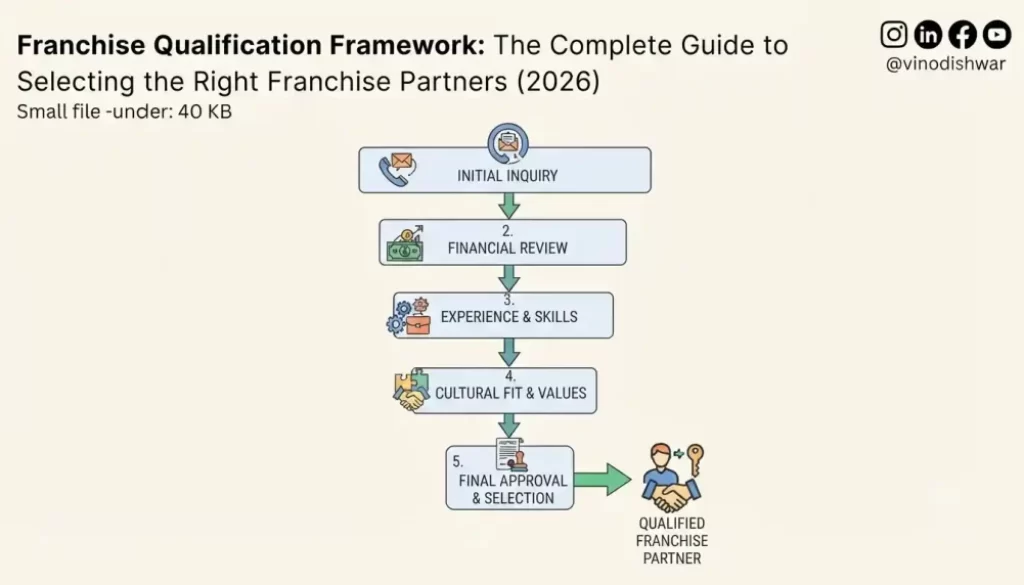
Franchise Qualification Framework
Lead Inquiry
        │
        ▼
Pre-Qualification
        │
        ▼
Qualification Questionnaire
        │
        ▼
Discovery Meeting
        │
        ▼
Leadership Assessment
        │
        ▼
Financial Review
        │
        ▼
Candidate Scorecard
        │
        ▼
Final Evaluation
        │
        ▼
Franchise Approval
        │
        ▼
Training & Onboarding
Common Qualification Mistakes
Avoid these common mistakes:
- Approving candidates based only on available capital
- No documented qualification criteria
- Inconsistent interviews
- Ignoring cultural fit
- Weak CRM documentation
- Poor follow-up
- Rushing candidate approval
- Failing to verify information
- Overlooking operational commitment
A disciplined qualification process protects both the franchisor and future franchisees.
Best Practices
- Develop standardized qualification criteria.
- Use structured interviews and scorecards.
- Evaluate both financial and non-financial factors.
- Maintain consistent documentation in a CRM.
- Involve multiple stakeholders in final decisions where appropriate.
- Regularly review and refine qualification standards.
- Ensure all recruitment activities comply with applicable laws.
How Franchise Development Consultants Help
Professional franchise development consultants help businesses:
- Design franchise qualification systems
- Develop candidate scorecards
- Create interview frameworks
- Build CRM workflows
- Improve recruitment processes
- Train franchise recruitment teams
- Develop governance systems
- Coordinate with qualified legal professionals regarding compliant recruitment practices
These systems improve franchisee selection while supporting sustainable network growth.
Why Choose Franchise Alpha?
At Franchise Alpha, we help businesses recruit stronger franchise partners through our proprietary SOLEMN® Framework, combining strategic planning, structured qualification, governance, operations, and recruitment systems.
Strategy
Design a franchise qualification roadmap aligned with your expansion objectives.
Operations
Standardize candidate evaluations, scorecards, discovery meetings, and onboarding systems.
Legal
Coordinate with qualified legal professionals to ensure recruitment documentation and processes comply with applicable legal requirements.
Entrust
Implement governance systems that improve franchisee quality and long-term network performance.
Marketing
Support recruitment with SEO, content marketing, franchise lead generation, and investor education campaigns.
Nitty-Gritty
Deploy CRM systems, qualification dashboards, automation workflows, and KPI reporting for consistent franchise recruitment.
Frequently Asked Questions
What is a franchise qualification framework?
A franchise qualification framework is a structured system used to evaluate prospective franchisees based on financial readiness, leadership, business experience, operational commitment, cultural fit, and long-term suitability.
Why is franchise qualification important?
Proper qualification helps recruit capable franchise partners, reduces operational risk, improves brand consistency, and increases long-term franchise success.
Should financial capability be the only qualification factor?
No. While financial readiness is essential, leadership, operational commitment, cultural alignment, communication, and business capability are equally important when evaluating franchise candidates.
Can qualification criteria vary by franchise model?
Yes. Qualification requirements may differ depending on the industry, investment level, operating model, and growth strategy of the franchise system.
Conclusion
A franchise qualification framework is one of the most valuable tools for building a successful franchise network.
By evaluating candidates through standardized financial, operational, leadership, and cultural criteria, businesses can recruit franchise partners who are more likely to succeed, strengthen the brand, and contribute to sustainable long-term expansion.
Investing in a structured qualification process today helps reduce recruitment risk and creates a stronger foundation for future growth.
Call to Action
Ready to Build a Better Franchise Qualification System?
Book a Franchise Readiness Assessment with Vinod Ishwar and discover how to implement a structured franchise qualification framework that helps you recruit stronger franchise partners.
Your assessment includes:
- Franchise Recruitment Audit
- Candidate Qualification Review
- Discovery Process Assessment
- CRM & Workflow Evaluation
- Customized Franchise Growth Roadmap
Recruit the right franchise partners and build a stronger franchise network.