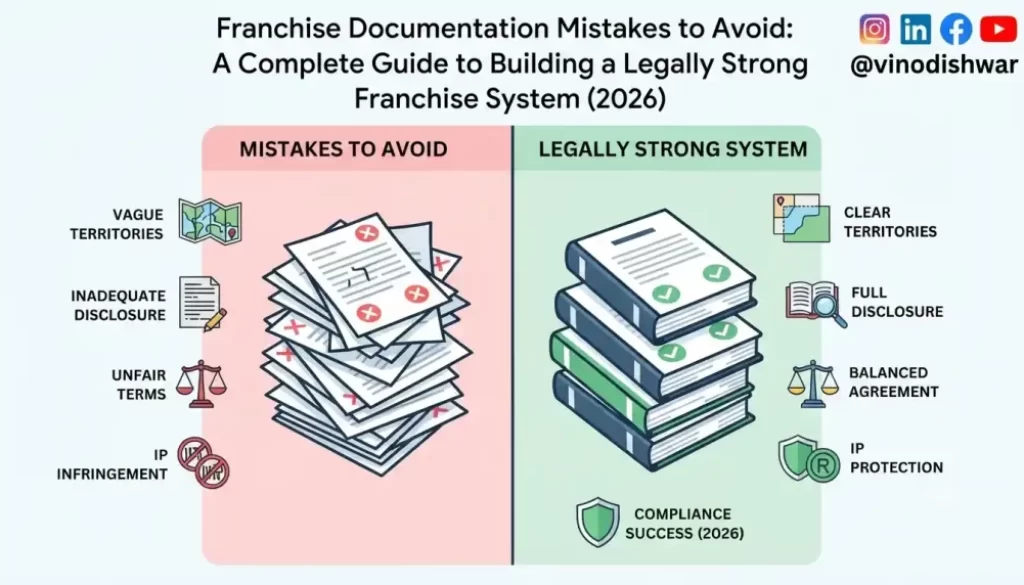
Franchise Documentation Mistakes to Avoid: A Complete Guide to Building a Legally Strong Franchise System (2026)
Many businesses believe they are ready to franchise because they have a successful outlet, loyal customers, and strong profits. However, one of the biggest reasons franchise systems fail is poor documentation.
Franchise documentation is much more than a legal agreement. It includes the operational systems, brand standards, intellectual property protection, training materials, compliance policies, and governance frameworks that enable franchisees to replicate the business successfully.
Weak or incomplete documentation often leads to inconsistent customer experiences, franchise disputes, operational confusion, and difficulty scaling the business.
Whether you operate a restaurant, café, retail store, salon, preschool, healthcare clinic, fitness center, manufacturing company, or service business, avoiding common documentation mistakes is essential before expanding through franchising.
This guide explains the most common franchise documentation mistakes, why they happen, and practical strategies to prevent them.
Important: Franchise documentation requirements vary by country and jurisdiction. Always work with qualified franchise lawyers and advisors to prepare or review legal documents before offering franchise opportunities.
Why Franchise Documentation Matters
Comprehensive franchise documentation helps businesses:
- Protect intellectual property
- Define rights and responsibilities
- Standardize operations
- Maintain brand consistency
- Reduce legal disputes
- Improve franchisee performance
- Support regulatory compliance
- Enable scalable expansion
Strong documentation creates a repeatable system that franchisees can follow with confidence.
The Cost of Poor Documentation
Incomplete documentation can result in:
- Franchise disputes
- Brand inconsistency
- Customer dissatisfaction
- Operational inefficiencies
- Compliance failures
- Trademark misuse
- Training gaps
- Financial reporting issues
- Slower franchise growth
Investing in documentation early is significantly less expensive than resolving disputes later.
15 Common Franchise Documentation Mistakes
1. Franchising Without Documented Systems
Many founders rely on personal knowledge instead of documented processes.
Without written systems:
- Employees improvise
- Franchisees interpret procedures differently
- Customer experiences become inconsistent
Document every critical business process before franchising.
2. Using Generic Franchise Agreement Templates
Every franchise business is different.
Using copied or generic legal templates may fail to address:
- Territory rights
- Royalty structures
- Intellectual property licensing
- Industry-specific risks
- Performance expectations
Legal agreements should be tailored by qualified franchise lawyers.
3. Weak Operations Manual
An Operations Manual should explain how to operate the business consistently.
Common problems include:
- Missing procedures
- Outdated information
- Limited operational detail
- Poor organization
A strong manual becomes the operational blueprint for every franchisee.
4. Missing Standard Operating Procedures (SOPs)
SOPs provide detailed instructions for daily operations.
Without SOPs:
- Quality varies
- Employee training becomes inconsistent
- Operational efficiency declines
Every recurring task should have a documented SOP.
5. Ignoring Intellectual Property Protection
Some businesses begin franchising before protecting:
- Trademarks
- Logos
- Brand names
- Marketing assets
- Proprietary systems
Protecting intellectual property should be an early priority.
6. Inconsistent Brand Guidelines
Poorly documented branding leads to:
- Different logo usage
- Inconsistent colors
- Conflicting marketing materials
- Customer confusion
Comprehensive Brand Guidelines help preserve brand identity.
7. Undefined Territory Rights
Territory disputes often arise because documentation fails to clearly define:
- Exclusive territories
- Protected areas
- Online sales rights
- Expansion boundaries
Clear documentation reduces conflict.
8. Poor Training Documentation
Training should include:
- Learning objectives
- Standard curriculum
- Assessment methods
- Certification requirements
Well-documented training supports consistent performance.
9. Missing Compliance Procedures
Businesses often overlook documenting:
- Operational audits
- Brand inspections
- Reporting requirements
- Corrective actions
Compliance systems should be integrated into franchise operations.
10. Weak Confidentiality Protection
Franchisees gain access to valuable business knowledge.
Documentation should protect:
- Recipes
- Trade secrets
- Supplier information
- Customer databases
- Business processes
Confidentiality provisions should remain effective even after the franchise relationship ends.
11. Outdated Documentation
Business systems evolve over time.
Outdated manuals and agreements can create confusion and increase risk.
Establish a regular review and update process.
12. Lack of Digital Documentation
Many businesses still rely on printed manuals.
Modern franchise systems benefit from:
- Digital Operations Manuals
- Online training platforms
- Document version control
- Cloud-based compliance systems
Digital documentation improves accessibility and consistency.
13. Poor Version Control
Multiple versions of documents can result in:
- Conflicting procedures
- Incorrect policies
- Operational inconsistencies
Maintain one official version with controlled updates.
14. Not Defining Roles and Responsibilities
Documentation should clearly identify:
- Franchisor obligations
- Franchisee obligations
- Support responsibilities
- Reporting expectations
Clear accountability improves collaboration.
15. Failing to Test Documentation
Before launching a franchise program:
- Pilot the manuals
- Test SOPs
- Review training materials
- Conduct operational simulations
Testing identifies gaps before expansion.
Step-by-Step Documentation Best Practices
Step 1: Protect Your Intellectual Property
Secure trademarks, proprietary content, and confidential business assets.
Step 2: Document Every Core Process
Create detailed SOPs for all critical business activities.
Step 3: Develop an Operations Manual
Include:
- Operations
- Quality standards
- Customer service
- Technology systems
- Compliance procedures
Step 4: Prepare Legal Documentation
Work with qualified legal professionals to prepare:
- Franchise Agreement
- Licensing provisions
- Confidentiality agreements
- Compliance policies
Step 5: Create Brand Guidelines
Standardize visual identity, messaging, signage, marketing materials, and digital branding.
Step 6: Build Training Documentation
Develop onboarding materials, certifications, assessments, and refresher programs.
Step 7: Review and Update
Schedule periodic reviews to ensure documentation remains accurate, compliant, and aligned with business growth.
Franchise Documentation Checklist
Before franchising, confirm you have:
Legal Documents
- Franchise Agreement
- Trademark registrations or applications
- Confidentiality agreements
- Compliance policies
Operational Documents
- Operations Manual
- SOPs
- Quality standards
- Audit procedures
Brand Documents
- Brand Guidelines
- Marketing policies
- Digital branding standards
Training Documents
- Training manuals
- Certification process
- Assessment materials
Governance
- Reporting systems
- Performance reviews
- Version control process
- Documentation update schedule
Practical Example
A successful specialty coffee chain planned to franchise nationally.
During its readiness assessment, consultants identified several documentation gaps:
- Outdated SOPs
- No Brand Guidelines
- Weak training documentation
- Generic legal agreements
- No version control process
The company updated its documentation, implemented digital manuals, introduced compliance audits, and standardized franchise training.
As a result, new franchisees launched faster, customer experience became more consistent, and operational support requests declined significantly.
Franchise Documentation Framework
Business Knowledge
        │
        ▼
Intellectual Property Protection
        │
        ▼
Operations Manual
        │
        ▼
Standard Operating Procedures
        │
        ▼
Brand Guidelines
        │
        ▼
Legal Documentation
        │
        ▼
Training Systems
        │
        ▼
Compliance & Audits
        │
        ▼
Regular Updates
        │
        ▼
Scalable Franchise System
Common Warning Signs
Review your franchise documentation if:
- Employees rely on verbal instructions
- Every outlet operates differently
- Franchisees frequently ask the same questions
- Customer experiences vary
- Manuals have not been updated in years
- Brand usage is inconsistent
- Training outcomes differ significantly
- Operational audits reveal recurring issues
These signs often indicate documentation weaknesses.
How Franchise Development Consultants Help
Professional franchise development consultants assist businesses by:
- Conducting documentation audits
- Building Operations Manuals
- Developing SOPs
- Creating Brand Guidelines
- Designing compliance systems
- Coordinating with qualified legal professionals
- Structuring franchise governance
- Preparing businesses for scalable expansion
Experienced consultants help transform business knowledge into documented, repeatable systems.
Why Choose Franchise Alpha?
At Franchise Alpha, we help businesses eliminate documentation gaps through our proprietary SOLEMN® Framework, creating structured, scalable, and investor-ready franchise systems.
Strategy
Assess documentation readiness before expansion.
Operations
Develop comprehensive Operations Manuals, SOPs, quality systems, and process documentation.
Legal
Coordinate with qualified franchise legal professionals to prepare agreements, intellectual property protection, and compliance documentation.
Entrust
Build governance frameworks that improve accountability and consistency.
Marketing
Standardize branding, communication, and customer experience guidelines.
Nitty-Gritty
Implement audit systems, reporting dashboards, version control, and continuous improvement processes.
Frequently Asked Questions
Why is franchise documentation important?
Franchise documentation provides the legal and operational foundation for consistent business operations, protects intellectual property, reduces disputes, and supports scalable expansion.
What is the biggest documentation mistake businesses make?
One of the most common mistakes is attempting to franchise before documenting operational systems, SOPs, and brand standards.
How often should franchise documentation be updated?
Documentation should be reviewed regularly and updated whenever business processes, regulations, technology, or brand standards change.
Who should prepare franchise documentation?
Operational documents are typically developed with franchise consultants and operations specialists, while legal agreements should be prepared or reviewed by qualified franchise lawyers.
Conclusion
Strong franchise documentation transforms a successful business into a scalable franchise system.
By avoiding common documentation mistakes and investing in comprehensive legal, operational, and compliance documentation, businesses can protect their brand, improve franchisee performance, reduce risks, and create a foundation for long-term growth.
Documentation is not simply paperwork—it is the operating system that enables successful franchise expansion.
Call to Action
Ready to Strengthen Your Franchise Documentation?
Book a Franchise Readiness Assessment with Vinod Ishwar and discover how to eliminate documentation gaps before expanding your business.
Your assessment includes:
- Documentation Audit
- Operations Manual Review
- SOP Assessment
- Brand Guidelines Evaluation
- Customized Franchise Documentation Roadmap
Build a franchise system that is documented, compliant, and ready to scale.