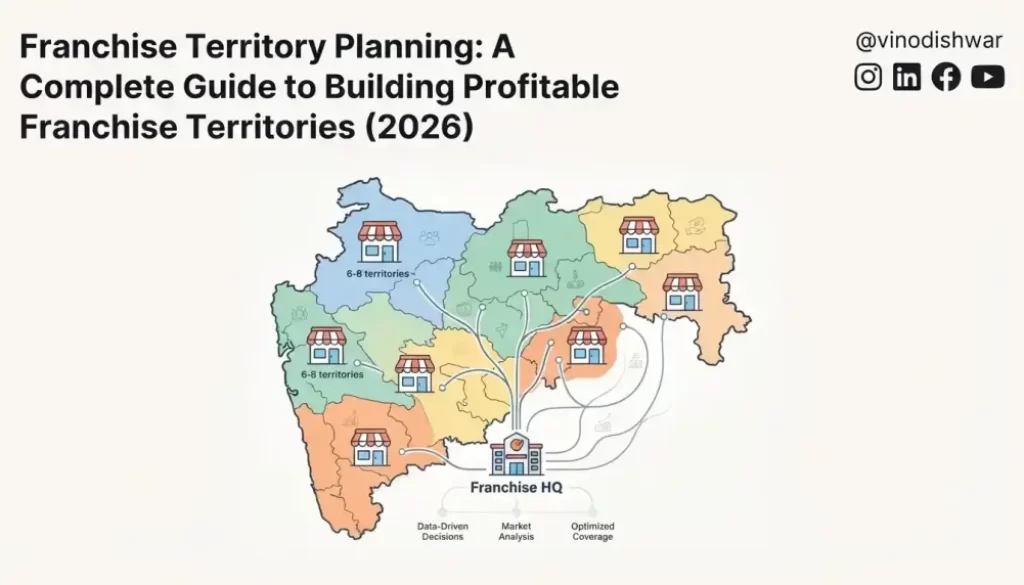
Franchise Territory Planning: A Complete Guide to Building Profitable Franchise Territories (2026)
One of the most critical yet often overlooked aspects of franchise development is Franchise Territory Planning. Even the strongest franchise brand can struggle if territories are poorly designed, leading to internal competition, franchisee dissatisfaction, uneven market coverage, and slower business growth.
A well-planned territory strategy ensures that each franchisee has sufficient market potential to operate profitably while allowing the franchisor to maximize long-term expansion opportunities. Effective territory planning also improves operational efficiency, simplifies marketing efforts, and protects brand consistency across the franchise network.
Whether you’re developing a restaurant, café, retail chain, salon, healthcare clinic, education institute, fitness center, or service business, Franchise Territory Planning forms the foundation of sustainable franchise expansion. Before expanding, businesses should complete a Franchise Readiness Assessment.
This guide explains how franchise territory planning works, why it matters, and how businesses can design territories that support profitable long-term growth.
What is Franchise Territory Planning?
Franchise Territory Planning is the process of defining geographic areas where franchisees have the right to operate under a franchisor’s brand.
A territory may be based on:
- Cities
- Postal codes
- Districts
- Population size
- Market potential
- Travel distance
- Customer catchment area
- State or regional boundaries
The objective is to create balanced territories that provide franchisees with adequate business opportunities while supporting future network expansion. Learn how a strong Franchise Business Model supports effective territory planning.
Why Franchise Territory Planning Matters
A structured territory strategy helps businesses:
- Prevent franchisee conflicts
- Avoid market saturation
- Improve customer accessibility
- Increase franchisee profitability
- Support faster expansion
- Optimize regional marketing
- Strengthen operational efficiency
- Protect long-term brand value
Without clear territory planning, businesses often experience inconsistent performance and strained franchise relationships.
Key Factors in Franchise Territory Planning
1. Population Analysis
Population size directly influences market potential.
Evaluate:
- Population density
- Household income
- Age demographics
- Lifestyle preferences
- Consumer spending habits
Higher population does not always guarantee higher demand, making demographic analysis essential.
2. Market Demand
Assess local demand for your products or services by studying:
- Customer behavior
- Industry trends
- Existing competitors
- Economic growth
- Purchasing patterns
Only high-potential markets should be prioritized.
3. Geographic Coverage
Territories should provide convenient customer access while allowing operational efficiency.
Consider:
- Driving distance
- Traffic conditions
- Accessibility
- Public transport
- Urban vs rural characteristics
4. Competitive Landscape
Analyze:
- Direct competitors
- Indirect competitors
- Local brands
- National chains
- Market gaps
Territories with excessive competition may require different expansion strategies.
5. Operational Support
Franchise support teams should be able to efficiently serve every outlet within a territory.
Consider:
- Field visits
- Training logistics
- Supply chain
- Inventory distribution
- Regional management
Operational efficiency improves franchise performance.
6. Future Expansion Potential
Territories should allow for future growth.
Businesses should evaluate:
- Population growth
- Commercial development
- Infrastructure projects
- Emerging business districts
- New residential communities
Planning ahead prevents expensive territory restructuring later. Businesses planning multi-city growth should also follow a structured Regional Franchise Development Strategy.
Types of Franchise Territories
Exclusive Territory
Only one franchisee operates within a designated area.
Advantages
- Strong franchisee confidence
- Reduced internal competition
- Higher investment appeal
Best For
- Restaurants
- Salons
- Healthcare
- Education
- Retail
Protected Territory
The franchisor limits expansion within a defined area but may reserve certain rights.
Suitable when gradual expansion is planned.
Non-Exclusive Territory
Multiple franchisees may operate within the same market.
Best suited for:
- Delivery businesses
- Service franchises
- High-density urban markets
Territory Planning Models
Geographic Model
Based on:
- City
- District
- Postal code
- State
Population Model
Territories are assigned according to population size.
Example:
- One franchise per 250,000 residents
Radius Model
Defines territories using a specific distance from each outlet.
Example:
- 5 km radius
- 10 km radius
- 20 km radius
Market Potential Model
Uses factors such as:
- Purchasing power
- Customer demand
- Commercial activity
- Growth potential
This is often the most accurate method.
Steps to Build a Franchise Territory Strategy
Step 1: Conduct Market Research
Study:
- Demographics
- Competition
- Consumer demand
- Real estate
- Industry trends
Step 2: Define Territory Criteria
Determine whether territories will be based on:
- Population
- Geography
- Sales potential
- Postal codes
- Catchment areas
Step 3: Forecast Business Potential
Estimate:
- Customer volume
- Revenue opportunity
- Operating costs
- Profitability
This ensures each territory can sustain a successful franchise.
Step 4: Create Territory Maps
Develop detailed maps showing:
- Territory boundaries
- Existing outlets
- Planned expansion
- Growth opportunities
Digital mapping tools improve planning accuracy.
Step 5: Protect Territory Rights
Clearly define territory rights in the Franchise Agreement.
Specify:
- Exclusivity
- Expansion rights
- Online sales policies
- Territory adjustments
Transparent agreements reduce future disputes.
Step 6: Monitor Territory Performance
Review territories regularly based on:
- Sales
- Population growth
- Competition
- Customer demand
- Expansion opportunities
Territory strategies should evolve with market conditions. Once territories are finalized, businesses should implement professional Franchise Development Services to support franchise recruitment and expansion.
Practical Example
A growing premium bakery brand plans expansion across Hyderabad.
Instead of assigning random locations, the company analyzes:
- Population density
- Income levels
- Office clusters
- Residential communities
- Shopping districts
- Competitor locations
Based on this research, Hyderabad is divided into eight balanced franchise territories, each capable of supporting two profitable outlets over five years.
The structured approach results in:
- Higher franchisee profitability
- Faster customer acquisition
- Strong regional branding
- Reduced franchise conflicts
- Sustainable long-term growth
Franchise Territory Planning Framework
Business Readiness
        │
        ▼
Market Research
        │
        ▼
Demographic Analysis
        │
        ▼
Competition Assessment
        │
        ▼
Territory Design
        │
        ▼
Financial Forecasting
        │
        ▼
Territory Mapping
        │
        ▼
Franchise Agreement
        │
        ▼
Territory Launch
        │
        ▼
Performance Monitoring
        │
        ▼
Continuous Territory Optimization
Common Territory Planning Mistakes
Avoid these common mistakes:
- Creating territories that are too small
- Granting excessively large territories
- Ignoring demographic data
- Expanding without market research
- Overlapping franchise territories
- Weak legal documentation
- Failing to update territory plans
- Prioritizing speed over strategic growth
Effective territory planning protects both franchisee profitability and long-term brand value.
How Franchise Development Consultants Help
Learn more about professional Franchise Development Services offered by Franchise Alpha. Experienced franchise consultants assist businesses by:
- Conducting territory analysis
- Designing expansion strategies
- Building territory maps
- Preparing legal documentation
- Developing financial models
- Identifying high-growth markets
- Structuring exclusive territory policies
- Supporting long-term franchise expansion
Professional guidance reduces expansion risks while improving profitability.
Why Choose Franchise Alpha?
At Franchise Alpha, we help businesses build profitable franchise territory strategies using our proprietary SOLEMN® Framework.
Strategy
Develop customized territory plans aligned with business goals and market demand.
Operations
Create scalable SOPs, Operations Manuals, and operational systems.
Legal
Prepare Franchise Agreements with clearly defined territory rights and expansion policies.
Entrust
Reduce founder dependency through structured business systems and leadership development.
Marketing
Generate qualified franchise enquiries through targeted regional marketing campaigns.
Nitty-Gritty
Monitor territory performance, optimize KPIs, and support sustainable franchise growth.
Frequently Asked Questions
What is franchise territory planning?
Franchise territory planning is the process of defining geographic areas where franchisees can operate while ensuring balanced market opportunities and sustainable business growth.
Why are exclusive territories important?
Exclusive territories reduce internal competition, improve franchisee confidence, encourage investment, and create stronger long-term franchise relationships.
How are franchise territories determined?
Territories are commonly designed using population analysis, market demand, demographics, geographic boundaries, competition, and future growth potential.
Can franchise territories change over time?
Yes. Territory boundaries may be adjusted as markets evolve, populations grow, or expansion strategies change, provided the Franchise Agreement allows for such modifications.
Conclusion
Franchise Territory Planning is one of the most important strategic decisions in franchise development.
Well-designed territories maximize franchisee profitability, reduce operational challenges, improve customer accessibility, and create a strong foundation for sustainable regional, national, and international expansion.
Successful franchise networks are not built by opening the maximum number of outlets—they are built by placing the right outlets in the right territories at the right time.
Call to Action
Ready to Build a Winning Franchise Territory Strategy?
Book a Franchise Readiness Assessment with Vinod Ishwar and receive a customized territory planning strategy for your franchise business.
Your assessment includes:
- Franchise Readiness Evaluation
- Territory Mapping Analysis
- Market Potential Assessment
- SOP & Operations Review
- Customized Franchise Expansion Roadmap
Build profitable franchise territories that support long-term growth and franchisee success.