Franchise Development vs Business Expansion: What’s the Difference? (2026)
Franchise Development vs Business Expansion is one of the most important decisions entrepreneurs face when planning long-term growth. Every ambitious business owner eventually asks how to expand successfully while balancing investment, operational control, and scalability.
Every ambitious business owner reaches a point where one important question arises:
“How should I grow my business?”
Should you open more company-owned outlets?
Should you franchise your business?
Should you expand into new cities yourself?
Or should you allow franchise partners to invest and grow your brand?
Although these terms are often used interchangeably, business expansion and franchise development are two very different growth strategies.
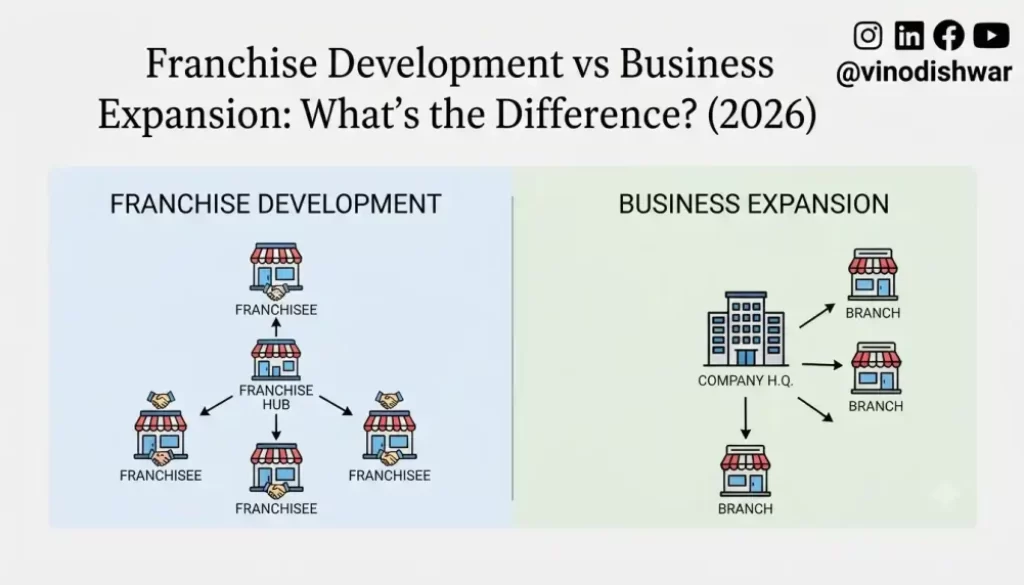
Business expansion is the broader objective of growing a company, while franchise development is a specific expansion model that uses independent entrepreneurs to scale the business.
Choosing the right approach can significantly impact your investment requirements, operational control, profitability, and long-term scalability.
This guide explains the differences between Franchise Development vs Business Expansion, helping founders choose the right strategy for sustainable growth.
Business Expansion in Franchise Development vs Business Expansion
Business expansion refers to any strategy used to increase the size, revenue, customer base, or geographic presence of a business.
Expansion can take many forms, including:
- Opening new company-owned outlets
- Entering new cities
- Expanding into new states
- Launching new products
- Growing online sales
- Entering international markets
- Acquiring competitors
- Building distribution networks
- Licensing
- Franchising
Franchising is one type of business expansion—but not the only one.
Franchise Development in Franchise Development vs Business Expansion
Franchise development is the structured process of converting a successful business into a franchise system that independent entrepreneurs can operate using standardized business systems.
Instead of investing your own capital for every new outlet, franchise partners invest in opening and operating locations under your brand.
Franchise development includes:
- Franchise strategy
- Business model design
- SOP development
- Operations Manual
- Franchise Agreement
- Training systems
- Marketing systems
- Technology integration
- Franchise support
- Performance management
The objective is to build a repeatable and scalable business model.
Franchise Development vs Business Expansion: Key Differences
Understanding Franchise Development vs Business Expansion helps business owners choose the right growth strategy based on their goals and available resources.
| Feature | Franchise Development | Business Expansion |
|---|---|---|
| Growth Model | Franchise Network | Multiple expansion methods |
| Investment | Primarily franchisee-funded | Company-funded or mixed |
| Ownership | Franchisee-owned outlets | Company-owned or hybrid |
| Scalability | Very High | Moderate to High |
| Capital Requirement | Lower | Higher |
| Operational Control | Shared with franchisees | Direct company control |
| Revenue Sources | Franchise fees, royalties, product supply | Direct sales and profits |
| Expansion Speed | Faster | Usually slower |
| Risk | Shared with franchisees | Company bears most risk |
| Documentation | Extensive | Moderate |
When Should You Choose Business Expansion?
Traditional business expansion may be the better option if:
- You want complete operational control.
- You have sufficient capital.
- Your business model is difficult to replicate.
- Quality depends heavily on specialized expertise.
- Expansion will remain limited to a few locations.
- You prefer company-owned assets.
Examples include:
- Luxury hotels
- Specialized manufacturing
- Large hospitals
- Technology companies
- Research organizations
When Should You Choose Franchise Development?
Franchise development is ideal when:
- Your business has proven profitability.
- Operations are repeatable.
- SOPs can be documented.
- Customer experience is standardized.
- Brand recognition is growing.
- Demand exists in multiple markets.
- Expansion capital is limited.
Industries that commonly franchise include:
- Restaurants
- Cafés
- Salons
- Retail stores
- Fitness centers
- Educational institutes
- Healthcare clinics
- Service businesses
- Cloud kitchens
Benefits of Business Expansion
Traditional expansion offers several advantages.
Complete Operational Control
The company manages every outlet directly.
Consistent Decision-Making
Business decisions remain centralized.
Higher Profit Retention
There are no royalty-sharing arrangements.
Strong Brand Oversight
The company directly controls quality and customer experience.
However, these benefits often require significantly higher capital investment.
Benefits of Franchise Development
Franchising provides unique advantages.
Faster Growth
Franchisees invest in opening new locations.
Lower Capital Requirement
Expansion requires less company-owned investment.
Shared Risk
Franchisees assume much of the operational and financial risk.
Recurring Revenue
Income comes from:
- Franchise fees
- Royalties
- Marketing contributions
- Product supply
- Technology fees
Local Market Knowledge
Franchisees often understand their regional markets better. Businesses planning to franchise can benefit from professional franchise development services that help build scalable systems and structured expansion strategies.
Challenges of Business Expansion
Business expansion can involve:
- High capital investment
- Slower growth
- Recruitment challenges
- Greater operational responsibility
- Higher financial risk
- Increased management complexity
These factors can limit the pace of expansion.
Challenges of Franchise Development
Franchise development also has challenges.
These include:
- Extensive documentation requirements
- Franchisee recruitment
- Training commitments
- Ongoing support obligations
- Brand consistency management
- Legal compliance
Strong systems help overcome these challenges.
Which Model is More Scalable?
For businesses seeking rapid national growth, franchise development often provides greater scalability because expansion is funded largely by franchise partners.
Businesses aiming for slower, highly controlled growth may prefer company-owned expansion.
The right choice depends on:
- Business objectives
- Capital availability
- Operational maturity
- Leadership capability
- Industry characteristics
Practical Example
Imagine a successful premium salon brand with five profitable outlets.
Option 1: Business Expansion
The company opens ten additional salons using its own investment.
Pros:
- Full control
- Higher profit per outlet
Cons:
- Significant capital required
- Slower rollout
- Higher operational burden
Option 2: Franchise Development
The company develops a franchise system and partners with local entrepreneurs.
Pros:
- Faster expansion
- Lower capital requirement
- Shared operational risk
- Recurring royalty income
Cons:
- Requires strong SOPs
- Continuous franchise support
- Greater focus on system standardization
Decision Checklist
Ask yourself these questions:
✅ Is your business consistently profitable?
✅ Can operations be standardized?
✅ Are your processes documented?
✅ Can someone else successfully operate your business?
✅ Is demand growing in multiple cities?
✅ Do you want faster expansion with lower investment?
If you answered “yes” to most of these questions, franchise development may be the better choice.
Business Expansion Decision Framework
Business Growth Goal
        │
        ▼
Assess Business Readiness
        │
        ▼
Evaluate Capital Availability
        │
        ├──────────────┐
        ▼              ▼
Company-Owned      Franchise Development
Expansion          Strategy
        │              │
        ▼              ▼
Controlled      Systemized Growth
Expansion       Through Partners
        │              │
        └──────┬───────┘
               ▼
       Sustainable Business Growth
How Franchise Development Consultants Help
Professional franchise consultants assist businesses by:
- Assessing expansion readiness
- Comparing growth models
- Designing franchise strategies
- Creating SOPs
- Developing Operations Manuals
- Preparing legal documentation
- Building franchise systems
- Supporting expansion planning
Expert guidance helps founders select the most appropriate growth strategy while reducing operational risk.
Why Choose Franchise Alpha?
At Franchise Alpha, we help businesses expand using our proprietary SOLEMN® Framework.
Strategy
Develop customized growth strategies, franchise models, and expansion roadmaps.
Operations
Standardize SOPs, Operations Manuals, workflows, and business systems.
Legal
Prepare Franchise Agreements, protect intellectual property, and strengthen compliance.
Entrust
Reduce founder dependency and build leadership capability.
Marketing
Generate qualified franchise leads through digital marketing and franchise sales systems.
Nitty-Gritty
Monitor KPIs, improve profitability, and continuously optimize business performance.
Frequently Asked Questions
What is the difference between franchise development and business expansion?
Business expansion is the overall process of growing a company through various methods, while franchise development is a specific expansion strategy where independent entrepreneurs operate outlets using a standardized franchise system.
Is franchising better than opening company-owned outlets?
It depends on your goals. Franchising generally enables faster, lower-capital expansion, while company-owned growth provides greater operational control.
Which businesses should choose franchise development?
Businesses with proven profitability, repeatable operations, strong customer demand, and standardized processes are ideal candidates for franchising.
Why hire a franchise development consultant?
A consultant helps evaluate franchise readiness, design scalable systems, develop documentation, and build a structured expansion strategy.
Conclusion
Both business expansion and franchise development are effective growth strategies—but they serve different purposes.
Traditional expansion offers greater control but usually requires significant investment and operational oversight.
Franchise development enables faster, asset-light growth by leveraging standardized systems and entrepreneurial partners.
The best strategy is the one that aligns with your business model, resources, and long-term vision.
The most successful businesses don’t just grow—they choose the right growth model.
Choosing between Franchise Development vs Business Expansion depends on your capital, operational capabilities, and long-term vision.
Call to Action
Unsure Which Growth Strategy Is Right for Your Business?
Book a Franchise Readiness Assessment with Vinod Ishwar to determine whether your business is better suited for company-owned expansion or franchise development.
Your assessment includes:
- Business Growth Evaluation
- Expansion Strategy Analysis
- Franchise Readiness Review
- SOP & Operations Assessment
- Customized Growth Roadmap
Build the right expansion strategy before investing in growth.