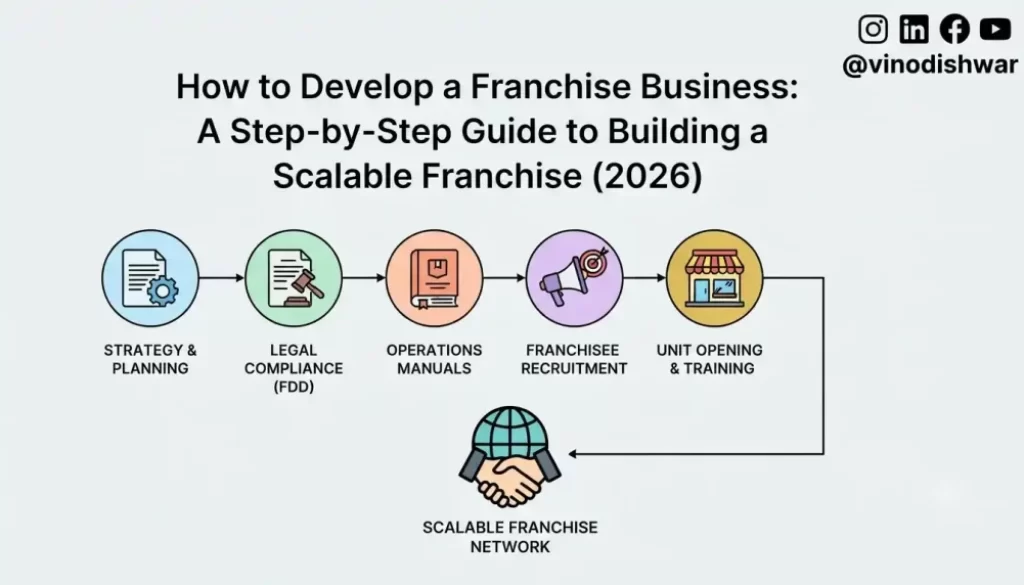
How to Develop a Franchise Business: A Step-by-Step Guide to Building a Scalable Franchise (2026)
How to Develop a Franchise Business is a question many entrepreneurs ask when they want to transform a successful single-location business into a scalable franchise network. Every successful franchise brand starts with a proven business model, strong systems, and a clear growth strategy.
Every successful franchise brand started with a single location, a proven business model, and a vision for growth. Whether it’s a restaurant, retail store, salon, fitness center, education institute, healthcare clinic, or service business, the journey from one outlet to a thriving franchise network requires more than ambition—it requires systems. Building a franchise requires proper planning, systems, and expert guidance.
Developing a franchise business means transforming your existing business into a scalable model that other entrepreneurs can successfully replicate while maintaining consistent quality, customer experience, and profitability.
Many businesses mistakenly believe that franchising begins with selling franchise rights. In reality, the process starts much earlier by building standardized operations, legal frameworks, training systems, and support mechanisms.
This guide explains how to develop a franchise business step by step, helping you build a strong foundation for sustainable expansion.
How to Develop a Franchise Business: Understanding the Process
Developing a franchise business is the process of converting an established and successful business into a franchise system that can be replicated across multiple locations by independent franchise owners.
The process includes:
- Creating a franchise business model
- Standardizing operations
- Developing SOPs
- Preparing legal documentation
- Designing training programs
- Building marketing systems
- Implementing technology
- Establishing franchise support
The goal is to create a business that grows through systems instead of depending on the founder.
Why Develop a Franchise Business?
Franchising offers significant advantages over company-owned expansion.
Faster Growth
Expand into multiple cities using franchisee investment.
Lower Capital Requirement
Franchisees invest in opening and operating new outlets.
Recurring Revenue
Generate revenue through:
- Franchise Fees
- Royalty Income
- Marketing Contributions
- Product Supply
- Technology Fees
Stronger Brand Presence
Multiple locations improve visibility and customer trust.
Higher Business Valuation
Scalable franchise systems are often more attractive to investors.
Is Your Business Ready?
Before developing a franchise, ask yourself:
- Is the business consistently profitable?
- Is there proven customer demand?
- Can operations be replicated?
- Are processes documented?
- Does the business have a unique competitive advantage?
- Is the brand recognized?
- Can someone else operate the business successfully?
If the answer to most questions is “yes,” your business may be ready for franchising. Businesses should complete a franchise readiness assessment before starting expansion.
How to Develop a Franchise Business Step-by-Step
Step 1: Assess Franchise Readiness
Evaluate:
- Financial performance
- Market demand
- Operational maturity
- Brand reputation
- Leadership capability
- Growth potential
A readiness assessment identifies strengths and improvement areas before expansion.
Step 2: Design the Franchise Business Model
Define:
- Initial investment
- Franchise fee
- Royalty percentage
- Territory rights
- Franchisee profile
- Support structure
- Profitability projections
A balanced model benefits both franchisor and franchisee.
Step 3: Standardize Business Operations
Document every core process, including:
- Sales
- Customer service
- Inventory
- Procurement
- Finance
- HR
- Quality control
Operational consistency is essential for successful franchising.
Step 4: Develop Standard Operating Procedures (SOPs)
Create detailed SOPs for:
- Opening and closing procedures
- Staff recruitment
- Customer handling
- Product or service delivery
- Inventory management
- Cash handling
- Safety protocols
- Complaint resolution
SOPs reduce dependency on individual employees.
Step 5: Create a Franchise Operations Manual
The Operations Manual should include:
- Brand standards
- Daily workflows
- Technology guidelines
- Marketing policies
- HR processes
- Reporting systems
- Quality assurance
This manual becomes the operational blueprint for every franchise.
Step 6: Prepare Legal Documentation
Protect your business with:
- Franchise Agreement
- Trademark Registration
- Brand Usage Guidelines
- Non-Disclosure Agreement (NDA)
- Franchise Disclosure Documents (where applicable)
Professional legal documentation reduces risk.
Step 7: Develop Franchise Training Programs
Training should cover:
- Operations
- Sales
- Customer experience
- Financial management
- Technology
- Marketing
- Leadership
- Brand standards
Well-trained franchisees perform more consistently.
Step 8: Build Marketing and Lead Generation Systems
Develop a franchise sales engine that includes:
- Franchise website
- Digital marketing
- Social media campaigns
- Franchise brochures
- Investor presentations
- CRM
- Discovery Day events
A structured marketing system attracts qualified franchise investors. Professional franchise development services help businesses create structured marketing systems and attract qualified franchise investors.
Step 9: Recruit the Right Franchise Partners
Evaluate potential franchisees based on:
- Financial capability
- Business experience
- Leadership qualities
- Commitment
- Cultural alignment
- Long-term vision
The right franchisees contribute to sustainable growth.
Step 10: Launch and Support Franchisees
Provide assistance with:
- Site selection
- Outlet setup
- Staff hiring
- Initial marketing
- Technology implementation
- Opening support
Continuous guidance ensures a successful launch.
Step 11: Monitor Performance
Track key metrics such as:
- Revenue
- Customer satisfaction
- Operational compliance
- Marketing performance
- Inventory management
- Franchise profitability
Regular reviews help identify improvement opportunities.
Step 12: Scale Strategically
Expand through:
- Multi-unit franchising
- Area development
- Multi-city expansion
- Multi-state growth
- Master franchising
- International markets
Growth should be based on systems, not speed alone.
Franchise Development Checklist
Before launching your franchise, ensure you have:
✅ Profitable flagship business
✅ Franchise strategy
✅ Business model
✅ SOPs
✅ Operations Manual
✅ Franchise Agreement
✅ Trademark protection
✅ Training system
✅ Marketing toolkit
✅ CRM
✅ Technology platform
✅ Franchise support system
Common Mistakes to Avoid
Many businesses struggle because they:
- Expand before documenting processes
- Depend heavily on the founder
- Underestimate franchisee training
- Lack ongoing support
- Select franchisees based only on investment
- Ignore technology
- Fail to monitor performance
Avoiding these mistakes improves long-term success.
Practical Example
A successful bakery wants to expand nationwide.
Without franchise development:
- Recipes differ between locations.
- Customer experience varies.
- Inventory management becomes inconsistent.
- Quality declines.
With a structured franchise system:
- SOPs standardize production.
- Training ensures consistency.
- Operations Manuals guide every outlet.
- CRM tracks franchise performance.
- Marketing supports local launches.
The bakery grows into a trusted national brand.
Franchise Business Development Framework
Successful Business
        │
        ▼
Readiness Assessment
        │
        ▼
Franchise Strategy
        │
        ▼
Business Model
        │
        ▼
Operational Standardization
        │
        ▼
SOP Development
        │
        ▼
Operations Manual
        │
        ▼
Legal Documentation
        │
        ▼
Training Programs
        │
        ▼
Marketing & Lead Generation
        │
        ▼
Franchise Recruitment
        │
        ▼
Launch & Support
        │
        ▼
Performance Monitoring
        │
        ▼
Business Expansion
How Franchise Consultants Add Value
An experienced franchise consultant can help you:
- Assess franchise readiness
- Design a profitable franchise model
- Develop SOPs and Operations Manuals
- Prepare legal documentation
- Create training systems
- Build franchise marketing strategies
- Recruit qualified franchisees
- Scale efficiently across regions
Professional guidance reduces costly mistakes and accelerates expansion.
Why Choose Franchise Alpha?
At Franchise Alpha, we help businesses develop scalable franchise systems through our proprietary SOLEMN® Framework.
Strategy
Develop franchise models, pricing, and expansion roadmaps.
Operations
Create SOPs, Operations Manuals, workflows, and business systems.
Legal
Prepare Franchise Agreements and protect intellectual property.
Entrust
Reduce founder dependency and strengthen leadership.
Marketing
Generate qualified franchise leads and build sales systems.
Nitty-Gritty
Track KPIs, improve operations, and optimize profitability.
Frequently Asked Questions
How do I develop a franchise business?
Start by assessing franchise readiness, creating a franchise business model, standardizing operations, developing SOPs, preparing legal documentation, building training systems, and establishing franchise support.
How long does it take to develop a franchise business?
Most businesses require 3–6 months to complete the franchise development process, depending on operational complexity.
Which businesses can become franchises?
Restaurants, cafés, retail stores, salons, fitness centers, educational institutes, healthcare businesses, manufacturing companies, and service brands are all suitable for franchising if they have proven systems.
Why are SOPs important in franchise development?
SOPs ensure every franchise location follows consistent operational processes, helping maintain quality, customer experience, and brand standards.
Conclusion
Developing a franchise business is not about selling licenses—it is about building a repeatable business system that others can operate successfully.
Businesses that invest in standardized processes, strong documentation, training, technology, and ongoing support create franchise networks capable of sustainable growth and long-term profitability.
Successful franchise brands are built on systems, consistency, and continuous improvement.
Call to Action
Ready to Develop Your Franchise Business?
Take the first step toward national expansion with a Franchise Readiness Assessment by Vinod Ishwar.
You’ll receive:
- Franchise Readiness Evaluation
- Business Model Review
- SOP Assessment
- Franchise Development Roadmap
- Customized Expansion Strategy
Book your Franchise Readiness Assessment today and start building a scalable franchise business. Build your franchise foundation with expert guidance and a proven expansion strategy.