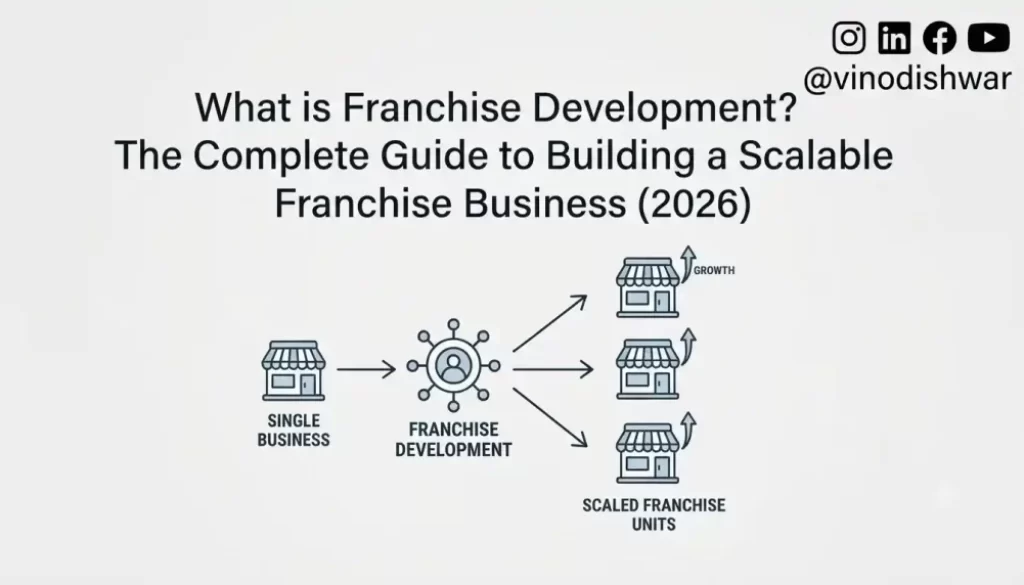
What is Franchise Development? The Complete Guide to Building a Scalable Franchise Business (2026)
What is Franchise Development?
Franchise development is the structured process that helps successful businesses transform into scalable franchise brands. From McDonald’s and Domino’s to fast-growing Indian businesses, successful companies build systems before expanding.
They didn’t simply sell franchises.
They built a franchise system.
That systematic process is called Franchise Development.
Franchise development is the structured process of transforming an already successful business into a scalable franchise model that can be replicated across multiple locations while maintaining consistent quality, operations, customer experience, and profitability.
Many business owners assume franchising means preparing a franchise agreement and selling franchise rights.
In reality, those are only small components of a much larger process.
Successful franchise development involves business strategy, operations, legal documentation, technology, training, branding, marketing, and continuous franchise support.
Without these systems, even successful businesses struggle to scale.
This guide explains everything you need to know about franchise development, including the complete process, benefits, common mistakes, and how to prepare your business for long-term franchise success.
What is Franchise Development?
Franchise Development is the process of converting an existing business into a franchise system that other entrepreneurs can successfully operate using standardized processes, documentation, operational systems, and ongoing support.
Instead of expanding entirely with your own investment, franchise development allows independent business owners (franchisees) to invest in opening and operating new locations using your proven business model.
A professionally developed franchise includes:
- A proven business model
- Standard Operating Procedures (SOPs)
- Operations Manual
- Franchise Agreement
- Franchise Disclosure Documents
- Training systems
- Marketing systems
- Technology platforms
- Support systems
- Performance monitoring
The goal is not simply to open more outlets—it is to build a business that can grow consistently without depending entirely on the founder.
Why Franchise Development Matters
Many businesses grow successfully with one or two locations but struggle when they attempt to expand. Businesses planning expansion can benefit from expert franchise consulting services that help create scalable systems and structured growth strategies.
Common challenges include:
- Inconsistent customer experience
- Lack of documentation
- Founder dependency
- Poor employee training
- Operational confusion
- Quality issues
- Weak management systems
Franchise development solves these problems by building repeatable systems.
Instead of managing every outlet yourself, you create a framework that allows franchise partners to deliver the same customer experience using documented processes. Many businesses require a proper franchise readiness assessment before expansion.
Benefits of Franchise Development
Professional franchise development provides numerous advantages:
Faster Expansion
Franchisees invest their own capital, allowing businesses to expand more rapidly than company-owned growth.
Lower Capital Investment
The franchisor does not bear the full cost of opening every new outlet.
Recurring Revenue
Franchise businesses generate income through:
- Franchise fees
- Royalty fees
- Marketing contributions
- Product supply
- Training services
Stronger Brand Presence
More franchise locations increase market visibility and customer trust.
Business Scalability
Well-documented systems allow expansion into multiple cities and states.
Increased Business Valuation
Businesses with standardized franchise systems often achieve higher valuations.
Franchise Development Process: Step-by-Step Guide
Step 1: Franchise Readiness Assessment
Before franchising, evaluate:
- Profitability
- Business maturity
- Market demand
- Scalability
- Competitive advantage
Not every successful business is immediately ready for franchising.
Step 2: Develop the Franchise Business Model
Determine:
- Investment requirements
- Franchise fees
- Royalty structure
- Territory policy
- Profitability projections
- Target franchisee profile
Step 3: Standardize Business Operations
Document every operational activity including:
- Customer journey
- Sales process
- Daily operations
- Inventory
- HR procedures
- Reporting systems
- Quality standards
Step 4: Create Standard Operating Procedures (SOPs)
Every task should be documented so that any franchisee can replicate the business consistently.
Examples include:
- Opening procedures
- Closing procedures
- Customer service
- Staff recruitment
- Inventory management
- Complaint handling
Step 5: Develop the Franchise Operations Manual
The Operations Manual becomes the blueprint for every franchise location.
It includes:
- Business systems
- Brand guidelines
- Operational standards
- Marketing procedures
- HR policies
- Technology usage
Step 6: Prepare Legal Documentation
Essential legal documents include:
- Franchise Agreement
- Trademark Protection
- NDA
- Franchise Disclosure Document
- Licensing documentation
Step 7: Build Training Systems
Franchisees require structured onboarding covering:
- Operations
- Sales
- Customer service
- Technology
- Financial management
- Brand standards
Step 8: Create Franchise Marketing Systems
Build systems for:
- Lead generation
- Digital marketing
- Franchise website
- Investor presentations
- Discovery Day
- Sales funnel
Step 9: Recruit Franchise Partners
Evaluate candidates based on:
- Financial capability
- Business experience
- Leadership
- Cultural fit
- Growth mindset
Step 10: Launch and Support
Support includes:
- Opening assistance
- Field visits
- Marketing guidance
- Operational audits
- Performance reviews
- Continuous training
Franchise Development Checklist
Before launching your franchise, ensure you have:
✅ Profitable flagship business
✅ Documented SOPs
✅ Operations Manual
✅ Franchise Business Model
✅ Legal Agreements
✅ Trademark Registration
✅ Training Program
✅ Marketing Toolkit
✅ Franchise Sales Process
✅ CRM
✅ Technology Platform
✅ Ongoing Support System
Common Franchise Development Mistakes
Avoid these common errors:
Expanding Too Early
Growth without proven systems creates inconsistency.
Founder Dependency
Businesses that rely on the founder cannot scale effectively.
Weak Documentation
Without documentation, franchisees operate differently.
Poor Franchisee Selection
Choosing the wrong partners damages the brand.
Lack of Ongoing Support
Franchisees need continuous guidance to succeed.
Practical Example
Imagine a successful café operating one profitable outlet in Bengaluru.
Without franchise development:
- Every new outlet depends on the founder.
- Recipes differ.
- Customer service varies.
- Staff training is inconsistent.
With franchise development:
- SOPs standardize operations.
- Recipes are documented.
- Staff receive identical training.
- Technology tracks performance.
- Every outlet delivers the same customer experience.
The business evolves from a local café into a scalable national brand.
Franchise Development Framework
Successful Business
        │
        ▼
Readiness Assessment
        │
        ▼
Business Model Design
        │
        ▼
Operations Documentation
        │
        ▼
SOP Development
        │
        ▼
Operations Manual
        │
        ▼
Legal Documentation
        │
        ▼
Training Systems
        │
        ▼
Franchise Marketing
        │
        ▼
Lead Generation
        │
        ▼
Franchise Sales
        │
        ▼
Franchise Launch
        │
        ▼
Ongoing Support
        │
        ▼
National Expansion
How Franchise Development Consultants Help Businesses Scale
Professional consultants assist businesses by:
- Assessing franchise readiness
- Designing franchise models
- Creating SOPs
- Preparing Operations Manuals
- Developing legal documentation
- Building training systems
- Designing franchise marketing strategies
- Supporting franchise sales
- Creating scalable business systems
Working with experienced consultants helps reduce costly mistakes and accelerates expansion. Professional franchise consultants help businesses create scalable franchise models.
Why Choose Franchise Alpha?
At Franchise Alpha, we help businesses transform into scalable franchise brands through our proprietary SOLEMN® Framework:
- Strategy – Franchise model design and expansion planning.
- Operations – SOPs, manuals, and business systems.
- Legal – Franchise agreements and intellectual property protection.
- Entrust – Leadership development and reducing founder dependency.
- Marketing – Franchise lead generation and brand positioning.
- Nitty-Gritty – KPIs, audits, and continuous operational improvement.
Our structured approach enables businesses to build sustainable franchise networks across India and internationally.
Frequently Asked Questions
What is Franchise Development?
Franchise development is the process of converting a successful business into a scalable franchise system using standardized operations, legal documentation, training, and support.
How long does franchise development take?
Typically, franchise development takes 3–6 months, depending on business complexity and documentation requirements.
What businesses can be franchised?
Restaurants, cafés, retail stores, salons, education centers, healthcare businesses, service companies, manufacturing businesses, fitness brands, and cloud kitchens can all be franchised.
Do I need SOPs before franchising?
Yes. SOPs are essential because they ensure operational consistency across every franchise location.
Why should I hire a franchise development consultant?
A consultant helps you design the franchise model, create documentation, avoid costly mistakes, and build scalable systems for long-term success.
Call to Action
Ready to Franchise Your Business?
If you’re planning to expand your business through franchising, the first step is understanding whether your business is truly franchise-ready. Book a Franchise Readiness Assessment with Vinod Ishwar.
Book a Franchise Readiness Assessment with Vinod Ishwar and receive:
- Franchise Readiness Evaluation
- Business Model Assessment
- SOP & Operations Review
- Growth Roadmap
- Customized Franchise Development Strategy
Start building a scalable franchise that grows beyond the founder.