Franchise CRM Guide: How to Manage Franchise Leads, Sales & Franchisee Relationships (2026)
Introduction
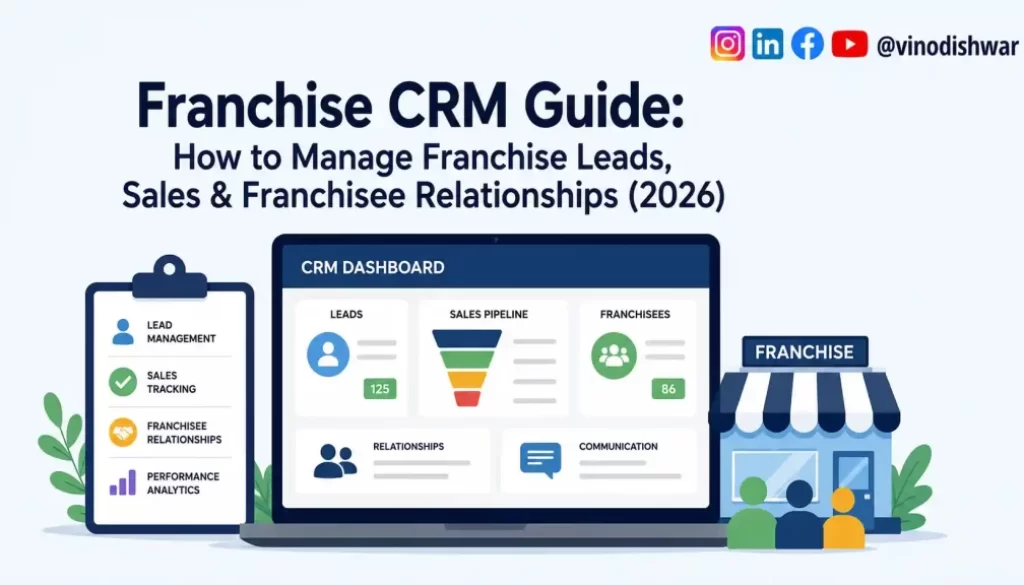
A Franchise CRM Guide helps franchisors manage franchise leads, automate follow-ups, and build stronger franchisee relationships through a structured CRM system. Every successful franchise brand has one thing in common—they manage relationships systematically.
Every successful franchise brand has one thing in common—they manage relationships systematically.
As franchise enquiries increase, relying on spreadsheets, notebooks, or manual follow-ups becomes inefficient. Missed calls, delayed emails, forgotten reminders, and inconsistent communication can result in losing qualified franchise investors. Before implementing a CRM, it’s important to understand how to qualify franchise leads so your sales pipeline contains high-quality prospects. Learn more in our How to Qualify Franchise Leads Guide:
https://vinodishwar.com/how-to-qualify-franchise-leads/
This is where a Franchise CRM (Customer Relationship Management) system becomes essential.
A Franchise CRM centralizes every lead, tracks every interaction, automates follow-ups, manages the franchise sales pipeline, and helps franchisors make data-driven decisions.
Whether you receive 20 enquiries a month or 2,000, a CRM ensures every prospective franchisee receives a professional and consistent experience.
This guide explains how Franchise CRM systems work, why they matter, and how to build an efficient CRM process that supports long-term franchise expansion.
What Is a Franchise CRM?
A Franchise CRM is a Customer Relationship Management system specifically designed to manage franchise enquiries, franchise sales, investor communication, and franchisee relationships.
Unlike a standard CRM used for product sales, a Franchise CRM tracks the complete franchise recruitment journey—from the first enquiry to franchise agreement signing and beyond.
A Franchise CRM typically manages:
- Franchise enquiries
- Lead qualification
- Discovery calls
- Investor presentations
- Discovery Day scheduling
- Follow-up automation
- Document sharing
- Franchise agreements
- Onboarding
- Franchisee communication
It becomes the operational backbone of franchise development. A CRM performs even better when combined with an effective Franchise Lead Generation strategy that consistently attracts qualified investors.
https://vinodishwar.com/franchise-lead-generation/
Why Every Franchisor Needs a Franchise CRM Guide
Implementing a Franchise CRM helps businesses:
- Capture every franchise enquiry
- Improve response times
- Automate follow-ups
- Increase lead conversion
- Manage investor communication
- Track franchise sales
- Improve team collaboration
- Reduce manual work
- Measure sales performance
- Scale franchise recruitment
A CRM turns scattered information into an organized growth system.
Franchise CRM Guide Workflow (15-Step Process)
Step 1. Capture Every Lead
Collect enquiries from:
- Website forms
- Google Ads
- SEO
- Franchise portals
- Events
- Referrals
Every enquiry should automatically enter the CRM.
Step 2. Create Lead Profiles
Store information including:
- Name
- Contact details
- Location
- Investment budget
- Business experience
- Lead source
Complete profiles improve sales efficiency.
Step 3. Assign Lead Scores
Evaluate prospects based on:
- Budget
- Experience
- Territory
- Readiness
- Motivation
Lead scoring helps prioritize follow-ups.
Step 4. Automate Initial Responses
Automatically send:
- Thank-you emails
- Franchise brochures
- Company profile
- Consultation booking links
Speed builds credibility.
Step 5. Schedule Discovery Calls
Track:
- Appointment dates
- Call notes
- Questions
- Follow-up actions
Nothing should rely on memory.
Step 6. Manage the Sales Pipeline
Typical CRM stages include:
- New Enquiry
- Contacted
- Qualified
- Discovery Call
- Investor Presentation
- Discovery Day
- Due Diligence
- Agreement Sent
- Franchise Signed
- Onboarding
Visual pipelines improve team productivity.
Step 7. Store Documents Securely
Maintain records for:
- Franchise brochures
- Agreements
- Disclosure documents
- Investor presentations
- Financial documents
Centralized documentation saves time.
Step 8. Automate Follow-Ups
Create workflows for:
- Reminder emails
- SMS notifications
- WhatsApp messages
- Task assignments
- Meeting confirmations
Automation improves consistency.
Step 9. Track Communication History
Record every:
- Phone call
- WhatsApp conversation
- Meeting
- Proposal
- Follow-up
A complete communication history improves relationships.
Step 10. Monitor KPIs
Measure:
- Lead response time
- Cost per lead
- Lead source performance
- Conversion rates
- Sales cycle length
- Franchise signings
Data drives better decisions.
Step 11. Integrate Marketing
Connect your CRM with:
- Google Ads
- Facebook Lead Ads
- Landing pages
- Website forms
- Email marketing platforms
Integrated systems reduce manual work.
Step 12. Manage Franchise Onboarding
Track:
- Agreement signing
- Training progress
- Store setup
- Launch activities
- Opening checklist
CRM supports the entire franchise journey.
Step 13. Generate Reports
Review reports on:
- Sales performance
- Marketing ROI
- Lead quality
- Team productivity
- Franchise recruitment
Reporting improves strategic planning.
Step 14. Improve Team Collaboration
Allow sales, marketing, operations, and leadership teams to access shared information and collaborate efficiently.
Transparency improves customer experience.
Step 15. Continuously Optimize the CRM
Regularly review:
- Pipeline stages
- Automation workflows
- Sales processes
- Reports
- User adoption
An optimized CRM evolves as your franchise grows.
Essential Features of a Franchise CRM
A robust Franchise CRM should include:
- Lead management
- Contact management
- Sales pipeline
- Lead scoring
- Task automation
- Email integration
- WhatsApp integration
- Document management
- Reporting dashboards
- Marketing automation
- Calendar integration
- Mobile access
- Workflow automation
- User permissions
- Analytics
Choose software that supports franchise-specific workflows.
Best CRM Software for Franchise Businesses
Popular CRM platforms include:
- Zoho CRM
- HubSpot CRM
- Salesforce
- Pipedrive
- Microsoft Dynamics 365
- Freshsales
- Monday CRM
The right choice depends on your business size, budget, and expansion goals.
Common CRM Mistakes
Businesses often make these mistakes:
- Using spreadsheets instead of CRM
- Failing to update lead records
- No automation
- Poor pipeline management
- Ignoring reporting
- Weak follow-up discipline
- Lack of team training
- No CRM strategy
Technology is only effective when supported by strong processes.
How Franchise Consultants Help
Experienced franchise consultants assist businesses by:
- Selecting the right CRM
- Designing franchise sales pipelines
- Building automation workflows
- Creating lead qualification systems
- Integrating marketing channels
- Developing KPI dashboards
- Training sales teams
- Optimizing franchise recruitment
A professionally configured CRM accelerates franchise growth.
The SOLEMN® Framework
At Franchise Alpha, Franchise CRM systems are implemented using the proprietary SOLEMN® Framework.
Strategy
Design CRM architecture aligned with franchise expansion goals.
Operations
Develop lead management workflows, automation, pipeline stages, and reporting systems.
Legal
Secure franchise documentation, agreements, compliance records, and investor data.
Entrust
Strengthen relationships through timely communication, personalized engagement, and consistent follow-ups.
Marketing
Integrate CRM with SEO, Google Ads, Meta Ads, email campaigns, landing pages, and lead generation channels.
Nitty-Gritty
Analyze KPIs, optimize workflows, improve conversion rates, and continuously enhance CRM performance.
This framework creates scalable CRM systems that support long-term franchise development.
Frequently Asked Questions
What is a Franchise CRM?
A Franchise CRM is a customer relationship management system that helps franchisors manage franchise enquiries, investor communication, sales pipelines, and franchise recruitment.
Why is CRM important for franchising?
CRM improves lead management, automates follow-ups, tracks sales performance, enhances investor communication, and supports scalable franchise expansion.
Which CRM is best for franchise businesses?
Popular options include Zoho CRM, HubSpot CRM, Salesforce, Pipedrive, Microsoft Dynamics 365, and Freshsales. The ideal CRM depends on your business needs and growth plans.
Can a CRM automate franchise sales?
Yes. Modern CRM systems automate lead capture, follow-ups, reminders, email campaigns, reporting, and sales workflows, improving productivity and conversion rates.
Conclusion
A Franchise CRM is more than a software platform—it is the operational engine behind successful franchise development.
By centralizing lead management, automating communication, tracking investor relationships, and providing valuable insights, CRM systems help franchisors scale efficiently while delivering a professional experience to every prospective franchisee.
Businesses that invest in structured CRM processes gain stronger franchise pipelines, better conversion rates, and long-term competitive advantages.
As your franchise network grows, your CRM becomes one of your most valuable business assets.
Call to Action
Build a Powerful Franchise CRM System
Book a Franchise CRM Strategy Session with Vinod Ishwar to design a customized franchise CRM, automate your sales pipeline, improve lead management, integrate marketing campaigns, and create a scalable franchise recruitment process.
Receive a complete CRM implementation roadmap tailored to your franchise expansion strategy.