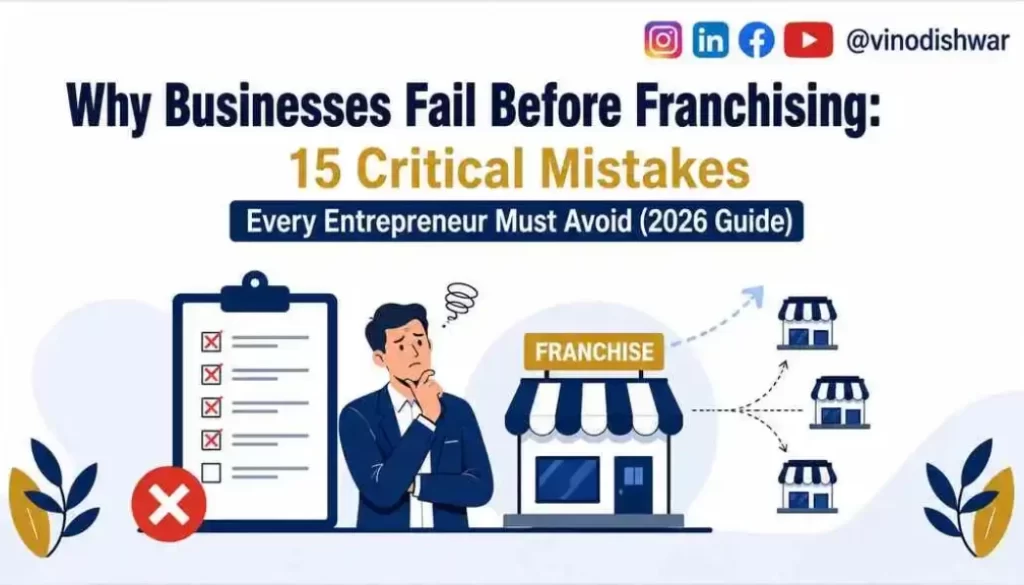
Why Businesses Fail Before Franchising: 15 Critical Mistakes Every Entrepreneur Must Avoid (2026 Guide)
Why Businesses Fail Before Franchising
Why Businesses Fail Before Franchising is a question many entrepreneurs ask when planning business expansion. Franchising is one of the fastest ways to scale a successful business, but many businesses fail before franchising because they are not operationally, financially, or strategically prepared.
Franchising is one of the fastest ways to scale a successful business. It allows entrepreneurs to expand into new cities, leverage franchisee investment, and build a recognizable brand without funding every new outlet themselves.
However, many businesses fail before they even sell their first franchise.
The failure is rarely because the idea is poor. Instead, it is often the result of launching a franchise model before the business is operationally, financially, or strategically ready.
Many founders assume that a profitable outlet automatically qualifies them to become a franchisor. Unfortunately, profitability alone does not create a successful franchise system.
This guide explains the most common reasons businesses fail before franchising and how to prepare for sustainable expansion.
Why Businesses Fail Before Franchising: Franchise Readiness Matters
A franchise is not simply another branch of your business.
It is a business model that must be replicated consistently by independent entrepreneurs operating in different markets.
To achieve this, every aspect of the business must be documented, standardized, measurable, and scalable.
Businesses that ignore this reality often experience:
- Poor franchise sales
- Operational inconsistency
- Franchisee dissatisfaction
- Brand dilution
- Legal disputes
- Financial losses
The solution is not to sell franchises faster but to become franchise-ready first. Before expanding your business, consider taking our Franchise Readiness Assessment to identify operational gaps, evaluate scalability, and prepare your business for successful franchising.
Mistake 1 – Franchising Too Early
One of the biggest mistakes entrepreneurs make is attempting to franchise immediately after achieving initial success.
Having one profitable outlet does not necessarily mean the business model can be replicated.
Before franchising, ask yourself:
- Is the business consistently profitable?
- Have operations been stable for at least 12–24 months?
- Can someone else run the business successfully?
- Is customer satisfaction consistent?
Expansion should be based on proven systems rather than enthusiasm alone.
Mistake 2 – No Standard Operating Procedures (SOPs)
Without documented processes, every franchisee operates differently.
This creates inconsistent customer experiences and damages brand reputation.
Essential SOPs include:
- Opening procedures
- Closing procedures
- Customer service standards
- Sales process
- Inventory management
- Staff training
- Quality control
- Hygiene standards
- Complaint handling
Well-written SOPs enable every outlet to deliver the same experience regardless of location.
Mistake 3 – The Business Depends on the Founder
Many businesses succeed because of the founder’s personal involvement.
Customers trust the owner.
Employees rely on the owner.
Key decisions are made only by the owner.
This dependency becomes a major obstacle when expanding through franchising.
A franchise business should operate successfully without the founder being present every day.
Mistake 4 – Weak Financial Model
A franchise must be profitable for both the franchisor and the franchisee.
Many businesses fail because they cannot clearly answer:
- What is the total investment?
- What are the operating costs?
- What is the expected break-even period?
- What are the projected margins?
- What return can a franchisee realistically expect?
Without a well-developed financial model, convincing serious investors becomes difficult.
Mistake 5 – Charging the Wrong Franchise Fee
Some businesses set franchise fees based on competitors.
Others choose arbitrary figures without understanding the value they provide.
A franchise fee should reflect:
- Brand strength
- Training provided
- Documentation
- Ongoing support
- Market demand
- Profit potential
An unrealistic pricing strategy can discourage qualified investors or reduce profitability.
Mistake 6 – Poor Brand Positioning
People invest in brands they trust.
Businesses with weak branding often struggle to attract quality franchise partners.
Strong franchise brands typically have:
- Professional identity
- Consistent visual branding
- Clear positioning
- Positive customer reviews
- Digital presence
- Market recognition
Brand perception directly influences franchise sales.
Mistake 7 – No Training System
Training is one of the most valuable assets a franchisor provides.
Without structured training, franchisees are forced to learn through trial and error.
A comprehensive training program should cover:
- Business operations
- Product knowledge
- Customer service
- Sales techniques
- Technology systems
- Marketing
- Financial reporting
- Compliance standards
Effective training improves operational consistency and franchisee confidence.
Mistake 8 – Choosing the Wrong Franchise Partners
Not every interested investor is the right franchisee.
Many businesses focus on selling franchises quickly instead of selecting partners carefully.
Ideal franchisees should demonstrate:
- Financial capability
- Business commitment
- Leadership skills
- Local market understanding
- Alignment with brand values
- Willingness to follow systems
Selecting the right partners is often more important than increasing franchise sales.
Mistake 9 – Ignoring Legal Documentation
Incomplete or poorly drafted documentation can create serious legal challenges.
Essential documents generally include:
- Franchise Agreement
- Operations Manual
- Brand Guidelines
- Intellectual Property Protection
- Confidentiality Clauses
- Territory Policy
- Training Guidelines
Proper documentation protects both the franchisor and the franchisee.
Mistake 10 – No Franchise Marketing Strategy
Simply creating a franchise package does not generate enquiries.
Businesses require a dedicated franchise marketing strategy that may include:
- SEO
- Franchise portals
- Social media
- Paid advertising
- Webinars
- Investor presentations
- Lead nurturing
- CRM systems
Generating qualified franchise leads requires consistent marketing efforts.
Mistake 11 – Poor Technology Adoption
Modern franchise systems rely on technology to maintain consistency.
Useful systems include:
- CRM software
- POS systems
- Inventory management
- Learning management systems
- Performance dashboards
- Digital reporting
Technology improves visibility across the franchise network.
Mistake 12 – Lack of Ongoing Support
The relationship with a franchisee begins after the agreement is signed.
Successful franchisors provide:
- Launch assistance
- Site visits
- Marketing support
- Operational audits
- Refresher training
- Performance reviews
Ongoing support strengthens franchisee relationships and improves long-term success.
Mistake 13 – Expanding Too Quickly
Rapid expansion without adequate support infrastructure often leads to operational problems.
Instead of pursuing aggressive outlet numbers, focus on:
- Quality franchisees
- Strong support systems
- Consistent execution
- Sustainable growth
Steady expansion is generally more successful than uncontrolled growth.
Mistake 14 – Ignoring Market Research
A business that performs well in one city may face different customer preferences elsewhere.
Before expanding, evaluate:
- Local demand
- Competition
- Purchasing power
- Consumer behaviour
- Real estate availability
Market research helps identify suitable expansion opportunities.
Mistake 15 – No Structured Franchise Development Framework
Many businesses approach franchising as a collection of individual tasks.
Successful franchisors follow a structured methodology.
At Franchise Alpha, we use the proprietary SOLEMN® Framework to evaluate franchise readiness across six essential pillars:
- Strategy – Business model and expansion planning.
- Operations – Standardized processes and execution.
- Legal – Documentation and compliance.
- Entrust – Franchisee selection and onboarding.
- Marketing – Franchise recruitment and brand growth.
- Nitty-Gritty – Performance monitoring and continuous improvement.
A structured framework reduces risk and creates a stronger foundation for long-term expansion.
Why Businesses Fail Before Franchising Checklist
Understanding why businesses fail before franchising helps entrepreneurs avoid costly mistakes and build a stronger foundation for sustainable expansion. Before launching a franchise program, ensure your business can confidently answer “yes” to the following questions:
✔ Is the business consistently profitable?
✔ Are operations documented?
✔ Can the business operate without the founder?
✔ Is the financial model validated?
✔ Are training systems in place?
✔ Is the brand legally protected?
✔ Is there a clear franchise recruitment strategy?
✔ Are support systems established?
✔ Is the customer experience consistent?
✔ Is there a long-term expansion plan?
The more boxes you can confidently check, the better prepared your business is for franchising. Explore our Franchise Development Services to build a scalable franchise model with expert guidance, proven systems, and long-term expansion strategies.
Frequently Asked Questions
Why do businesses fail before franchising?
The most common reasons include weak systems, lack of documentation, founder dependency, poor financial planning, inadequate training, and attempting to franchise before the business is operationally ready.
Can a profitable business still fail as a franchise?
Yes. Profitability alone does not guarantee franchise success. A business also needs standardized systems, documented processes, legal protection, and ongoing support mechanisms.
How do I know if my business is franchise-ready?
A professional franchise readiness assessment evaluates operational maturity, scalability, financial viability, brand strength, and documentation to determine whether your business is prepared for expansion.
Should I hire a franchise consultant before expanding?
Working with an experienced franchise consultant can help identify gaps, develop the right franchise model, and reduce the risks associated with rapid expansion.
Conclusion
The businesses that build successful franchise networks are rarely those that move the fastest—they are the ones that prepare the most thoroughly. The lessons discussed in this guide explain why businesses fail before franchising and how careful preparation can significantly improve long-term franchise success.
Franchising is not about selling licenses. It is about creating a repeatable business system that enables independent entrepreneurs to deliver a consistent customer experience while protecting the strength of the brand. Businesses can also refer to resources published by the International Franchise Association (IFA), MSME (Government of India), and Invest India to better understand franchising, entrepreneurship, and business expansion opportunities.
Taking the time to strengthen operations, document processes, validate financial models, and implement a structured expansion strategy can significantly improve the likelihood of long-term franchise success.
Call to Action
Thinking about franchising your business?
Before investing in franchise marketing or recruiting franchisees, start with a Franchise Readiness Assessment.
A professional assessment will help you identify operational gaps, evaluate scalability, and develop a roadmap for sustainable franchise growth.