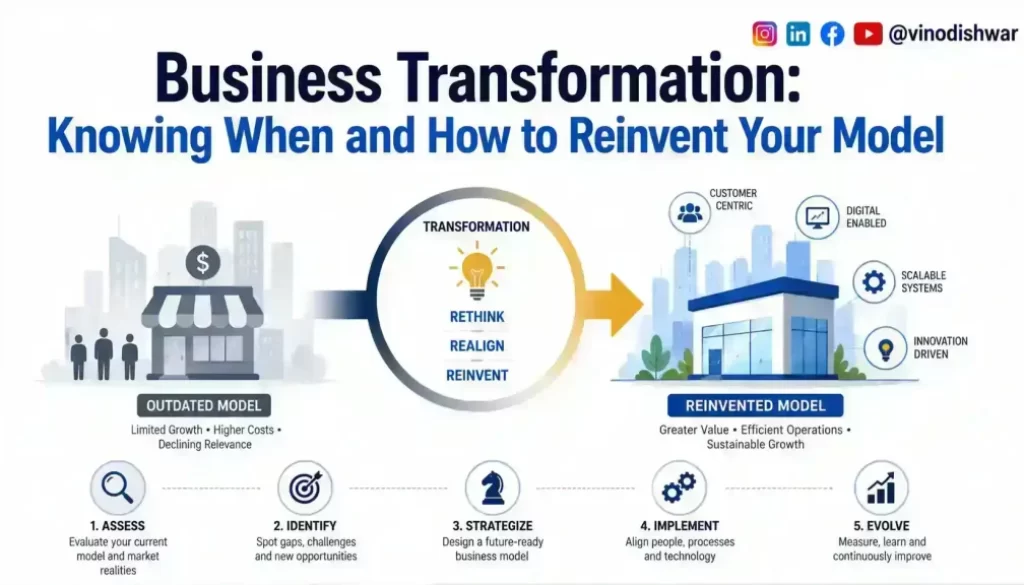
Business Transformation: Knowing When and How to Reinvent Your Model
Growth strategy conversations usually focus on doing more — more locations, more marketing, more products. But sometimes, the honest answer to a stalling business isn’t “more” — it’s “different.” Business transformation means fundamentally rethinking parts of your model, not just scaling the existing one further. Recognizing when this shift is needed, and executing it well, separates businesses that adapt successfully from those that fade as their market changes around them. A strong business strategy provides the foundation for successful business transformation and long-term growth.
Signs Your Business May Need Transformation, Not Just Expansion
- Revenue has plateaued despite consistent marketing and sales effort.
- Customer behavior in your category has visibly shifted, and your model hasn’t adapted.
- Competitors with fundamentally different approaches are consistently outperforming you.
- Your cost structure has become unsustainable relative to what customers are willing to pay.
- Your team is working harder than ever, with diminishing returns on effort.
If several of these resonate, incremental optimization — better ads, longer hours, small discounts — is unlikely to solve the underlying problem. The business model itself may need to change.
Types of Business Transformation
1. Business Model Transformation
Shifting how the business fundamentally makes money — for example, moving from one-time product sales to a subscription model, or from purely offline retail to an omnichannel approach combining physical and digital sales. Businesses planning major changes should also understand the importance of sustainable growth before expanding too quickly.
2. Operating Model Transformation
Restructuring how the business actually operates internally — centralizing functions that were previously handled independently at each location, or adopting new technology systems that fundamentally change workflow efficiency. Organizations can improve operational efficiency using McKinsey Insights on business transformation.
3. Customer Experience Transformation
Reimagining how customers interact with the business end-to-end — from discovery through purchase through post-purchase support — often driven by changing customer expectations shaped by newer, more convenient competitors. Improving the customer journey becomes easier when supported by an effective business website that converts visitors into customers.
4. Market Repositioning
Shifting target customer segments, price positioning, or category focus in response to changing market dynamics, competitive pressure, or an honest reassessment of where the business can compete most effectively.
How to Approach Transformation Without Destabilizing the Business
1. Diagnose Before Prescribing
Before deciding what to change, invest real time understanding why current performance has plateaued — through customer research, competitive analysis, and honest internal assessment — rather than assuming you already know the answer.
2. Pilot Before Committing Fully
Test transformation initiatives in a controlled way — one location, one product line, one customer segment — before rolling out changes across the entire business. This limits risk while providing real data on whether the new direction actually works. Testing new ideas before scaling also helps businesses identify market opportunities with lower risk.
3. Bring Your Team Along, Not Just Your Customers
Transformation often requires employees to learn new skills, adopt new processes, or let go of familiar ways of working. Clear communication about why the change is necessary, combined with proper training and support, determines whether transformation succeeds or meets internal resistance.
4. Protect Core Strengths While Changing What Isn’t Working
Transformation doesn’t mean abandoning everything. Identify what genuinely still works — brand trust, product quality, customer relationships — and build the transformation around preserving and leveraging those strengths, not discarding them.
5. Set Clear Success Metrics Before You Begin
Define specifically what success looks like for the transformation — revenue targets, customer satisfaction scores, operational efficiency gains — so you can objectively evaluate progress rather than relying on subjective impressions.
Common Transformation Mistakes
- Waiting too long to act, until financial pressure forces rushed, poorly planned changes.
- Changing everything at once, without piloting or sequencing the transformation carefully.
- Underestimating the internal change management required, focusing only on external customer-facing changes.
- Copying a competitor’s transformation directly, without adapting it to your own brand strengths and customer base.
- Losing sight of what originally made the business successful in the pursuit of reinvention.
Key Takeaways
- Plateaued performance despite consistent effort often signals a need for transformation, not just more of the same.
- Transformation can target the business model, operations, customer experience, or market positioning.
- Piloting changes before full rollout significantly reduces transformation risk.
- Internal change management is as important as external customer-facing changes.
- Preserving core strengths while transforming weaker areas produces more resilient outcomes.
Conclusion
Business transformation is rarely comfortable, but it’s often the difference between a business that adapts and thrives through changing markets and one that quietly declines while doing more of what used to work. Recognizing the signs early, and approaching change deliberately, gives your business the best chance of successful reinvention. Successful transformation also depends on continuous innovation, allowing businesses to improve processes and stay competitive.
-Vinod Ishwar
Frequently Asked Questions
1. What is business transformation?
Business transformation is the process of changing a company’s business model, operations, technology, or customer experience to improve long-term performance and adapt to market changes.
2. When should a business consider transformation?
A business should consider transformation when growth stalls, customer expectations change, competitors outperform it, or existing operations become inefficient.
3. What are the different types of business transformation?
Common types include business model transformation, operational transformation, customer experience transformation, digital transformation, and market repositioning.
4. How can businesses reduce the risks of transformation?
Businesses should test new strategies through pilot projects, involve employees early, define measurable goals, and implement changes gradually.
5. Why is business transformation important for long-term growth?
Business transformation helps companies stay competitive, improve efficiency, meet changing customer needs, and build a sustainable foundation for future growth.