Single-Unit vs Multi-Unit Franchising: Which Model Is Right for You?
Choosing the right franchise model is one of the most important decisions for anyone planning to invest in or expand a franchise business. The debate between single-unit vs multi-unit franchising goes beyond simply deciding how many outlets to own—it determines your investment requirements, operational responsibilities, growth potential, and long-term profitability. Whether you’re a first-time entrepreneur or an experienced business owner, selecting the right model can significantly influence your franchise journey.
Many aspiring franchisees focus primarily on choosing the right brand, while overlooking the importance of selecting the right ownership structure. However, understanding the differences between single-unit and multi-unit franchising helps entrepreneurs align their investment strategy with their financial capacity, management experience, and long-term business goals.
Before deciding which model is right for you, it’s also helpful to understand what makes a brand franchise-ready, as scalable systems and proven business processes are essential for both single-unit and multi-unit expansion.
Understanding Single-Unit Franchising
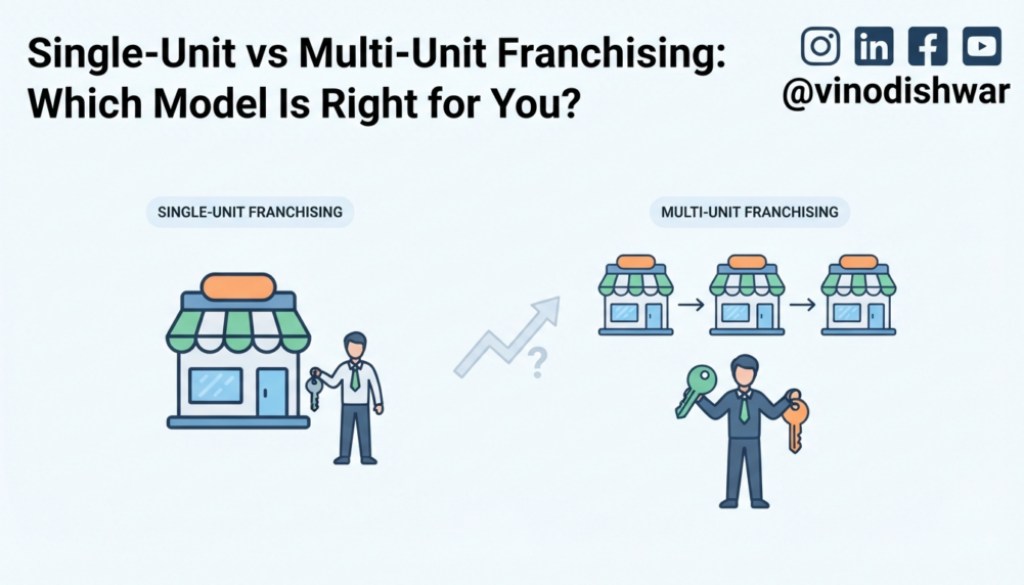
Single-unit franchising is the most common entry point into the franchise industry. Under this model, a franchisee purchases the right to own and operate one outlet under an established brand.
This model is particularly suitable for first-time entrepreneurs who want to gain hands-on business experience before expanding further.
Advantages of Single-Unit Franchising
Lower Initial Investment
Operating a single outlet requires significantly less capital than committing to multiple locations. This makes it an attractive option for entrepreneurs with limited financial resources.
Easier Day-to-Day Management
Managing one location allows franchisees to remain closely involved in daily operations, staff management, customer service, and quality control.
Lower Business Risk
Since only one outlet is involved, operational risks and financial exposure remain relatively controlled.
Opportunity to Learn
Many successful multi-unit franchisees begin with one outlet, gain valuable operational experience, and expand only after proving the business model works successfully.
Challenges of Single-Unit Franchising
While single-unit franchising offers several advantages, it also has certain limitations.
These include:
- Limited revenue potential from a single location
- Slower expansion opportunities
- Dependence on one market
- Lower purchasing power compared to larger franchise operators
- Future expansion often requires signing additional franchise agreements
Despite these challenges, single-unit franchising remains an excellent starting point for entrepreneurs entering the franchise industry.
Understanding Multi-Unit Franchising
Multi-unit franchising allows a franchisee to own and operate multiple outlets of the same brand. These outlets may be located within one city, across different regions, or under an exclusive territory development agreement.
Rather than managing one business location, multi-unit franchisees oversee an entire network of franchise outlets.
This model is generally preferred by experienced entrepreneurs, business groups, or investors with larger financial resources and professional management capabilities.
Advantages of Multi-Unit Franchising
Higher Revenue Potential
Owning multiple outlets allows franchisees to generate income from several business locations simultaneously.
Economies of Scale
Multi-unit operators often benefit from:
- Bulk purchasing discounts
- Shared marketing expenses
- Centralized management
- Better staff utilization
- Lower operational costs per outlet
These efficiencies improve profitability over time.
Stronger Relationship with the Franchisor
Large franchise partners often receive additional operational support, improved communication, and greater strategic collaboration due to their contribution to network growth.
Better Territory Protection
Many multi-unit agreements provide exclusive development rights, preventing competing franchisees from operating within the same territory.
This creates stronger market presence while reducing internal competition.
Challenges of Multi-Unit Franchising
Although multi-unit franchising offers significant growth opportunities, it also involves greater complexity.
Entrepreneurs should carefully evaluate:
- Higher capital investment
- Increased working capital requirements
- Larger management teams
- Supply chain coordination
- Consistent quality control
- Greater financial risk if market conditions change
Unlike single-unit operations, multi-unit businesses usually require professional management structures rather than owner-operated models.
Factors to Consider Before Choosing a Franchise Model
1. Capital Availability
The first question every entrepreneur should ask is:
“Can I comfortably finance multiple locations without affecting business stability?”
Multi-unit franchising requires not only higher initial investment but also sufficient working capital to support multiple outlets during the early growth phase.
If financial resources are limited, starting with a single-unit franchise is often the smarter choice.
2. Business Experience
Experienced business owners generally adapt more quickly to multi-unit operations because they understand delegation, financial management, recruitment, and operational systems.
First-time entrepreneurs often benefit from learning these skills while managing a single location before expanding.
3. Long-Term Business Goals
Consider where you want your business to be five or ten years from now.
If your objective is to build a large franchise portfolio, multi-unit franchising may accelerate growth.
If you prefer a stable business with hands-on involvement and lower operational complexity, a single-unit model may be more appropriate.
4. Evaluate the Franchisor’s Support System
Not every franchisor has the infrastructure to support rapid expansion. Before choosing between single-unit vs multi-unit franchising, evaluate the level of support the franchisor provides.
Ask questions such as:
- Is comprehensive training provided for new franchisees?
- Will the franchisor assist with opening multiple locations?
- How is operational support managed across different outlets?
- Is there a dedicated relationship manager for multi-unit franchisees?
- Does the franchisor offer marketing, technology, and supply chain support as the network grows?
A strong support system enables franchisees to scale confidently while maintaining consistent operational standards.
5. Understand Your Market Opportunity
Your location and target market play a major role in determining which franchise model is most suitable.
For example:
- Quick Service Restaurants (QSRs) often benefit from multiple outlets within a city because brand visibility increases with every additional location.
- Education franchises may perform better with strategically placed centres serving different neighbourhoods.
- Retail businesses may require flagship outlets before expanding into surrounding markets.
Before investing, conduct detailed market research to understand customer demand, competition, population density, purchasing power, and future growth opportunities.
6. Think About Exit and Succession Planning
Many entrepreneurs overlook what happens when they eventually decide to sell or transfer their franchise business.
Multi-unit franchise businesses are often more attractive to investors because they:
- Generate higher overall revenue.
- Have established management systems.
- Operate across multiple locations.
- Offer stronger long-term business value.
Single-unit franchises can also be profitable, but their valuation typically depends heavily on the performance of one location.
Planning your exit strategy from the beginning helps maximize future business value.
Single-Unit vs Multi-Unit Franchising: A Practical Example
Imagine two entrepreneurs investing in the same food franchise.
Entrepreneur A opens one outlet in a growing Tier-2 city. They personally manage day-to-day operations, build a loyal customer base, and reinvest profits. After three years of successful operations, they expand to a second location using the experience and cash flow from the first outlet.
Entrepreneur B signs a multi-unit development agreement from the beginning and launches three outlets across a metropolitan city. They hire experienced managers, invest significantly more capital, and scale the business much faster. However, they also face greater operational complexity and financial exposure if customer demand falls below expectations.
Both approaches can succeed. The better choice depends on your financial resources, management capabilities, business experience, and willingness to handle operational complexity.
Common Mistakes to Avoid
Whether you choose single-unit or multi-unit franchising, avoiding common mistakes can significantly improve your chances of long-term success.
Choosing Prestige Over Practicality
Some entrepreneurs select multi-unit franchising because it appears more impressive. However, larger investments also involve greater operational responsibilities and financial risks.
Underestimating Management Requirements
Managing several locations requires leadership, delegation, reporting systems, and experienced operational managers. Attempting to personally oversee every outlet often leads to inconsistent performance.
Delaying Expansion Unnecessarily
Some successful single-unit franchisees hesitate to expand even after establishing profitable operations. Missing the right expansion window can reduce future market opportunities.
Ignoring Territory Protection
Before signing a multi-unit agreement, ensure your territory rights are clearly documented to avoid internal competition from additional franchise outlets.
Focusing Only on Investment Cost
Instead of comparing only franchise fees, evaluate long-term profitability, support systems, operational scalability, and brand strength.
Professional Guidance Can Simplify the Decision
Choosing between single-unit vs multi-unit franchising should never be based solely on investment size. Every entrepreneur has different goals, financial capacity, and operational experience.
Working with experienced Franchise Consulting professionals can help evaluate suitable franchise opportunities, analyse investment requirements, negotiate franchise agreements, and develop a long-term expansion strategy.
Businesses planning to scale should also understand why most expansions fail before they scale, as rapid growth without proper systems often creates avoidable operational challenges.
Entrepreneurs can also explore Startup India for government-backed resources, business guidance, and support programmes relevant to new business ventures.
Key Takeaways
- Single-unit franchising is ideal for entrepreneurs seeking lower investment, lower risk, and hands-on management.
- Multi-unit franchising offers higher revenue potential but requires greater capital, stronger systems, and experienced management.
- The franchisor’s support infrastructure plays an important role in successful expansion.
- Market opportunity and territory strategy should influence your decision.
- Long-term business goals should determine the franchise model you choose rather than short-term financial considerations.
Conclusion
The decision between single-unit vs multi-unit franchising is one of the most important strategic choices in your franchise journey. While single-unit franchising provides a practical and lower-risk entry into business ownership, multi-unit franchising offers greater scalability and long-term growth for entrepreneurs with the right resources and management capabilities.
There is no universally “better” franchise model. The right choice depends on your investment capacity, business experience, operational strengths, and future vision. By carefully evaluating these factors and seeking professional guidance before making a commitment, you can build a stronger foundation for long-term franchise success.
— Vinod Ishwar
Frequently Asked Questions (FAQs)
What is single-unit franchising?
Single-unit franchising is a franchise model where a franchisee owns and operates one outlet under a franchisor’s brand. It is ideal for first-time entrepreneurs who want lower investment, hands-on management, and lower business risk.
What is multi-unit franchising?
Multi-unit franchising allows a franchisee to own and operate multiple outlets of the same franchise brand, often within a defined territory. It offers higher growth potential but requires greater investment and operational expertise.
Which franchise model is better for beginners?
For most first-time entrepreneurs, single-unit franchising is the better choice because it requires less capital, is easier to manage, and provides valuable operational experience before expanding into multiple locations.
Is multi-unit franchising more profitable?
Multi-unit franchising has the potential to generate higher overall revenue because multiple outlets contribute to business growth. However, profitability depends on effective management, market demand, and the franchisor’s support system.
What factors should I consider before choosing a franchise model?
You should evaluate your available capital, management experience, long-term business goals, market opportunity, franchisor support, territory rights, and willingness to manage multiple business locations.
What are the biggest risks of multi-unit franchising?
The main risks include higher financial investment, increased operational complexity, staffing challenges, supply chain management, and greater financial exposure if market conditions change.
Can I start with one franchise and expand later?
Yes. Many successful franchise owners begin with a single outlet, gain operational experience, and then expand into multi-unit franchising after establishing a profitable business.
How can a franchise consultant help me choose the right model?
A franchise consultant can evaluate your investment capacity, business goals, operational readiness, and market opportunities to recommend the most suitable franchise model while helping you avoid costly mistakes.