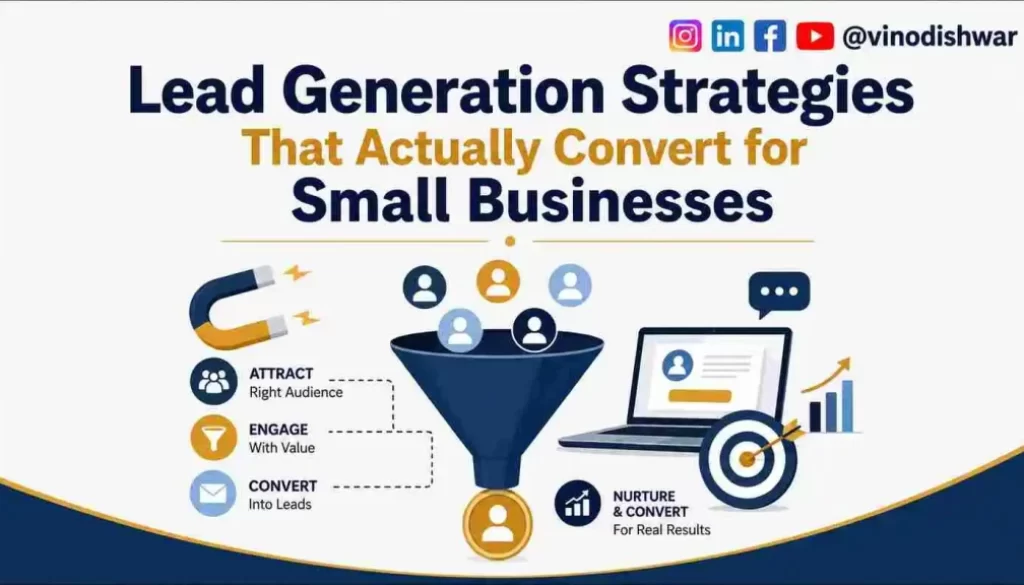
Lead Generation Strategies That Actually Convert for Small Businesses
Lead generation strategies help small businesses attract qualified prospects, generate consistent enquiries, and convert potential customers into long-term clients. The right lead generation strategies focus on quality over quantity, ensuring your marketing efforts produce measurable business growth instead of just increasing traffic. Successful lead generation strategies combine SEO, valuable content, targeted campaigns, and customer engagement to generate high-quality leads that are more likely to convert into paying customers.
Lead generation is often measured by raw numbers — how many form submissions, how many inquiries, how many contacts collected. But a large volume of unqualified leads that never convert into paying customers represents wasted marketing spend and sales team time, not genuine business growth. Effective lead generation focuses on attracting the right prospects, not simply the most prospects. Improving digital visibility helps businesses reach more potential customers through search engines and online platforms.
Understanding Qualified vs Unqualified Leads
A qualified lead genuinely fits your target customer profile, has a real need for your product or service, and has some reasonable likelihood of purchase intent or capability. Unqualified leads — while sometimes still valuable for other purposes like general brand awareness — dilute the efficiency of your sales process and skew performance metrics if treated the same as genuinely qualified prospects.
Best Lead Generation Strategies for Small Businesses
1. Content Marketing With Clear Intent Alignment
Creating content that addresses the specific questions and problems your genuine target customers are searching for naturally attracts more qualified leads than generic, broad-appeal content designed purely to maximize traffic volume. Businesses should first develop a strong content marketing strategy to consistently attract and educate potential customers.
2. Lead Magnets Aligned With Genuine Buyer Intent
Offering valuable resources — guides, templates, consultations, free trials — in exchange for contact information works best when the resource itself is specifically relevant to your actual product or service, naturally filtering for genuinely interested prospects.
3. Targeted Paid Advertising
Rather than broad, low-cost targeting aimed at maximizing lead volume, precise targeting based on demographics, interests, and behaviors relevant to your actual customer profile typically generates fewer but significantly higher-quality leads.
4. Search Engine Optimization for High-Intent Keywords
Ranking for specific, high-intent search terms — reflecting genuine purchase consideration rather than general informational curiosity — attracts prospects further along in their buying journey and more likely to convert. A well-optimized business website plays a crucial role in converting organic visitors into qualified leads.
5. Referral and Partnership Programs
Leads generated through referrals from existing satisfied customers or trusted partner relationships typically convert at significantly higher rates than colder, less-trusted acquisition channels. Businesses can also follow Google Search Centrahttps://developers.google.com/searchl for SEO best practices that improve website visibility and organic lead generation.
6. Webinars and Educational Events
Hosting genuinely valuable educational sessions related to your industry attracts prospects with real interest and engagement, providing both lead generation and relationship-building opportunities simultaneously.
7. Email Nurture Sequences
Not every lead converts immediately. Structured email sequences that continue providing value and relevant information over time help nurture leads who aren’t yet ready to purchase toward eventual conversion.
8. Clear, Low-Friction Landing Pages
Landing pages designed with a clear, single call-to-action, minimal distraction, and genuinely relevant messaging convert significantly better than generic pages trying to accomplish multiple objectives simultaneously.
How to Qualify Leads Effectively
Implement clear qualification criteria — budget, need, decision-making authority, timeline — to prioritize sales effort toward genuinely promising leads, rather than treating every inquiry with equal urgency and resource investment regardless of fit.
Measuring the Success of Lead Generation Strategies
Track conversion rates from lead to customer, not just raw lead volume, alongside cost per qualified lead and eventual customer lifetime value by channel. This reveals which lead generation strategies genuinely drive profitable growth, versus those simply generating impressive-looking but low-converting volume. Tracking lead performance with Google Analytics helps businesses understand which marketing channels generate the highest-quality leads.
Common Lead Generation Strategy Mistakes
- Optimizing purely for lead volume rather than lead quality and conversion rate.
- Using generic, broadly targeted lead magnets that attract uninterested or unqualified prospects.
- Neglecting lead nurturing, losing potentially valuable prospects who aren’t ready to purchase immediately.
- Failing to define clear qualification criteria, treating every lead with equal priority regardless of genuine fit.
- Not tracking conversion by channel, making it difficult to identify which lead sources genuinely drive business results.
Key Takeaways
- Lead quality and conversion potential matter significantly more than raw lead volume for genuine business growth.
- Content, lead magnets, and advertising should be aligned specifically with genuine target customer intent.
- Referral and partnership-generated leads typically convert at higher rates than colder acquisition channels.
- Structured lead nurturing helps convert prospects who aren’t immediately ready to purchase.
- Tracking conversion rates and cost per qualified lead by channel reveals genuinely effective lead generation strategies.
Conclusion
Effective lead generation isn’t about maximizing the number of inquiries your business receives — it’s about attracting genuinely qualified prospects who are meaningfully likely to become paying, satisfied customers. Prioritizing quality and conversion over raw volume builds far more sustainable, profitable growth. Reviewing your lead generation strategies regularly helps improve conversion rates, reduce marketing costs, and create a predictable pipeline of qualified business opportunities. Businesses should regularly review their go-to-market strategy to improve lead quality and customer acquisition.
-Vinod Ishwar
Frequently Asked Questions (FAQs)
1. What are lead generation strategies?
Lead generation strategies are marketing techniques used to attract potential customers, collect their contact information, and convert them into qualified leads who are more likely to purchase your products or services.
2. Why are lead generation strategies important for small businesses?
Effective lead generation strategies help small businesses attract the right audience, improve conversion rates, reduce customer acquisition costs, and build a consistent pipeline of potential customers.
3. Which lead generation strategies work best for small businesses?
Some of the most effective lead generation strategies include content marketing, search engine optimization (SEO), targeted advertising, email marketing, referral programs, webinars, and optimized landing pages.
4. How can content marketing improve lead generation?
Content marketing attracts potential customers by answering their questions, solving their problems, and providing valuable information. This builds trust and encourages visitors to become qualified leads.
5. What is a qualified lead?
A qualified lead is a potential customer who matches your target audience, has a genuine need for your product or service, and is more likely to make a purchase compared to general website visitors.
6. How do landing pages increase lead conversions?
Well-designed landing pages with clear messaging, strong calls-to-action, and simple forms help visitors take action quickly, resulting in higher lead conversion rates.
7. How can SEO support lead generation strategies?
SEO improves your website’s visibility in search engines, helping your business attract people actively searching for your products or services, resulting in higher-quality organic leads.
8. How do you measure the success of lead generation strategies?
Businesses can measure success by tracking qualified leads, conversion rates, cost per lead, customer acquisition cost, return on investment (ROI), and overall revenue generated from marketing campaigns.